What can I do about a low appraisal on a refinance?
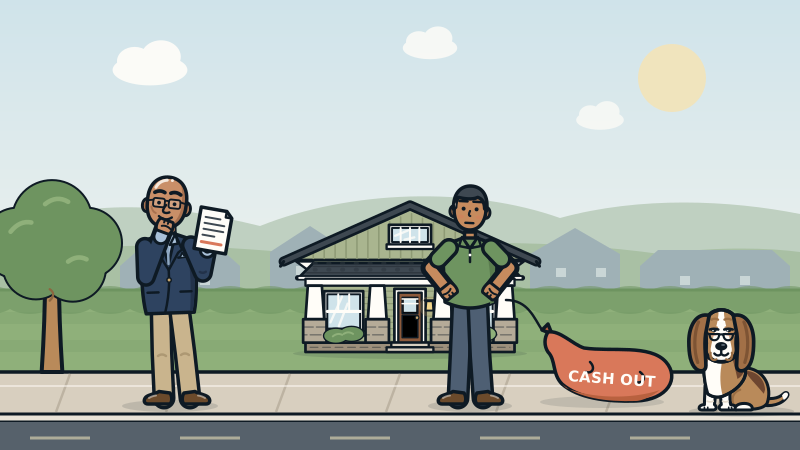
Start by reading the full appraisal, which your lender must give you free, at least three business days before closing in most cases. Check it for errors and missed sales, then submit a reconsideration of value through the lender. If the value holds, you can lower the loan amount, pay down the balance, wait, or look at streamline programs.
Why a low value hits a refinance so hard
On a purchase, the lender uses the lower of the price or the appraised value. On a refinance there is no price. Fannie Mae's rule is that the property value for a refinance is the current appraised value. The appraisal is the whole ballgame.
That value drives your loan-to-value ratio (LTV), which is your loan amount divided by the home's value. A lower value pushes the LTV up. NerdWallet notes that the ratio affects how much equity you can pull out and whether you can refinance at all.
A quick hypothetical. Say you owe $500,000 and hoped the house would appraise at $800,000. That is about 63% LTV. If it appraises at $700,000, the same loan is about 71%. If your cash-out program caps out at 80%, the amount you can take shrinks by $80,000. Same house, same kitchen, same neighbor who still hasn't returned your ladder. Different number.
Get the report and read every page
Under the federal Equal Credit Opportunity Act rules (Regulation B), a lender on a first-lien home loan must give you a copy of the appraisal promptly when it is done, or three business days before closing, whichever comes first. You can waive that timing and get it at closing instead, but don't, unless you have a good reason. The lender can't charge you for the copy itself.
Once you have it, read it like you are checking a restaurant bill after a big group dinner. Things to check:
- Square footage, bedroom and bathroom count, and lot size
- Upgrades: kitchen, baths, roof, windows, HVAC, solar. Were they noticed?
- The condition rating, and the comments that support it
- The comparable sales: how similar are they, how close, and how recent?
- The market trend comments, and whether any time adjustments were made
If you find a factual error, like a missed bathroom or the wrong square footage, write it down with proof: permits, a floor plan, receipts, dated photos. Facts beat feelings. "My house feels bigger than that" is not evidence, no matter how sincerely you say it.
In my view a good report teaches you the market, not only the number. If you can't tell why each adjustment was made, that is worth asking about.
Challenge it the right way: the reconsideration of value
A reconsideration of value (ROV) is a formal request asking the appraiser to look again at specific evidence. It works on refinances too. For loans that go to Fannie Mae, the lender must tell you about the ROV process at application and again when it gives you the appraisal, and the rules allow one borrower-initiated ROV per appraisal. Use it well.
Fannie Mae's requirements say a request should include:
- Your name, the property address, the appraisal's effective date, the appraiser's name and the date of your request
- A clear description of what you think is unsupported, inaccurate or missing
- Up to five alternative comparable sales, with their data sources
- An explanation of why that new information supports a different value
Send it through your lender, not the appraiser. NerdWallet makes the point well: the appraiser works for the lender, so the lender is the one who passes your request along. Calling the appraiser yourself just slows things down.
One more timing note: once the loan closes, Fannie Mae no longer allows a borrower ROV. Do this before you sign.
If the value doesn't move, change the plan
Sometimes the appraisal is right and the hope was wrong. That stings, but it is still good information. Here are the realistic options:
- Borrow less. A smaller loan or smaller cash-out can bring the LTV back under the program limit.
- Pay down the balance. If you have cash, a principal payment at closing can do the same thing.
- Ask about a different loan program. LTV limits vary by program and lender. Your loan officer may have another option.
- Look at streamline refinances. The FDIC's summary of FHA's Streamline Refinance says no appraisal is required, and no cash may be taken out. NerdWallet notes that VA's Interest Rate Reduction Refinance Loan (IRRRL) works similarly for VA loans. Good for a lower rate, useless for cash.
- Try another lender. It means paying for a new appraisal, and NerdWallet warns there is no guarantee the next one comes in higher.
- Wait. If your market is rising, or you are finishing upgrades, refinancing later may simply work better.
What I check first when a homeowner asks me about a low refi value
When someone sends me a refinance appraisal they don't trust, I start with the comparable sales. Were they truly similar houses? Did they sell recently? Were better sales sitting right down the street?
Next I check the time adjustments. Fannie Mae requires the appraiser to analyze market change from each comp's contract date to the effective date, and to support the adjustment, or the lack of one, with evidence. I test the most recent window the data supports, because a stale average can hide a market that moved.
Then condition. In the markets I work, buyers react to condition more than age. A remodeled older house rated like a tired one is a common source of a low number.
For a second opinion, I offer a desktop review: I check someone else's appraisal against the evidence and tell you plainly whether the value holds up. Sometimes the answer is "this is wrong, and here is the proof." Sometimes it is "this is fair, and here is why." Both answers save you money.
Key takeaways
- On a refinance, the appraised value is the value. There is no contract price to fall back on.
- A low value raises your LTV and can shrink or kill a cash-out.
- You get a free copy of the appraisal, generally at least three business days before closing.
- Use your one reconsideration of value with specific errors and up to five better sales.
- If the value holds, borrow less, pay down, switch programs, or wait.
People also ask
Can I order my own appraisal for a refinance?
Not one the lender can use for a Fannie Mae loan, because lenders can't use appraisals ordered by borrowers. A private appraisal or desktop review can still help you build a strong reconsideration request.
Do I still pay for an appraisal if the refinance falls through?
Usually, yes. The appraiser did the work. Regulation B lets the lender require a reasonable fee to cover the appraisal cost, though it can't charge for giving you a copy.
Can a low appraisal keep me paying PMI?
It can. Your value helps determine your LTV, and mortgage insurance rules depend on LTV. Ask your servicer or lender what value they need and what their removal rules are.
Sources
- NerdWallet: What to Do About a Low Home Appraisal
- CFPB: Regulation B, 12 CFR 1002.14 Rules on Providing Appraisals and Other Valuations
- Fannie Mae Selling Guide B4-1.3-12: Quality Assurance (reconsideration of value)
- Fannie Mae Selling Guide B2-1.2-01: Loan-to-Value (LTV) Ratios
- FDIC: FHA Streamline Refinance summary
Got a question we haven't answered?
Suggest a topic or ask your own appraisal question. The best ones become posts.