What is the 90% rule when selling a house in California probate?
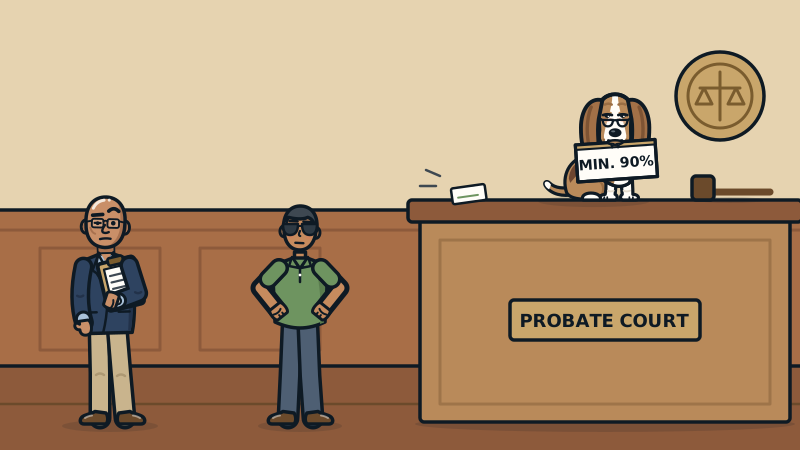
Under California Probate Code section 10309, a court can confirm a private probate sale of real property only if the price is at least 90% of the appraised value. The appraisal must have been done, and its valuation date must fall, within one year before the confirmation hearing. A narrow exception exists under section 10207.
The rule in plain English
When a house is sold through probate with court confirmation, the judge does not simply take the executor's word that the price is fair. The law sets a floor.
California Probate Code section 10309(a) says the court may confirm a private sale of real property only if three things are true:
- The property was appraised within one year before the date of the confirmation hearing.
- The valuation date of that appraisal is also within one year before the hearing.
- The offer is at least 90% of the appraised value.
That is the whole 90% rule. If the appraisal says $800,000, the court cannot confirm a private sale for less than $720,000. A buyer who offers $700,000 because "it's probate, they're desperate" will find out the estate is not allowed to be that desperate.
This is general information. Probate procedure depends on the facts and the court, so confirm the details with a California probate attorney.
Why the one-year window has two parts
Section 10309 looks at two separate things: when the appraisal was made, and the date the value applies to. Both have to be within one year before the hearing.
This matters because estate appraisals are often retrospective. Many estate appraisals value the home as of the date of death. If the death was 18 months before the confirmation hearing, that date-of-death value is too old for the 90% test, even if the report was written last month.
Markets move. A value from two springs ago can be a different market entirely. The law is basically saying what I say about comps: read the market close to now, not a fuzzy average from a year that already left the building.
When a new appraisal can be ordered
Section 10309(b) lists the situations where a new appraisal may be obtained before the sale or the confirmation:
- The property was never appraised.
- It has not been appraised within one year before the hearing.
- The valuation date of the most recent appraisal is more than one year before the hearing.
- The court is satisfied the most recent appraisal is too high or too low.
That last one is worth underlining. The appraisal is not sacred. If it is too high, a fair offer may fail the 90% test and the house sits. If it is too low, the floor is set too low and the estate could leave money on the table.
Section 10309(c) also covers who makes the new appraisal. If the original appraisal was not made by a probate referee, the new one does not have to be either. If a probate referee made the original, that same referee may make the new one without a new court order. A new referee is appointed only when the original cannot act or there is another reason to replace them.
The exception and the overbid
Section 10309 starts with the words "except as provided in Section 10207." That exception is narrow. Section 10207 deals with selling estate land suitable for a shift-in-land-use loan to a grazing or pasture association under a federal farm program. In that case the price cannot be less than the value set by an independent appraiser. If you are selling a three-bedroom ranch in a suburb, this almost certainly is not you. If you are selling pasture to a grazing association, call your attorney today.
The 90% floor is also not the last word on price. At the confirmation hearing, section 10311 lets other buyers overbid. The higher offer has to be at least 10% more on the first $10,000 of the original bid and 5% more on the amount above $10,000. On a $100,000 bid, that works out to $105,500. On bigger numbers it adds up fast, which is why probate buyers sometimes show up at the hearing with a nervous face and a backup plan.
What to do as an executor or listing agent
- Check the dates first. Find when the current appraisal was made and its valuation date. Count back one year from the expected hearing date.
- If either date is stale, plan for a new appraisal before you list or before the hearing. Ask your attorney who should prepare it.
- Price with the floor in mind. Know the 90% number before you review offers so nobody is surprised in escrow.
- Document condition. Give the appraiser access, photos and a list of known problems. A probate house that has sat empty often has issues nobody has looked at in a while.
- If the appraisal looks off, say so early. Section 10309(b) allows a new appraisal if the court is satisfied the last one is too high or too low.
- Warn buyers about overbids. An accepted offer can still be topped at the hearing.
What I see in the field
Probate and estate work is a big part of my practice. The trouble I see most is not the 90% math. It is a value that was right on the date of death and wrong on the date of the hearing, because the market moved and nobody updated it.
A good value for a probate sale is one an agent can price from and a judge can rely on. It should show the sales, explain the condition, and make clear what date it applies to. Facts over feelings matters even more when the seller is an estate. The person who loved the house is not there to argue about the wallpaper, and the court is not going to argue for it either.
Key takeaways
- A court-confirmed California probate sale must be at least 90% of the appraised value.
- The appraisal and its valuation date must both be within one year before the confirmation hearing.
- A new appraisal can be obtained if the old one is stale, missing, or too high or too low.
- Accepted offers can still be overbid at the hearing under section 10311.
People also ask
Does the 90% rule apply to every probate sale?
Section 10309 applies when the court confirms a private sale of real property, with an exception in section 10207. Whether your sale needs court confirmation depends on how the estate is being administered, so ask your probate attorney.
Who appraises a house in California probate?
It can be a probate referee or another appraiser, depending on the estate. Section 10309(c) says that if the original appraisal was not made by a probate referee, a new one does not have to be made by a referee either.
Can a buyer get a probate house below 90% of the appraisal?
Not in a private sale the court confirms under section 10309. The fix for a value that is too high is a new appraisal, not a lower confirmed price.
Sources
Got a question we haven't answered?
Suggest a topic or ask your own appraisal question. The best ones become posts.