How is the Prop 19 $1 million exclusion calculated?
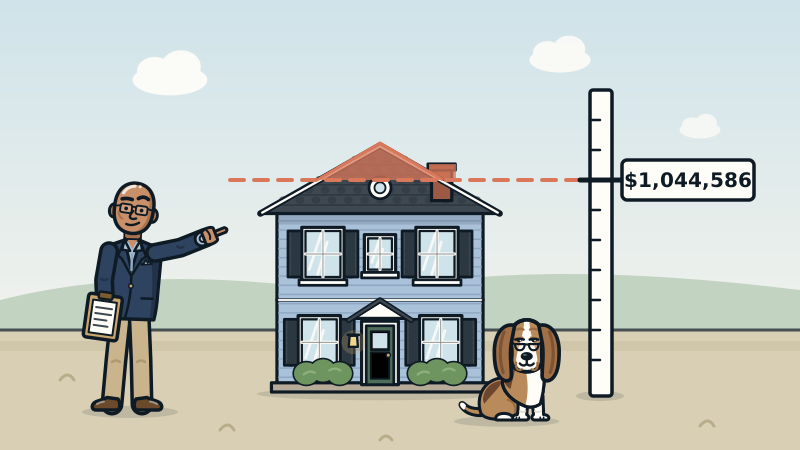
Add the parent's factored base year value to the adjusted $1 million amount, which is $1,044,586 for transfers from February 16, 2025 through February 15, 2027. If the home's market value on the transfer date is at or below that total, the child keeps the parent's taxable value. Any market value above it is added on.
Who qualifies for the exclusion in the first place
Proposition 19 changed how a parent's home is reassessed when it passes to a child. According to the California State Board of Equalization (BOE), the exclusion covers a family home that was the parent's principal residence and becomes the child's principal residence. A family farm can qualify too. A rental house does not.
To keep the exclusion, the child has to file for the homeowners' exemption (or the disabled veterans' exemption) within one year of the transfer. The BOE says a late filing only helps going forward.
There is also a claim form for the exclusion itself, BOE-19-P. The BOE lists the deadline as within three years from the date of death or transfer, or before the property is transferred to a third party, whichever comes first.
If nobody in the family plans to live there, this calculation is mostly trivia. Fun trivia, but trivia.
The formula, one step at a time
Here is how the BOE describes the math:
- Find the factored base year value. This is the parent's taxable value as the assessor has carried it, including the yearly inflation factors. It is on the property tax records.
- Add the adjusted $1 million amount that applies on the date of transfer.
- Compare that total to the home's market value on the date of transfer.
- If market value is at or below the total, the child takes over the parent's factored base year value.
- If market value is higher, the difference is added to the factored base year value, and that becomes the new taxable value.
The BOE's own example uses the original $1,000,000 figure: a factored base year value of $300,000 and a market value of $1,500,000. The limit is $1,300,000. The extra $200,000 is added on, so the new taxable value is $500,000.
Notice that you do not lose the whole exclusion when you go over. You only pay tax on the part above the line. Prop 19 is a speed bump, not a wall.
The adjusted amounts by transfer date
The $1 million amount is adjusted every two years. The BOE publishes these figures:
| Date of transfer | Exclusion amount |
|---|---|
| February 16, 2021 to February 15, 2023 | $1,000,000 |
| February 16, 2023 to February 15, 2025 | $1,022,600 |
| February 16, 2025 to February 15, 2027 | $1,044,586 |
Now run the BOE's same hypothetical house through the 2025 to 2027 figure. The factored base year value is $300,000. Add $1,044,586, and the limit is $1,344,586. With a market value of $1,500,000, the amount over the limit is $155,414. The new taxable value is $455,414.
The date of transfer picks the row. For an inheritance, BOE Property Tax Rule 462.260 says the date of change in ownership is the date of death. For a living trust that becomes irrevocable at death, it is the date the trust becomes irrevocable, which is usually the same day. It is not the day the deed is finally recorded or the day someone gets around to calling the assessor.
Why market value on the transfer date matters so much
Look at the formula again. The factored base year value is fixed. The exclusion amount is fixed. The only number that can move is market value on the transfer date, and every dollar of it above the limit lands on the new taxable value.
That value is as of a past date, often months before anyone thinks about it. It should reflect the house as it was on that date: the 1980s kitchen, the original windows, the roof that was due. A house that needs work is worth less than the same house finished, and buyers in the markets I work react to condition more than to age.
The value should come from sales that closed around the transfer date, adjusted for how each one differed from the house. I measure the market trend in the most recent window the data supports, because in a moving market a stale average can tilt the answer. An online estimate pulled two years later is answering the wrong question on the wrong date.
What happens if the child moves out later
The exclusion depends on the home staying a family home. The Butte County Assessor explains that if the child moves out, the property is reassessed starting with the lien date after the move-out. The new taxable value reflects market value as of the date the child inherited it, plus inflation adjustments.
That means the date of death value can come back years later. If it was never documented, the family may be reconstructing it long after the fact. Butte County also notes that if another eligible child moves in within one year and gets the exemption, the exclusion can continue.
Rules and procedures can vary in how each county handles them, so check with the assessor where the house sits.
What to do if you are inheriting a parent's home
- Confirm the home was the parent's principal residence and that a child will live there as their principal residence.
- Get the factored base year value from the county assessor or the property tax bill.
- Order a date of death appraisal from a licensed appraiser so you have evidence of market value on the transfer date.
- File for the homeowners' exemption within one year of the transfer.
- File the BOE-19-P claim within three years, or before any transfer to a third party, whichever is earlier.
- Keep the appraisal with your tax records. It can matter again if the occupancy ever changes.
This is general information. Tax treatment depends on the facts, so confirm with a CPA or tax attorney.
Key takeaways
- The limit equals the factored base year value plus the adjusted $1 million amount.
- For transfers from February 16, 2025 through February 15, 2027, that amount is $1,044,586.
- Market value above the limit is added to the taxable value. You do not lose the whole exclusion.
- The child must make it a principal residence and file for the homeowners' exemption within one year.
- Market value on the transfer date is the only moving number, so document it.
People also ask
Does Prop 19 apply to a rental property I inherit from my parents?
Not the family home exclusion. The BOE says the home must be the parent's principal residence and become the child's principal residence. A family farm is a separate category.
Who decides the market value for Prop 19?
The county assessor sets it as of the date of transfer. A date of death appraisal gives the family its own documented evidence of that value.
What if the house is worth less than the limit?
Then the child generally takes over the parent's factored base year value with nothing added, as long as the other requirements are met.
Sources
Got a question we haven't answered?
Suggest a topic or ask your own appraisal question. The best ones become posts.