Can I get PMI removed with a new appraisal?
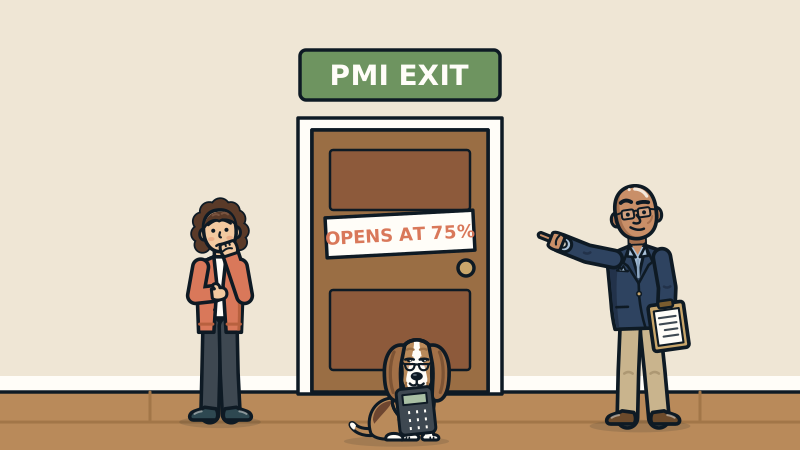
Often, yes. On a Fannie Mae conventional loan, you can ask your servicer to drop PMI based on today's value if your loan-to-value is 75% or less after two to five years, or 80% or less after five years, with a clean payment history. The servicer orders the valuation, and you have to ask.
There are two roads off PMI, and only one uses today's value
Private mortgage insurance (PMI) protects the lender, not you. You pay for it anyway. That is the kind of deal only a mortgage could make sound normal.
Fannie Mae's servicing rules give you two ways out. The first is based on the original value of the house. You can ask to cancel when your balance is scheduled to reach, or actually reaches, 80% of that original value. If you do nothing, PMI ends automatically when the balance is scheduled to hit 78% of original value, or at the midpoint of the loan term if that comes first. That automatic rule applies to one-unit primary homes and second homes closed on or after July 29, 1999.
The second road uses the current value. This is the one people mean when they ask about a new appraisal. If your home has gone up in value, or you improved it, today's number can get you under the line years earlier than the payment schedule would.
One catch on the first road: even an original-value request gets a value check. The value has to come back at least equal to the original value, or the servicer must deny it unless you pay the balance down.
The numbers Fannie Mae uses for current-value removal
Loan-to-value (LTV) is your loan balance divided by the home's value. Here is what Fannie Mae requires when you ask to cancel based on current value:
| Property | Loan age (seasoning) | Max LTV |
|---|---|---|
| One-unit primary home or second home | 2 to 5 years | 75% |
| One-unit primary home or second home | Over 5 years | 80% |
| One-unit primary or second home, with value-adding improvements | Under 2 years (waiver) | 80% |
| Investment property (1–4 units) or 2–4 unit primary home | Over 2 years | 70% |
You also need a clean payment record: current when you ask, no payment 30 or more days late in the last 12 months, and no payment 60 or more days late in the last 24 months.
The valuation has to be based on an inspection of both the inside and the outside of the house. A drive-by squint from the curb does not count.
Two more rules surprise people. Your servicer is not allowed to solicit you for a current-value cancellation, so nobody is going to call you with the good news. You have to ask. And these are Fannie Mae's rules. If Freddie Mac or a private investor owns your loan, ask your servicer for that investor's terms. FHA mortgage insurance is a different animal entirely.
Improvements can shorten the wait, repairs cannot
Normally you need at least two years of loan age before current value counts. Fannie Mae waives that two-year minimum if you made improvements that increased the value. In that case the LTV must be 80% or less, and you have to describe the improvements.
Fannie Mae draws a clear line here: repairs that only maintain the property are not improvements. A new water heater replacing a dead one keeps the house working. It does not make it worth more. Same for patching the roof or repainting the trim. Your servicer is not going to give you credit for fixing what broke.
A kitchen remodel, a new bathroom or added living space is a different story. In the markets I work, buyers react to condition more than age, so a remodeled kitchen can move the number.
Here is the part people skip. Cost is not value. If you spent $60,000 on a kitchen, the market does not owe you $60,000. The appraiser measures what buyers in your area actually paid for homes with and without that kind of update. Sometimes the answer is close to what you spent. Sometimes your custom wine wall is worth exactly as much as the next buyer loves wine.
Do the math before you spend a dime
Before you ask for anything, figure out what value you need. Take your current loan balance and divide it by the LTV you have to hit.
Here is a hypothetical. Say your balance is $480,000 and your loan is three years old, so you need 75%.
- $480,000 ÷ 0.75 = $640,000
The house has to appraise at $640,000 or more. If the loan were six years old, you would only need 80%:
- $480,000 ÷ 0.80 = $600,000
Now compare that target to real evidence, not the number your neighbor bragged about at the block party. Look at closed sales of similar homes nearby in the last few months. If the best recent sales sit well above your target, you are in good shape. If they sit right on top of it, you are flipping a coin, and that coin costs you a valuation fee if it lands wrong.
Online estimates are a starting point at best. They have never walked through your house, and they do not know the back bedroom still has the 1985 carpet.
What to do: the steps that actually get PMI removed
- Ask your servicer who owns the loan. Fannie Mae, Freddie Mac and private investors each have their own rules.
- Check your payment history. One 30-day late in the last year can stop the request cold.
- Run your target value using the math above and the right LTV for your loan age.
- Make a list of improvements with dates, costs and permits. If you are under two years, this list is your whole case.
- Request cancellation in writing and ask what valuation the servicer will order, who performs it and what it costs. On a Fannie Mae loan, the servicer gets the valuation through Fannie Mae's process. An appraisal you order on your own is not a substitute.
- Get the house ready. Clear access to the attic, panel and water heater, and have your upgrade list on the counter.
- Read the answer. If the servicer denies the request, it has to tell you why, including the valuation results, within 30 days.
What I see in the field
Most homeowners who ask me about PMI have a number in their head before I ever pull a comp. Usually it came from a website, a postcard, or a brother-in-law who sold a house in 2021 and has not stopped talking about it.
Facts over feelings. The valuation for a PMI request works the same way as any other: it comes from what similar homes actually sold for, adjusted for real differences in size, condition and location. Hope is not a comparable sale.
If you are unsure whether you are close, a private appraisal can be a reality check before you file the request. Your servicer will still order its own valuation, so think of it as a scouting report, not a ticket. And if the evidence says you are not there yet, that is useful too. It means you keep paying down the loan and try again later instead of paying to hear no.
Key takeaways
- Fannie Mae allows PMI removal on current value at 75% LTV (2 to 5 years) or 80% LTV (over 5 years) for one-unit homes.
- Value-adding improvements can waive the two-year wait, but maintenance repairs do not count.
- You need a clean payment record and an interior and exterior valuation.
- Your servicer will not offer this. You have to ask, in writing.
- Divide your balance by the required LTV to see the value you need before you pay for anything.
People also ask
Can I use an appraisal I ordered myself to remove PMI?
Usually not. On a Fannie Mae loan, the servicer obtains the valuation through Fannie Mae's own process. Your own appraisal can tell you whether it is worth asking, but the servicer decides based on its valuation.
Does PMI ever go away on its own?
Yes. On a one-unit primary or second home closed on or after July 29, 1999, PMI ends automatically when the balance is scheduled to reach 78% of original value, or at the loan's midpoint, as long as payments are current.
Do the same rules apply to FHA mortgage insurance?
No. FHA mortgage insurance follows HUD's rules, not Fannie Mae's, and they work differently. Ask your loan officer or servicer how your FHA loan's insurance ends.
Sources
Got a question we haven't answered?
Suggest a topic or ask your own appraisal question. The best ones become posts.