How does the step-up in basis work when you inherit a house?
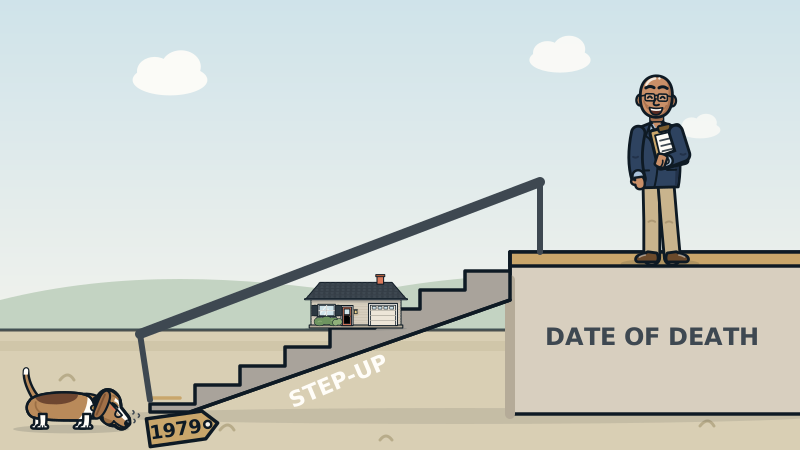
When you inherit a house, your tax basis generally becomes the home's fair market value on the date the owner died, not what they originally paid for it. If you later sell for more than that basis, the gain is taxable. A date-of-death appraisal is the usual way to document that value.
Basis is the number the IRS subtracts from your sale price
Basis is the starting line for figuring out how much of a sale is profit. Sell a house, subtract your basis, and the difference is your gain or loss.
When someone buys a house, their basis is mostly what they paid, plus improvements. When you inherit that house, federal tax law hands you a fresh starting line. Under Internal Revenue Code section 1014(a), the basis of property you get from someone who died is generally its fair market value on the date of death.
That is the step-up. The price your parents paid in 1979 stays in the shoebox with the recipe cards. What matters now is what the house was worth the day they passed.
The IRS puts it plainly in its own FAQ: if you sell the property for more than your basis, you have a taxable gain. Sell for about what it was worth at death, and there may be little or no gain at all.
Here is how the math plays out, with made-up numbers
Say a parent bought a house decades ago for $90,000. On the date they died, similar homes nearby supported a value of $900,000. A year later you sell it for $930,000.
| Scenario | Basis | Gain before selling costs |
|---|---|---|
| With the step-up | $900,000 | $30,000 |
| If the old price still counted | $90,000 | $840,000 |
Same house, same sale. One version gets a much smaller tax bill. Your CPA will also account for selling costs and anything else that adjusts basis, so treat this as a sketch, not a return.
Two more details help heirs. First, the holding period: under section 1223(9), if you sell inherited property within a year of the death, you are treated as having held it for more than a year. Second, the rule says fair market value, period. If the house was worth less at death than the owner paid, your basis goes down, not up. It is a step-up most of the time, but technically it is a reset.
The exceptions and twists people miss
- The one-year boomerang. Section 1014(e) says that if you gift appreciated property to someone, they die within one year, and it comes back to you (or your spouse), you keep their old basis. No step-up. The IRS saw that trick coming.
- The alternate valuation date. An executor filing an estate tax return (Form 706) can elect to value the estate six months after death instead. Under section 2032, that election is only allowed if it lowers both the gross estate and the tax. If it is elected, your basis follows that value.
- Consistent basis reporting. If the executor sends you a Schedule A to Form 8971, the IRS says you may be required to report a basis consistent with the estate tax value, and a penalty can apply if you don't.
- Community property. IRS Publication 551 says that when one spouse dies, the total value of community property, even the surviving spouse's half, generally becomes the basis of the entire property. California is a community property state, so this one matters here.
- Gifts during life are different. If a parent gives you the house while alive, you generally take their old basis. No reset.
Why the date-of-death value needs real evidence
The step-up is only as good as the number behind it. Fair market value, as the estate tax regulations define it, is the price a willing buyer and a willing seller would agree on, neither forced to act and both knowing the relevant facts. It is not what the house might fetch at a rushed sale, and it is not a website estimate printed the week of the funeral.
What I do for these assignments is called a retrospective appraisal. The value is set as of the date of death, even if I write the report months later. That means comparable sales (recent sales of similar nearby homes) from around that date, and the house in the condition it was in on that date. If the family replaced the roof after the funeral, the roof does not count yet.
Sometimes the best sale is a little older or a little newer than the date of death. I can still use it if I adjust it to that date and to the house. Facts over feelings: a number that is too low means more tax later, and a number that is too high with nothing behind it is hard to defend if anyone ever asks.
A good report also teaches the reader the market as it stood on that date: which sales mattered, how prices were moving, and why each adjustment is what it is. Your CPA should be able to read it and follow the logic without calling me. If a report just says "in my opinion" and stops, ask for more.
What to do if you just inherited a house
- Write down the exact date of death. Everything keys off that date.
- Order a date-of-death appraisal from a licensed appraiser. It does not have to happen on that day. It just has to be valued as of that day.
- Tell the appraiser what the house looked like then. Old photos, repair bids, notes about leaks or a dead furnace all help.
- Ask the executor two questions: Is an estate tax return being filed, and will I get a Schedule A to Form 8971?
- Keep receipts for improvements you make after inheriting. They generally add to your basis, which can lower your gain later.
- Talk to your CPA before you sell, not after. Tax treatment depends on the facts, and this post is general information only.
Do these early and the only surprise at tax time will be how calm you are.
Key takeaways
- Inherited property generally takes a basis equal to its fair market value on the date of death.
- The step-up can wipe out decades of appreciation for tax purposes, but the value has to be supported.
- Exceptions exist: the one-year gift boomerang, the alternate valuation date and consistent basis reporting.
- In California, community property can get a full basis adjustment when one spouse dies.
- Get a retrospective appraisal as of the date of death and run the sale past your CPA first.
People also ask
Can I get a date-of-death appraisal years later?
Yes. A retrospective appraisal values the house as of a past date using sales and conditions from that time. The further back you go, the more work it takes to reconstruct the condition, so earlier is easier.
Is the inheritance itself taxable income?
The IRS FAQ focuses on the sale: the gross proceeds from selling inherited property are included in income, and you pay tax on any gain over your basis. Ask your CPA how your situation is reported.
Do I get a step-up if the house is in a living trust?
It depends on how the trust is set up and whether the property is included in the estate. That is a question for your CPA or estate attorney.
Sources
Got a question we haven't answered?
Suggest a topic or ask your own appraisal question. The best ones become posts.