Why did my home appraisal come in low?
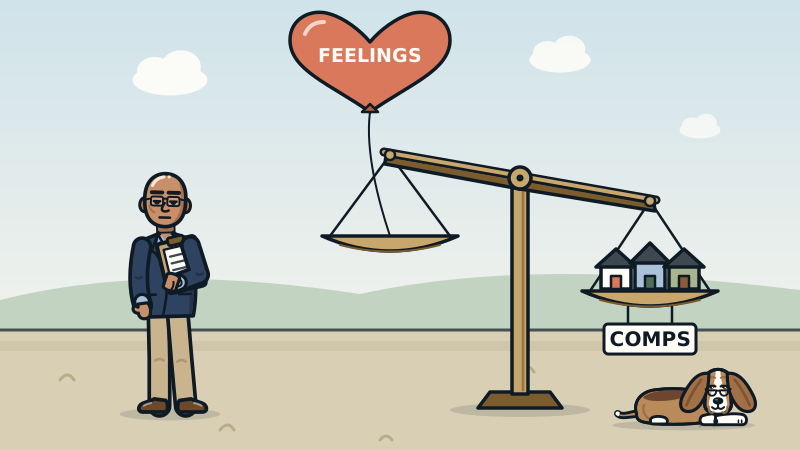
Low appraisals usually come down to three things: the contract price was ahead of the market, the market cooled, or similar nearby homes sold for less. Upgrades count only at what buyers pay for them, not what they cost. If the report has real errors or missed better sales, you can ask your lender for a reconsideration of value.
The price was set by hope, and the appraisal was set by sales
Chase's guide lists four common reasons an appraisal comes in below what people expected. The first is simple: the seller or the agent overestimated the home's value. Pricing can get ambitious or emotional. A list price is a wish. A contract price is one buyer agreeing to that wish, often in a hurry, often after the third open house cookie.
The contract price does not set value. One buyer and one seller is not the whole market. My job is to tell the lender what the typical buyer would pay, based on what buyers actually paid for similar homes. If you paid $40,000 over asking because you loved the backyard lemon tree, the lemon tree has to show up in the sales data too. Usually it does not.
This feels personal when you are the buyer. It is not. The appraisal is not saying you made a bad choice. It is saying the evidence stops at a certain number, and the lender only lends on evidence.
The market moved, or the comps closed lower
Two more reasons on Chase's list are market conditions and comparable sales. Comparable sales (comps) are recent sales of similar homes nearby. If those homes sold for less than your contract price, they pull the estimate down. If demand softened because inventory piled up or the economy wobbled, buyers stop paying last quarter's prices.
Timing is where I see a lot of confusion. A market can turn in a few months. If prices dipped since spring, a comp from spring has to be adjusted down to today. Fannie Mae requires that time adjustments, or the lack of them, be supported by evidence. I read the market on the shortest recent window the data can support. A 12-month average can hide a turn that happened in the last 90 days.
It works the other way too. In a rising market, an older comp should be adjusted up. If it was not, that is a fair question to raise.
Why your upgrades did not count dollar for dollar
This one stings. You spent $80,000 on the kitchen, and the appraisal gave it a fraction of that. That is the fourth reason on Chase's list, and Chase puts it clearly: value reflects buyers' perceptions and reactions to upgrades, not only what they cost.
Fannie Mae's rules say the same thing in appraiser language. Adjustments must reflect the market's reaction to the differences between homes. Their own example: a $20 per square foot adjustment based on a rule of thumb is wrong when the market analysis shows it should be $100. Rules of thumb are out. Measured reactions are in.
I measure those reactions from real sales. The cleanest method is paired sales: find two similar homes, one with the feature and one without, and look at the price gap. Seller credits work the same way. A $15,000 credit does not get a $15,000 adjustment. It gets whatever the market actually reacted with, and that has to be measured too.
A kitchen can be beautiful and still be worth only what the street will pay for it. The street is a tough critic.
When a low appraisal really is a mistake
Appraisers are human. I have never met one who enjoys being wrong, but errors happen. Look for these:
- Wrong facts: square footage, bedroom or bath count, lot size, garage, pool.
- Missed upgrades: a new roof, HVAC, or a remodel that is not mentioned.
- Weak comps: sales from a different neighborhood, much older sales, or homes that are not really similar when better ones were available.
- Unsupported adjustments: Fannie Mae says a statement that only notes an adjustment was made is not acceptable. The report has to summarize the evidence.
- No time adjustment in a market that clearly moved.
Opinions are not errors. "My neighbor says the house is worth more" is not evidence. A closed sale down the street that the appraiser missed is.
What I see in the field
A low appraisal is rarely about a lazy appraiser or a grudge. A common pattern is a bidding war that ran past the last good sale. Picture ten buyers chasing one house. One wins, and the winner pays extra for the privilege of winning.
That premium is real to the buyer who paid it. It is not yet proven to the market. Once a few more homes sell at that level, the next appraisal can use them. Until then, the appraiser is working with the sales that exist.
Appraisers are not trying to kill deals. A good report should show you exactly why the number landed where it did: which sales carried the most weight, what each adjustment was based on, and how the market was moving on the effective date. If you finish reading yours and still can't tell why, that is worth a polite question to your lender.
What to do in the next 48 hours
- Read the whole report, not only the value. Check every fact about the house against what you know.
- Call your agent and loan officer. Ask how much time your contract gives you before the appraisal contingency deadline.
- Gather proof: corrections to square footage or room counts, a list of upgrades with dates, and recent nearby sales that are not in the report.
- Ask your lender for a reconsideration of value (ROV). Under Fannie Mae rules, you get one borrower-initiated ROV per appraisal and may submit up to five alternative comparable sales. HUD rescinded FHA's matching rules on March 19, 2025, so on an FHA loan, ask the lender for its process. Send it through the lender. Chase's guide says borrowers should not contact the appraiser directly.
- Run the money math while you wait: renegotiate the price, split the gap with the seller, bring more cash, or walk away if your contingency allows it.
Keep the request factual and short. A tidy list of five strong sales beats a four-page letter about how much your kids love the yard.
Key takeaways
- Low appraisals usually come from an ambitious price, a cooling market or lower nearby sales.
- The contract price does not set value. One buyer is not the whole market.
- Upgrades and seller credits count at the market's reaction, not their cost.
- Fannie Mae requires adjustments to be supported by market evidence, not rules of thumb.
- If the report has errors or missed better sales, ask the lender for a reconsideration of value.
People also ask
Can I order a second appraisal if the first is low?
Not on your own for the same loan. The lender orders appraisals, and a new one is usually ordered only when the lender finds a real problem with the first report. Ask your loan officer what their policy allows.
Does a low appraisal kill the deal?
No. You can renegotiate, split the difference, bring cash to cover the gap, challenge the report with an ROV, or cancel if your appraisal contingency allows it.
Will the seller know the appraisal came in low?
Usually, because the buyer's side asks for a price change. Whether the seller sees the report itself depends on the contract and the parties involved.
Sources
Got a question we haven't answered?
Suggest a topic or ask your own appraisal question. The best ones become posts.