What happens if the appraisal comes in lower than the offer?
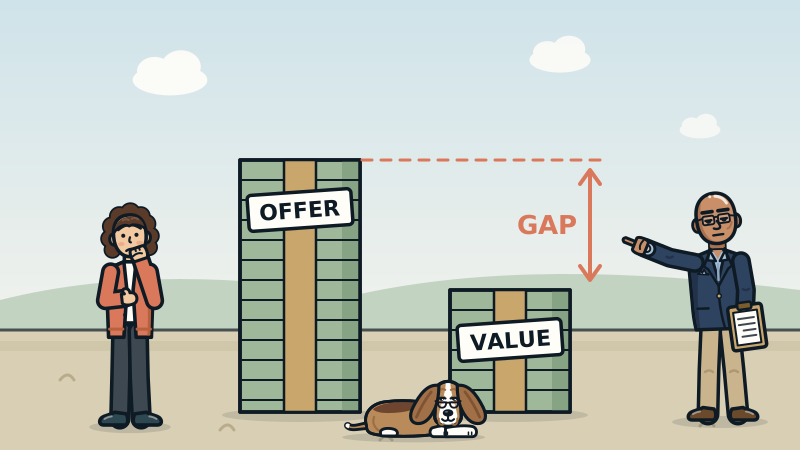
Your lender bases the loan on the lower of the sales price or the appraised value, so a low appraisal leaves a gap someone has to fill. Your main options are to renegotiate the price, pay the difference in cash, challenge the appraisal with facts and better sales, or cancel if your contract has an appraisal contingency.
Why a low appraisal changes your loan
On a purchase, Fannie Mae has lenders figure the loan-to-value ratio using the lower of the sales price or the appraised value. That one rule is why a low appraisal hurts. Your loan shrinks to fit the lower number, and the price in your contract stays where it was.
Here is a hypothetical. Say you offered $800,000 and planned to put 20% down. The lender expected to lend $640,000. The appraisal comes in at $760,000. Now 80% of the value is $608,000. To keep the same loan terms, you would need $192,000 at closing instead of $160,000. That $32,000 has to come from somewhere, and it is rarely from the couch cushions.
If you cover the gap by moving money out of your down payment instead, NerdWallet points out a second problem. Once your down payment drops below 20%, you will likely pay private mortgage insurance, and your loan terms can change.
How often does this happen?
Less often than the internet makes it sound. Fannie Mae studied purchase appraisals from September 2011 to August 2012 and found that 8.2% came in at least 2% below the contract price. Redfin's guide cites the same rough 8% figure. Treat that as a rough size of the problem, not a forecast for your street.
The same Fannie Mae research found what happens next. When an appraisal came in low, the chance that the buyer renegotiated a better price jumped from 8% to 51%. The chance that the sale was delayed or canceled went from 25% to 32%. In plain words, a low appraisal more often leads to a new price than to a dead deal.
That fits what I believe about value. The contract price does not set value. It is one buyer and one seller on one afternoon, sometimes after a bidding war and a very persuasive cover letter. The appraisal is supposed to test that price against what the rest of the market actually paid.
Your four real options
- Renegotiate. Ask the seller to drop to the appraised value, or split the difference. The seller knows the next buyer's lender will probably order an appraisal too.
- Pay the difference in cash. If you have the money and still want the house, you can cover the gap. Just run the numbers on mortgage insurance first if it means dipping below 20% down.
- Challenge the appraisal. If the report has wrong facts or missed better sales, ask your lender for a reconsideration of value. More on that below.
- Walk away. If your contract has an appraisal contingency and you are still inside its deadline, you can usually cancel and get your earnest money back. Without one, NerdWallet warns that you will likely lose your deposit, and the seller could take legal action. Talk to your agent, and to a real estate attorney if the contract language is unclear.
Some buyers also try a different lender. NerdWallet notes that takes time, and there is no promise the next appraisal will be higher.
How to challenge a low appraisal the right way
Fannie Mae requires lenders to have a process for a borrower-initiated reconsideration of value, called an ROV. A few rules matter:
- You get one borrower-initiated ROV per appraisal. Make it count.
- You can submit up to five additional comparable sales, with where the data came from.
- You have to point to what is unsupported, inaccurate or missing in the report, and explain why your new data supports a different value.
- The request goes through the lender, not straight to the appraiser.
- Once the loan closes, the borrower can no longer request an ROV.
What wins an ROV is evidence. A wrong bedroom count wins. A missed sale two blocks away with the same floor plan wins. "We really love this house" does not. I say this with affection: your feelings about the backyard are valid, but they are not a comparable sale.
What I see in the field
When I review a low appraisal, I check the facts first. Square footage, bedrooms, bathrooms, lot size, condition and upgrades. A surprising share of disputes start with a simple data error.
Next I look at the sales. Were they truly similar? Were they recent enough to reflect where the market is now, not where it was two seasons ago? Were the adjustments measured from real sales, or pulled from a rule of thumb?
Sometimes the honest answer is that the appraisal is right and the offer was rich. That is not a failure. That is information, and it is cheaper to learn before closing than after. When a buyer or agent wants a second opinion on the report, a desktop review checks the appraisal against the evidence, line by line.
What to do in the first 48 hours
- Get the full report from your lender. You are entitled to a copy.
- Check every fact about the house against what you know: size, rooms, garage, lot, upgrades, condition.
- Check your contingency deadline today. Missing it can take your best option off the table.
- Ask your agent for sales that are closed, close by, recent and truly similar. Active listings show the market but do not prove value.
- Decide your number before you call the seller: how much of the gap, if any, you are willing to cover.
- Submit one strong ROV if the facts support it, with up to five sales and a clear explanation.
Key takeaways
- Lenders lend on the lower of the price or the appraised value.
- A low appraisal more often leads to a renegotiated price than a canceled deal.
- You get one borrower-initiated ROV per appraisal, with up to five extra sales.
- Covering the gap from your down payment can trigger mortgage insurance.
- Check your appraisal contingency deadline the day the report arrives.
People also ask
Does the seller have to lower the price after a low appraisal?
No. The seller can refuse. But a buyer with an appraisal contingency can often walk away, and the next buyer's lender will order its own appraisal, so many sellers negotiate.
Can I order my own appraisal to fight a low one?
You can, and it can help you see the evidence, but the lender usually cannot use an appraisal you ordered yourself. Use it to build a stronger ROV or to decide your next move.
How long does a reconsideration of value take?
Fannie Mae does not set one fixed timeline. Each lender defines its own turn-time expectations, so ask your loan officer and keep your contract deadlines in mind.
Sources
Got a question we haven't answered?
Suggest a topic or ask your own appraisal question. The best ones become posts.