What is an appraisal contingency?
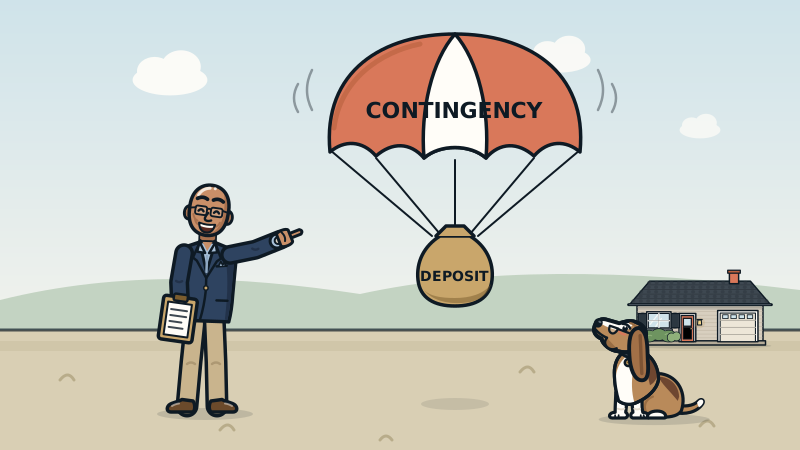
An appraisal contingency is a clause in a purchase contract that lets the buyer cancel without losing the earnest money deposit if the home appraises below the agreed price. It also gives the buyer room to renegotiate. Deadlines and wording depend on your state and contract form, so confirm yours with your agent or attorney.
What the clause actually does
When you make an offer with a loan, you are betting on two things: that the seller will take your price, and that the lender will agree the house is worth it. The seller part happens at the kitchen table. The lender part happens when the appraisal comes back.
An appraisal contingency protects you if those two things do not match. Experian describes it as a clause that lets a buyer walk away from the contract without losing their deposit if the home appraises below the sale price. Chase puts it simply: with the contingency, you can walk away without risking your earnest money.
Think of it as a parachute. You hope you never pull the cord. You are still very glad it is in the backpack.
It is also narrow on purpose. It covers the appraised value. It does not cover a rough inspection, a loan denial or cold feet. Those need their own contingencies, if your contract has them.
Why a low appraisal is your problem, not only the lender's
Lenders do not lend on your offer. They lend on the lower of the price or the appraised value. Fannie Mae's rule for purchase loans says exactly that: the property value used for the loan-to-value ratio is the lower of the sales price or the current appraised value.
Here is a hypothetical. Say you offer $800,000 with 20% down, planning a $640,000 loan. The appraisal comes in at $760,000. Your lender now figures 80% of $760,000, which is $608,000. The $32,000 difference does not disappear. It comes out of your pocket, on top of the down payment you already planned.
That is the moment the contingency earns its keep. Without it, you are stuck choosing between bringing more cash or walking away and likely losing your deposit. NerdWallet warns that without a contingency you will likely have to forfeit the deposit, and the seller may even take legal action.
Your options when the appraisal comes in low
With a contingency in place, a low appraisal opens a conversation instead of ending one. Chase and Experian list the same basic menu:
- Renegotiate the price. Ask the seller to come down to the appraised value or split the difference. This works better in a buyer's market than a seller's market.
- Pay the difference in cash. This means a bigger down payment than you planned.
- Challenge the appraisal. If there are factual errors or better comparable sales, your agent can send them to the lender and ask for a reconsideration of value. There is no guarantee it changes.
- Walk away. If nothing works, the contingency lets you cancel and recover your deposit, as long as you follow the contract's notice rules.
The seller usually knows that the next buyer's lender may see the same comps. That fact tends to make sellers more reasonable than they were on day one.
Who waives it, and why that is risky
In a competitive market, some buyers drop the appraisal contingency to make their offer stand out. Experian notes that waiving is most common among cash buyers and buyers with a down payment large enough to cover a gap. Keeping it can put you at a disadvantage against offers that do not have one.
The test is simple and unromantic. If the appraisal comes in low, can you cover the difference and still close? If the honest answer is "maybe, if my aunt sends a check," do not waive it.
There is a middle path. A gap coverage clause says you will cover a shortfall up to a set dollar amount that you choose. NerdWallet explains that if the gap is bigger than your cap, you can still withdraw and get your deposit back. It tells the seller you are serious without handing over a blank check.
What I want buyers to understand about the number
A contract price is one buyer and one seller agreeing on one day. It is a strong piece of evidence, but it is not the whole market. My job is to test that price against what similar homes actually sold for, adjusted for real differences in size, condition, location and timing.
Sometimes the market supports your price. Sometimes the bidding got ahead of the evidence. A low appraisal is not the appraiser punishing you for winning. It is the lender asking whether the facts back up the feelings.
That is why the contingency matters. It turns a disagreement between your offer and the evidence into a decision you get to make, instead of a loss you are forced to take.
If the appraisal does come in low, read the whole report before you react. Check the square footage, the bedroom and bath count, and whether the comparable sales are truly similar to your house. A wrong number on the grid is a lot easier to fix than a hurt feeling.
Checklist before you sign
- Find the deadline. Timelines vary by state and contract form. Know the exact date you must remove the contingency or give notice.
- Read the notice rules. Your contract says how and when you must tell the seller you are canceling or asking for changes. Missing a step can cost you the protection.
- Ask your lender for a realistic appraisal date so it lands before your deadline.
- Decide your gap number in advance. Know how much extra cash you could bring without draining your reserves.
- Talk to your agent or attorney before you waive or shorten the contingency. The wording is the protection.
Key takeaways
- An appraisal contingency lets you cancel and keep your deposit if the home appraises below the price.
- Lenders lend on the lower of price or appraised value, so a low appraisal means more cash from you.
- Waiving it only makes sense if you can cover a gap and still close.
- A gap coverage clause caps your exposure at a dollar amount you choose.
- Deadlines depend on your state and contract, so know yours.
People also ask
Is an appraisal contingency the same as a financing contingency?
No. A financing contingency covers you if you cannot get the loan. An appraisal contingency covers you if the home appraises below the price. A contract can have one, both or neither.
Do cash buyers need an appraisal contingency?
Usually there is no lender appraisal on a cash deal, so many cash buyers skip it. Some still order an appraisal on their own to make sure they are not overpaying.
Can the seller refuse to lower the price after a low appraisal?
Yes. The seller does not have to change the price. If you have a contingency, you can then cancel under its terms and recover your deposit.
Sources
Got a question we haven't answered?
Suggest a topic or ask your own appraisal question. The best ones become posts.