Should I waive the appraisal contingency to win a bidding war?
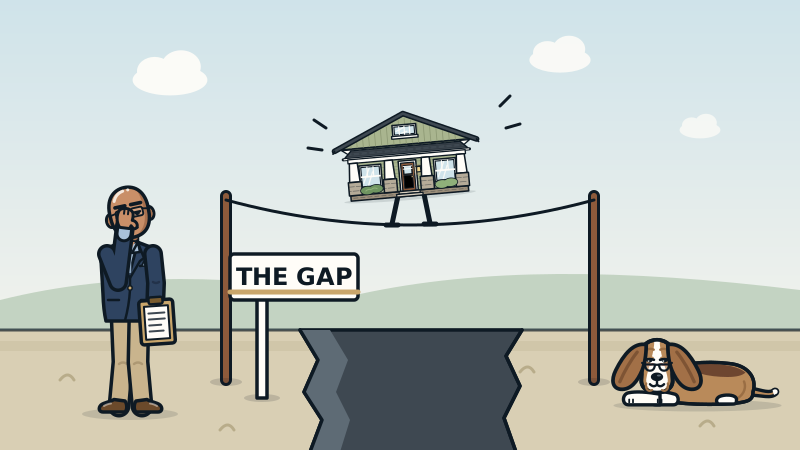
Only if you can afford to close even when the appraisal comes in low. Waiving makes your offer stronger, but without the contingency a low value usually means paying the gap in cash or risking your deposit. Know your maximum gap in dollars, talk to a real estate attorney, and consider a capped gap clause instead.
What the appraisal contingency protects
An appraisal contingency is a clause in your purchase contract. Experian describes it as giving the buyer the right to walk away if the home appraises below the sales price. Redfin notes it protects buyers from overpaying.
That matters because your lender does not lend against your offer. It lends against the value. NerdWallet puts it plainly: your loan amount is based on the home's appraised value, and lenders won't let you borrow more than the home is worth.
With the contingency, a low appraisal gives you options: renegotiate, cover part of the gap, or cancel and keep your deposit (under the terms of your contract). Without it, most of those doors close. Experian notes that backing out without one could cost you your earnest money deposit.
In a hot market, sellers love offers with no contingencies. Of course they do. Sellers also love buyers who offer to repaint the garage. Neither one is free.
What happens if you waive and the appraisal comes in low
Here is a hypothetical with round numbers. Say you offer $800,000 with 20% down on a conventional loan, and the appraisal comes back at $760,000.
| Item | If it appraised at price | If it appraised $40,000 low |
|---|---|---|
| Value the lender uses | $800,000 | $760,000 |
| Loan at 80% | $640,000 | $608,000 |
| Cash you bring for the price | $160,000 | $192,000 |
You still owe the seller $800,000. The loan shrinks, so the $40,000 difference comes out of your pocket, on top of your planned down payment. Loan programs and lender rules vary, so run your own numbers with your loan officer.
If you can't come up with the extra cash, NerdWallet warns that without the contingency you'll likely have to forfeit your deposit. That is the real price of a waived contingency: not the gap itself, but being forced to cover it or walk away from your deposit.
When waiving can make sense
Experian says waiving is most common for cash buyers, and also for buyers whose down payment can cover any gap between the offer and the appraised value. That is the honest test. Not "do I love the house," but "can I write the check if the number comes in short?"
Waiving can be reasonable when:
- You are paying cash, or most of the price in cash
- You have extra savings beyond your down payment and closing costs that you can set aside for a gap
- You have studied the recent comparable sales and your offer is in line with them
- A real estate attorney has reviewed the contract with you, which Experian recommends before waiving
Redfin's warning is the one to tape to your fridge: waiving contingencies increases the buyer's financial and legal risk. Risk is fine when you have priced it. It is a problem when you find out its size at the escrow office.
The middle path: cap how much gap you will cover
You don't have to choose between full protection and none. NerdWallet describes an appraisal gap clause, where your agent writes into the contract that you will pay the difference up to a limit you choose.
For example, you might agree to cover a gap of up to $25,000. If the appraisal comes in $15,000 short, you cover it. If it comes in $60,000 short, you are not on the hook for the whole thing, and you go back to the terms of your contract.
Sellers like this because it shows you are serious and funded. You like it because the worst case has a ceiling. The exact wording matters a lot, so have your agent and, if needed, an attorney set it up. Contract forms differ by state.
What I see in the field
Bidding wars produce contract prices. They don't automatically produce market value. When ten buyers chase one house, the winning price reflects the most motivated buyer on that day. The appraisal has to reflect what the wider market supports, using closed sales of similar homes.
Sometimes the comps catch up and support the price. Sometimes they don't, especially when the market moved fast and the closed sales are a few weeks behind. A good appraiser reads the most recent data the market supports, not a lazy 12-month average. But even a careful appraiser can't use sales that have not happened yet.
The contract price does not set value. One buyer and one seller is not the whole market. If you waive the contingency, you are betting that your offer matches the evidence. Look at the evidence before you place the bet.
How to decide before you write the offer
- Ask your agent for the closed sales that best match the house, and see where your offer sits.
- Pick your maximum gap in dollars, the amount you could pay in cash and still sleep.
- Confirm the cash is liquid, beyond your down payment, closing costs and moving money.
- Run the numbers with your loan officer for a value 5% and 10% below your offer.
- Choose your tool: keep the contingency, use a capped gap clause, or waive fully if the cash is truly there.
- Have an attorney review the contract language before you sign, as Experian suggests.
Key takeaways
- Your loan is based on the appraised value, not your offer.
- Without the contingency, a low appraisal usually means paying the gap or risking your deposit.
- Waive only if you can cover a realistic gap in cash.
- A capped appraisal gap clause gives sellers confidence and gives you a ceiling.
People also ask
Can I still challenge a low appraisal if I waived the contingency?
Yes, you can still ask your lender about a reconsideration of value if there are factual errors or missed sales. Waiving the contingency affects your contract with the seller, not your right to question the report.
Do cash buyers need an appraisal contingency?
Cash buyers have no lender requiring an appraisal, so they often skip it. Some still order one to make sure they are not overpaying.
Is an appraisal gap clause the same as waiving?
No. A gap clause limits how much of a shortfall you will cover. A full waiver leaves the amount open-ended.
Sources
Got a question we haven't answered?
Suggest a topic or ask your own appraisal question. The best ones become posts.