How does appraisal gap coverage work, and how much should I offer?
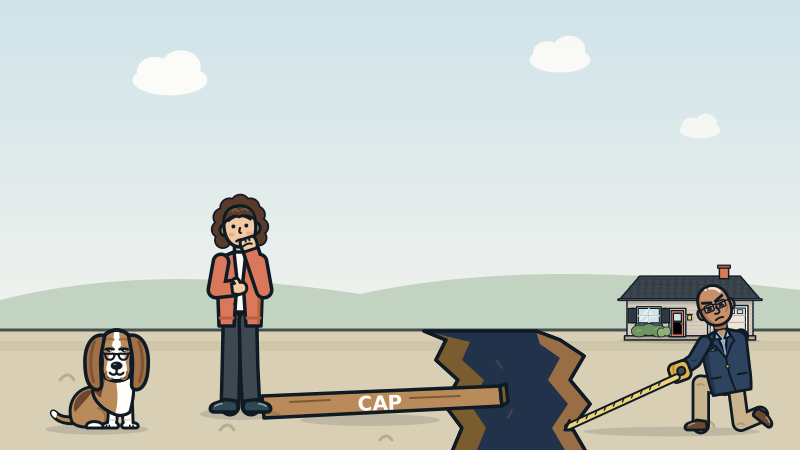
Appraisal gap coverage is a contract clause where the buyer agrees to pay the difference between the appraised value and the price, up to a set dollar cap. If the gap is bigger than the cap, the buyer can usually walk away with the deposit. The right cap is the extra cash the buyer can truly bring, not a guess.
Gap coverage is the middle seat between a contingency and no contingency
A normal appraisal contingency lets the buyer cancel if the house appraises below the price. Waiving it means the buyer is on the hook for any gap, however big. NerdWallet describes gap coverage as the option in between: the buyer agrees to pay the difference between the appraised value and the contract price, up to an amount they choose.
Here is how the cap plays out in NerdWallet's example. If the gap is $30,000 and the cap is $30,000, the buyer moves forward. If the cap is $20,000, the buyer can withdraw and get the deposit back, because the gap is $10,000 more than the clause covers.
For listing agents, this makes an offer easier to compare. For buyer's agents, it is a way to compete without handing your client a blank check. Blank checks are for lottery winners and people who do not read contracts.
The exact wording lives in your purchase agreement and any addendum, so read the form your market uses. The clause only does what it says.
The cash math most buyers miss
When the appraisal is lower than the price, the lender generally sizes the loan off the appraised value, not the contract price. Redfin's example: the lender will finance 80% of a $380,000 appraisal, not of the $400,000 the buyer agreed to pay.
Here is a hypothetical with round numbers. A buyer offers $800,000 and plans 20% down, which is $160,000 cash and a $640,000 loan. The house appraises at $770,000, a $30,000 gap.
| Option | Loan | Cash needed |
|---|---|---|
| Keep 20% down on the appraised value | $616,000 | $184,000 |
| Keep the original $640,000 loan | $640,000 | $160,000, but now about 83% of value |
In the first row, the buyer brings $24,000 more than planned. In the second, the buyer brings the same cash, but the down payment drops below 20% of the appraised value. NerdWallet notes that can trigger mortgage insurance and change the loan terms. Run these numbers with the loan officer before writing the offer, not after the appraisal.
How much gap coverage should you offer?
Neither NerdWallet nor Redfin gives a formula, and I will not invent one. The honest answer is two numbers, and the cap should be the smaller one.
- What the buyer can afford. Take the cash on hand, subtract the down payment, closing costs and a real reserve. Then use the math above, because a $30,000 gap does not cost exactly $30,000 once the loan shrinks.
- How far the price is past the evidence. Look at the closed sales an appraiser would likely use. If the best comps support $770,000 and you are offering $800,000, you already know roughly where the gap could land.
Offering $50,000 of coverage when the evidence suggests a $10,000 gap is generous. Offering $50,000 when the buyer has $20,000 in savings is fiction. NerdWallet points out that the offer has to be believable. A preapproval and proof of funds for the gap help sellers believe it.
What I see in the field
The contract price does not set value. One buyer and one seller agreeing on a number is not the whole market. When ten buyers fight over a house, the winner often pays a premium that no closed sale has proven yet.
That is where gap coverage earns its keep. It turns a vague promise into a sized risk. The best offers I see are written by agents who looked at the same evidence an appraiser will look at: the recent closed sales, the pending sales, and how fast prices are moving right now. A 12-month average can hide a turn that happened in the last 90 days. The market will be read as of the appraisal's effective date, so read it that way when you set the cap.
Also remember the appraisal is not a negotiation. A gap clause does not ask the appraiser to stretch. It just decides who pays if the evidence lands short.
Other ways to split a gap
Gap coverage is not the only tool. Redfin gives a simple split: on a $10,000 gap, ask the seller to drop the price by $5,000 while the buyer covers the other $5,000. Some offers write that split into the contract from day one.
- Fixed cap: the buyer covers up to a set dollar amount.
- Split: buyer and seller each cover part of the gap.
- Renegotiate later: keep a full contingency and talk price after the appraisal.
- Waive the contingency: only for buyers who can truly cover any gap. NerdWallet warns that walking away without a contingency can mean losing the deposit.
Get every version in writing. A handshake gap agreement has the shelf life of an open-house sandwich.
A checklist before you write the clause
- Pull the comps first. Look at the closed sales an appraiser would likely use, plus pending sales, and note how prices have moved in the last few months.
- Get the cash number from the buyer and the loan officer together, including reserves the lender requires.
- State the cap as a dollar amount, not a percentage or a vague promise to "cover the difference."
- Say what happens past the cap: cancel, renegotiate, or a split with the seller.
- Match the deadline to the appraisal contingency period in your contract.
- Attach proof of funds for the cap so the seller can trust it.
If any line on this list makes the buyer nervous, the cap is probably too high. Nervous buyers make great clients and terrible gamblers.
Key takeaways
- Gap coverage commits the buyer to cover a shortfall up to a stated cap.
- If the gap is bigger than the cap, the buyer can usually withdraw and keep the deposit.
- Lenders generally size the loan off the appraised value, so run the cash math first.
- Set the cap at the smaller of what the buyer can afford and what the comps suggest.
People also ask
Is gap coverage the same as waiving the appraisal contingency?
No. Waiving leaves the buyer exposed to any gap. Gap coverage limits that exposure to a set dollar amount and usually keeps the right to cancel beyond it.
Can the buyer use the down payment to cover the gap?
Sometimes, but it lowers the down payment as a share of the appraised value. That can add mortgage insurance or change the loan terms, so check with the lender first.
Does gap coverage affect what the appraiser concludes?
It should not. The appraiser reports value from market evidence. The clause only decides who pays if the value comes in below the price.
Sources
Got a question we haven't answered?
Suggest a topic or ask your own appraisal question. The best ones become posts.