What is an appraisal gap?
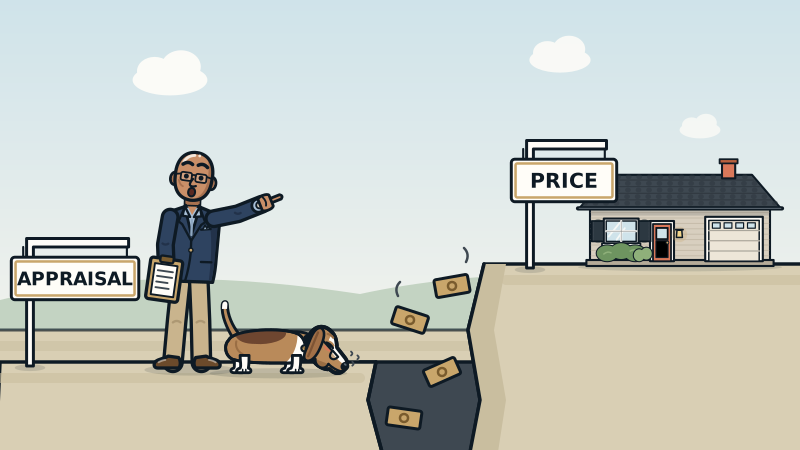
An appraisal gap is the difference between the price you agreed to pay and a lower appraised value. Lenders base the loan on the lower of the two, so the buyer has to cover the gap in cash, renegotiate with the seller, challenge the appraisal or use a contingency to walk away.
The gap is the space between the offer and the appraisal
You offer $330,000. The appraisal comes back at $300,000. That $30,000 difference is the appraisal gap. It shows up most often in hot markets, right about the time everyone stopped sleeping because of bidding wars.
The gap matters because of how the loan is sized. Fannie Mae's rule is plain: on a purchase, the property value used for the loan is the lower of the sales price or the appraised value. Your lender does not care that you love the backyard. It lends against the lower number.
So the gap is not a theory. It is money that has to come from somewhere before you get the keys.
Here is what a gap does to your cash
NerdWallet walks through an example that shows why gaps hurt more than people expect. I will use the same numbers:
| Item | Amount |
|---|---|
| Offer price | $330,000 |
| Appraised value | $300,000 |
| Loan at 95% of the appraised value (5% down) | $285,000 |
| Cash the buyer needs to close the price | $45,000 |
The buyer planned on about $15,000 down. Now they need about $45,000, because they owe the 5% down payment on the appraised value plus the whole $30,000 gap. Closing costs come on top of that.
This is why the first time many buyers hear the phrase "appraisal gap" is also the first time they check the balance of every account they own, including the coin jar.
Why appraisal gaps happen
Redfin lists the usual causes, and they match what I see:
- Bidding wars. When several buyers chase one house, the winner often pays more than recent sales support.
- Prices rising faster than the records. Appraisals rely on closed sales, and closed sales were priced weeks or months ago. In a fast-rising market, the data lags the deal.
- Unique upgrades. A custom feature can be hard to match with a comparable sale (comp), meaning a recent nearby sale of a similar home.
- Few recent sales nearby. Less data makes every conclusion harder to support.
Here is my view, and it is the uncomfortable part. The contract price does not set value. One buyer and one seller agreeing on a number is one data point, not the whole market. An appraiser who simply matched every contract would be a very expensive rubber stamp.
But the reverse is also true. If prices really are climbing, the appraiser has to measure it. Fannie Mae requires appraisers to analyze changes in market conditions from each comp's contract date through the effective date, and to support time adjustments, or the lack of them, with evidence. A report that ignores a rising market is not being careful. It is being late.
Your options when the appraisal comes in low
You have more choices than "pay it" or "panic." These are the main ones:
- Renegotiate. Ask the seller to drop to the appraised value or split the difference. Sellers know the next buyer's lender will likely see the same appraisal data.
- Cover the gap. Bring more cash. Redfin notes buyers use savings, gift funds or other sources, and some of those carry tax or cost tradeoffs.
- Use an appraisal gap clause. Some contracts include a clause where you agree ahead of time to cover a gap up to a set cap. If the gap is bigger than the cap, you can typically withdraw.
- Request a reconsideration of value (ROV). This is a formal request, through your lender, for the appraiser to look again. On Fannie Mae loans you can submit up to five other comparable sales with their sources. It is not guaranteed to work, so bring evidence, not frustration.
- Walk away. If your contract has an appraisal contingency, you can usually cancel and may recover your earnest money. Read the deadlines carefully and ask a real estate attorney if anything is unclear.
What to do before you write the offer
The best time to deal with an appraisal gap is before it exists. Here is my checklist:
- Ask your agent for the closed sales, not only the list prices. List prices are wishes. Closed sales are facts.
- Look at the most recent sales. If prices moved in the last 60 to 90 days, find the sales that prove it. Those are the ones an appraiser can use.
- Decide your gap number now. Know how much extra cash you could bring without draining your safety net.
- Talk to your lender about how the gap changes your down payment and closing costs.
- Think hard before waiving the appraisal contingency. It is your exit if the numbers fall apart.
- Keep a list of the home's upgrades and permits so the appraiser gets every real feature, not a guess.
What I see in the field
When an appraisal comes in under contract, the first reaction is usually that the appraiser missed something. Sometimes that is true, and an ROV with better comps fixes it. More often the buyer paid a premium to win, and the closed sales have not caught up.
Both outcomes are fine, as long as the number comes from evidence. What I want to see in any report, mine included, is the sales, the dates and the reasoning laid out so you can follow it. A low appraisal that teaches you the market is useful. A low appraisal with no explanation is a sad envelope with a number in it.
One more pattern: gaps cluster around homes with features nobody else on the street has. The pool house, the wine room, the garage with a car lift. Those things can carry real value, but the appraiser has to find sales that prove what buyers in that neighborhood pay for them. If the proof is not there, the feature gets a smaller number than the seller hoped.
Key takeaways
- An appraisal gap is the difference between your offer and a lower appraised value.
- Lenders use the lower of the price or the appraised value, so the gap comes out of your cash.
- Bidding wars, lagging sales data, unique upgrades and thin sales cause most gaps.
- You can renegotiate, cover the gap, request a reconsideration of value or use your contingency to walk.
People also ask
Does the seller have to lower the price if the appraisal is low?
No. The seller can refuse. Many sellers negotiate, because a new buyer using a loan may run into the same appraisal problem.
Is a cash buyer affected by an appraisal gap?
A cash buyer with no loan usually does not need an appraisal, so there is no lender gap. Some cash buyers still order one to make sure they are not overpaying.
Can I get a second appraisal if the first is low?
Your lender controls the appraisal, so you cannot order your own for the loan. A different lender would order a new appraisal, but that takes time and the result could be the same.
Sources
Got a question we haven't answered?
Suggest a topic or ask your own appraisal question. The best ones become posts.