How do you buy out a sibling's share of an inherited house?
Agree on the home's fair market value, multiply it by your sibling's ownership share, pay it, and record a new deed. If you cannot agree, a California co-owner can file a partition action, and in a partition by sale the co-owners who did not ask for the sale get a chance to buy out the others.
Start with one number everybody can trust
Every sibling buyout comes down to one number: what the house is worth. Everything else is arithmetic.
The trouble is that siblings rarely start on the same page. The one who wants to keep the house tends to see the cracked driveway and the 1970s bathroom. The one who wants out tends to see a website estimate plus a kitchen remodel that never happened. Thanksgiving gets quiet.
The fairest anchor is fair market value. Federal tax regulations define it as the price at which property would change hands between a willing buyer and a willing seller, neither under any compulsion and both knowing the relevant facts. Notice what that leaves out. It is not a fire-sale price because one sibling needs cash next month, and it is not a sentimental price because you learned to ride a bike in that driveway.
Get that number right and most of the arguing goes away, because there is nothing left to argue about except who keeps the dining table.
The buyout math is simpler than the family dinner
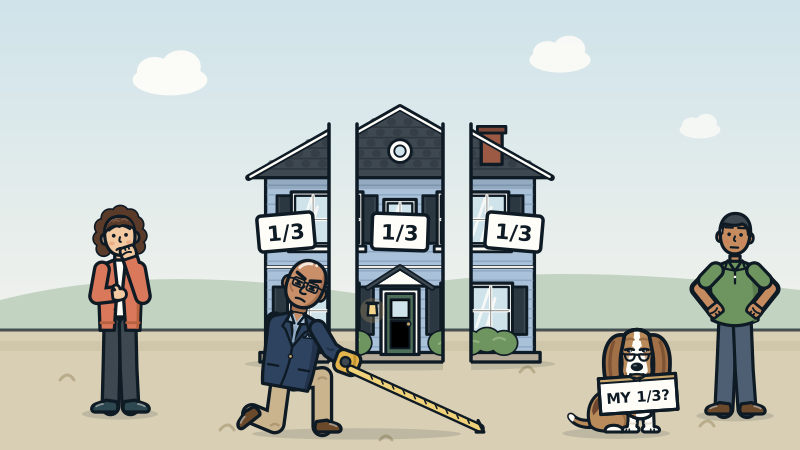
Here is a hypothetical with three siblings who each own one third of a house appraised at $900,000, with no loan on it.
| Step | Amount |
|---|---|
| Appraised fair market value | $900,000 |
| Each sibling's share (one third) | $300,000 |
| Keeping sibling pays the other two | $600,000 total |
If there is still a mortgage, the siblings are usually splitting the equity, which is the value minus the loan balance. With a $200,000 loan, the equity is $700,000, and each one-third share is about $233,333.
Families also argue about whether to knock off the real estate commission nobody is paying because nobody is listing the house. That is a negotiation point, not a rule. Put whatever you agree to in writing and have your attorney look at it.
If the house is still in a probate estate or a trust, the executor or trustee is part of the deal. The buyout may happen through the distribution instead of a sale between siblings, so ask the attorney how title moves before anyone writes a check.
Why one shared appraisal beats dueling estimates
Some families commission dueling appraisals like they are hiring lawyers. Each side picks an appraiser, each side gets a number it likes, and then they are right back where they started, minus two fees.
A better approach is one independent appraiser that everyone agrees on in writing, with everyone allowed to send in information. The sibling who lived there knows about the leak under the sink. The sibling across the country knows the house down the street just sold. Both facts belong in the file.
What you want back is a report that shows its work. Which sales were used, why they are similar, how each difference was measured from real sales instead of a rule of thumb, and why the value landed where it did. When the evidence is laid out, the sibling who wanted a higher number can see exactly why it is not there, and that conversation goes a lot better than "because I said so."
One more tip. If the estate also needs a date-of-death value for taxes, ask for both values as separate parts of the same assignment. The date-of-death value sets the heirs' tax basis, and the current value sets the buyout. They are often different numbers, and both are honest.
What happens when siblings can't agree
California gives co-owners a way out. Under Code of Civil Procedure section 872.210, an owner of an interest in real property held by several people can bring a partition action. Think of it as the legal version of "I'm telling Mom," except Mom is a judge and she bills by the hour.
California's Partition of Real Property Act now governs partition of real property unless all the co-owners agree otherwise in a record (CCP 874.313). Under it, the court generally orders an appraisal by a disinterested California-licensed appraiser, unless the co-owners agree on a value or a method. The parties get notice of the appraised value and can file an objection within 30 days, and the court holds a hearing before setting fair market value (CCP 874.316).
Here is the part that matters for buyouts. If a co-owner asks for a partition by sale, the co-owners who did not ask for the sale can buy out the ones who did. The price is the court-determined value of the whole property times each seller's fractional share. They have 45 days after the court's notice to elect to buy, and the court sets a payment deadline at least 60 days after its notice (CCP 874.317).
Partition works, but it is slow and expensive. Most families are better off settling on a neutral appraisal before it gets there. This is general information; your California attorney can tell you how it applies to your facts.
Steps for a clean buyout
- Confirm who holds title. Is the house still in the estate, in a trust, or already deeded to the siblings? That decides who signs.
- Agree on the appraiser and the instructions in writing. Name the effective date, whether you want a current value, a date-of-death value or both, and who pays.
- Give the appraiser full access and every fact you have: repairs, permits, leaks, recent neighborhood sales.
- Do the math together, including any loan balance and any agreed credits.
- Line up the money. If the buying sibling is borrowing, the lender will likely order its own appraisal, so build in time.
- Paper it properly. A written buyout agreement, a new deed and a title company or attorney to handle the transfer.
- Ask about taxes. Property tax reassessment under Prop 19 and the income tax basis of the share you buy are both questions for your CPA or attorney.
Key takeaways
- A buyout is fair market value times the sibling's share, adjusted for any loan.
- One neutral appraisal that shows its evidence beats two dueling numbers.
- If siblings deadlock, California partition law lets a court set value and gives non-requesting co-owners a buyout right.
- Put the terms, the appraiser and the effective date in writing before anyone pays.
People also ask
Can one sibling force the sale of an inherited house?
In California, a co-owner can file a partition action, and the court can order a division or a sale. In a partition by sale, co-owners who did not request it can buy out those who did at the court-set value.
Who pays for the appraisal in a sibling buyout?
There is no single rule. Siblings can split it by ownership share, or the estate can pay it if the executor agrees. The written agreement should say which.
Should we use the date-of-death value for the buyout?
Only if everyone agrees to. The date-of-death value is for tax basis. A buyout today usually uses a current value, and the two can differ.
Sources
Got a question we haven't answered?
Suggest a topic or ask your own appraisal question. The best ones become posts.