How does a California court value property in a partition action?
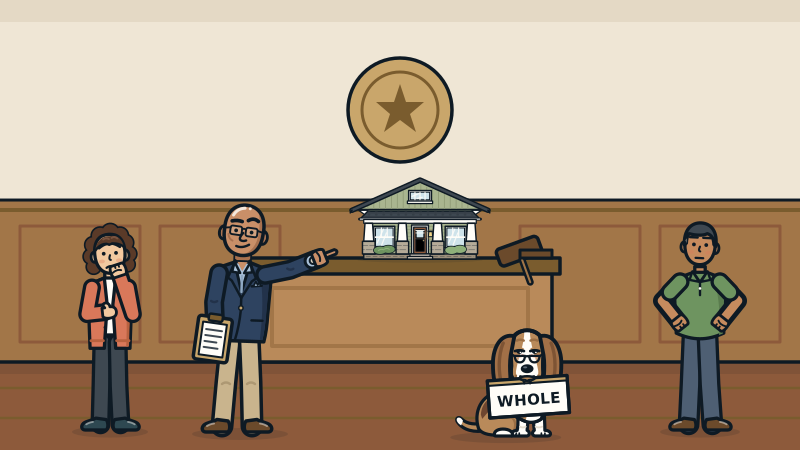
In most California partition cases, the court orders an appraisal by a disinterested, California licensed appraiser it appoints, who values the whole property as if one person owned it outright. The parties get notice and 30 days to object, then a hearing. Co-owners can skip the court appraisal by agreeing on a value or a valuation method.
What a partition action is
A partition action is a lawsuit between co-owners of real estate when they cannot agree on what to do with it. It often comes up after an inheritance. Three siblings inherit a house. One wants to live in it, one wants to sell, and one wants to rent it to a friend for a number nobody else has heard.
California Code of Civil Procedure 874.313 says that in an action to partition real property, the property is partitioned under the Partition of Real Property Act chapter unless all the co-owners (called cotenants) agree otherwise in a record. That chapter controls over other partition rules that conflict with it.
The first thing that chapter does is set the value. Everything after that, including whether a co-owner can buy out the others, runs off that number.
Three ways the court can set value
Under CCP 874.316, value gets set one of three ways:
- Agreement. If all cotenants agree on a value, or on a method of valuing the property, the court adopts it.
- The cost exception. If the court decides the evidentiary value of an appraisal is outweighed by its cost, it can hold an evidentiary hearing and set the value itself.
- A court-ordered appraisal. In every other case, the court determines fair market value by ordering an appraisal.
Option one is the cheapest and fastest. It also requires co-owners who can agree on something, which, if they could, they might not be in a partition action. Still, agreeing on a method (for example, one jointly chosen appraiser) is often easier than agreeing on a number.
What the court appraiser does
When the court orders an appraisal, CCP 874.316 says it appoints a disinterested real estate appraiser licensed in California. The appraiser determines the fair market value of the property assuming sole ownership of the fee simple estate. Then the appraiser files a sworn or verified appraisal with the court.
In plain words, the appraiser values the whole house as if one person owned all of it. Not a one-third share. Not the leftover slice after everyone stops speaking to each other. The whole property.
That matters later. If a co-owner buys out the others, CCP 874.317 prices each interest at the determined value of the whole property times that person's fractional share. A one-third owner's share is one-third of the full value.
A good appraisal here should read like it expects to be challenged, because it might be. Every comparable sale, every adjustment, and the market trend behind the effective date should be laid out where a judge can follow it.
Notice, objections and the hearing
CCP 874.316 sets out the timeline after the appraisal is filed:
- Within 10 days of filing, the court sends notice to each party with a known address. The notice states the appraised value, says the appraisal is available at the clerk's office, and says a party may file an objection within 30 days.
- No sooner than 30 days after the notice is sent, the court holds a hearing on value, whether or not anyone objected.
- At the hearing, the court may consider other evidence of value offered by a party, in addition to the court-ordered appraisal.
- After the hearing, and before it considers the merits of the partition, the court determines fair market value and sends notice.
Then the buyout window opens. Under CCP 874.317, a cotenant who did not ask for a sale can elect to buy the interests of those who did, with notice due no later than 45 days after the court's notice. The court then sets a payment date no sooner than 60 days out.
Thirty days is not much time to find, hire and get a written report from your own appraiser. Start early.
What I see in the field
Co-owners in these cases rarely disagree about the facts of the house. They disagree about what those facts are worth. One sibling remembers the house as the place they grew up. Another sees a list of repairs. The market sees neither memory. It sees the roof, the kitchen, the lot and what similar homes sold for.
When I prepare a report that may be offered as other evidence of value, I write it for a reader who has never seen the house and is looking for holes. Adjustments come from real paired sales, meaning similar homes that differ mainly in one feature, and from the wider market, not rules of thumb. Condition gets rated from what the record shows, not from anyone's description of it.
The goal is not to win. It is to give the court the clearest picture of the market. A report that teaches is harder to argue with than one that only announces a number.
What to do if you are headed toward a partition
- Try to agree on value or a method first. A jointly chosen appraiser can save the cost and delay of the court process.
- Gather the facts of the house: repair bills, permits, photos, and anything unusual about the lot or structures.
- Calendar the 30-day objection window as soon as the court's notice arrives.
- Decide early whether you want to buy the others out. The 45-day election window after the value is set moves fast, and you will need the money by the payment date.
- Consider a second opinion. A desktop review of the court appraisal can show whether its sales and adjustments hold up before the hearing.
This is general information. Your rights and procedure depend on the facts, so confirm with a California attorney.
Key takeaways
- California partition actions run under the Partition of Real Property Act chapter unless all co-owners agree otherwise in a record.
- The court usually orders an appraisal by a disinterested, California licensed appraiser.
- The property is valued as if one person owned it outright, not as a fractional share.
- Parties get notice and 30 days to object, and the court may consider other evidence of value.
- A buyout is priced at the full value times each co-owner's share.
People also ask
Can I bring my own appraisal to a partition hearing?
CCP 874.316 says the court may consider any other evidence of value a party offers, in addition to the court-ordered appraisal. Talk with your attorney about how to offer it.
Does a fractional share get a discount in a California partition?
The court appraiser values the property assuming sole ownership of the fee simple estate, and a buyout is priced at that value times the cotenant's fractional share.
What if no co-owner wants to buy the others out?
Under CCP 874.317, the case then moves on to the next stage of the partition rules (CCP 874.318). Your attorney can explain what that means for your property.
Sources
Got a question we haven't answered?
Suggest a topic or ask your own appraisal question. The best ones become posts.