What is paired sales analysis in an appraisal?
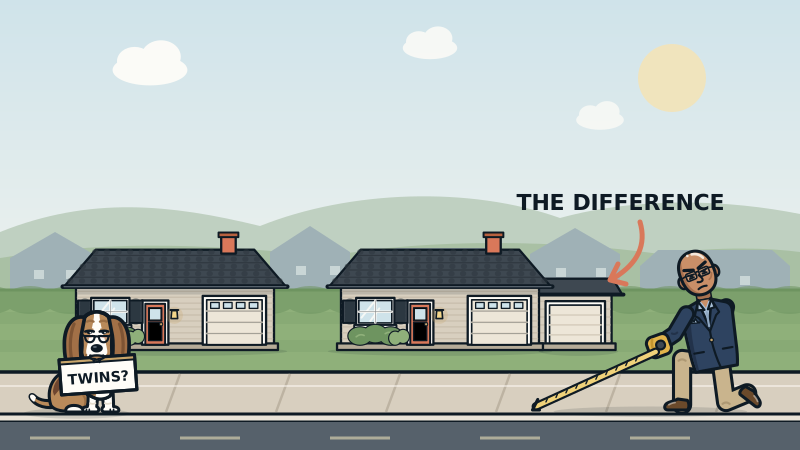
Paired sales analysis compares two sales that are nearly identical except for one feature, then treats the price difference as what buyers paid for that feature. Appraisers adjust out other differences first, use several pairs instead of one, and check for concessions or odd terms that can distort the gap. Fannie Mae lists it as an accepted method.
Two twins, one difference
Paired sales is the simplest honest way to answer the question every seller asks: what is my pool, garage or extra bedroom worth?
You find two homes that sold around the same time and are nearly the same in every way that matters. Same tract, same size, same condition. One has the feature and one does not. The price gap between them is the market's answer for that feature.
Say, hypothetically, two matching houses on the same street sell a few weeks apart. One has a three-car garage and one has a two-car garage. Everything else lines up. If the three-car house sold for more, that difference is evidence of what buyers paid for the extra bay. Not a guess. Not a cost sheet. A check someone actually wrote.
That is why I like it. The market already ran the experiment. I just have to find the results.
How a paired sale is built, step by step
- Gather the sales. Pull closed sales from the MLS and public records, close in time and location to each other.
- Isolate one difference. Pick two sales that differ mainly in the feature you are testing.
- Adjust out everything else first. If the garage house is also 200 square feet bigger, the size has to be accounted for before the leftover gap gets credited to the garage.
- Fix time and terms first. Sales concessions and market changes between the two sale dates come out before anything else. A seller credit or a rising month can look like a feature if you skip this step.
- Repeat with more pairs. Run several pairs for the same feature and reconcile them so one strange sale does not set the rate.
- Write it down. Addresses, dates, prices, sources and the math. If it is not documented, it did not happen.
Agents can do a version of this for pricing. Just know that step 3 and step 4 are where most kitchen-table versions fall apart. Two houses that look like twins in the listing photos can be cousins once you read the details.
Where paired sales break down
Paired sales has real limits, and a good appraiser tells you about them instead of hiding them.
- True twins are rare. Most neighborhoods do not hand you two identical homes that differ in exactly one thing and sold the same month.
- Hidden variables. Seller credits, unusual financing, a sale between relatives, or a buyer who had to have that exact house can all bend the gap. The MLS never shows the full picture, so sales get verified.
- Moving markets. If prices shifted between the two sale dates, the gap mixes the feature with the market. Time has to come out first.
- One pair is a story, not a rate. A single pair can say a pool is worth zero or a fortune. You need several pairs pointing the same way.
When local pairs run thin, I widen the search. The rate also has to hold up across the wider market and the larger set of sales, not only one block. When the narrow pairs and the wider measurement disagree, the one built on more sales usually wins.
One pair with a fantastic result is how the uncle at Thanksgiving prices his house. Five pairs that agree is how an appraiser does it.
What Fannie Mae says about supporting adjustments
Fannie Mae's rules (Selling Guide B4-1.3-09) say adjustments must reflect the market's reaction to differences between the properties. A note that says an adjustment was made is not enough. The report has to summarize the evidence and describe the data sources, tools and techniques used.
Fannie Mae lists paired sales alongside statistical analysis, modeling and other commonly accepted methods for supporting adjustments, including time adjustments. It also says appraisers should make market-based adjustments without regard to arbitrary limits on their size. That is the rule that ends the old 15% and 25% folklore for Fannie loans: the size of an adjustment is whatever the evidence supports.
For agents, this means you can ask a fair question when an adjustment looks off: what sales support this number? A well-built report should be able to answer that. How much the seller loves the feature is a different question, and nobody puts it on the grid.
How I use paired sales on a real file
Paired sales is one of my main tools, but I never let one method work alone. Here is my habit:
- Measure from real sales, not rules of thumb. A flat dollar figure per bedroom or per square foot that someone repeats at the office is not evidence. Pairs are.
- Read the market in real time. I test the most recent window the sales can support before falling back on a longer one. A 12-month average can hide a market that turned four months ago.
- Check the narrow answer against the wide one. A rate from four pairs in one tract should agree with what a bigger set of sales says. If it does not, I find out why.
- Use older sales carefully. A sale from a while ago can still teach something if it is adjusted to today's market and to the subject house. Lenders usually want recent comps on the grid, but the lesson still counts in the analysis.
- Show the work. Every rate in my reports comes with the named sales behind it, so the reader can check it.
A report should teach the market. A number with no evidence behind it teaches nothing. Paired sales makes that possible, because every rate comes with a receipt.
Key takeaways
- Paired sales compares two near-identical sales that differ in one feature to measure what buyers paid for it.
- Time, concessions and other differences have to be adjusted out before the gap means anything.
- Several pairs that agree beat one dramatic pair every time.
- Fannie Mae accepts paired sales and rejects arbitrary limits on adjustment size.
People also ask
How many paired sales does an appraiser need?
There is no fixed number in Fannie Mae's rules. More pairs that point the same way make a stronger case, and one pair alone is weak evidence.
Can agents use paired sales to price a listing?
Yes, and it beats price per square foot for valuing features. Adjust for time and concessions first, and verify the sales, because listing remarks rarely tell the whole story.
What if there are no good pairs in the neighborhood?
The appraiser widens the search to similar areas or a larger set of sales, or uses other accepted methods, and explains what was done in the report.
Sources
Got a question we haven't answered?
Suggest a topic or ask your own appraisal question. The best ones become posts.