Is there a limit on appraisal adjustments (the 15% / 25% rule)?
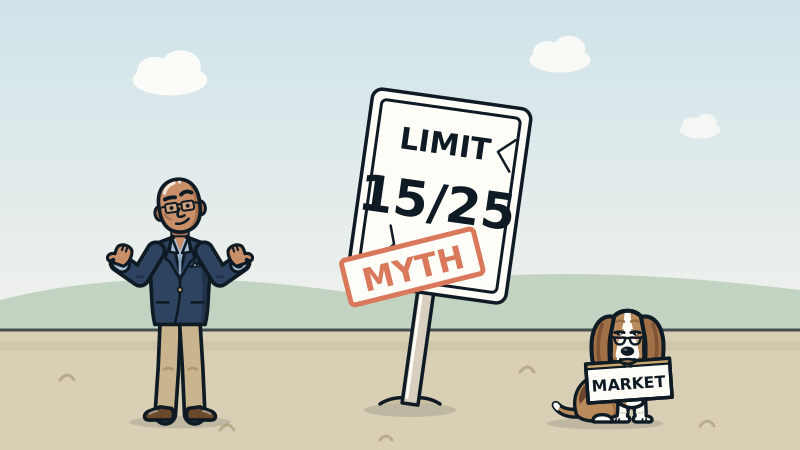
Not at Fannie Mae. Its Selling Guide says it has no specific limits or guidelines for net or gross adjustments, and the size or number of adjustments alone does not make a comparable unacceptable. What matters is whether each adjustment reflects the market's reaction. Very large adjustments can prompt an underwriter to check whether the value is supported.
Fannie Mae does not cap adjustments
The 15% / 25% rule still lives in a lot of loan officers' heads, right next to "rates will come back down by spring." For Fannie Mae loans, it is not a rule.
The Selling Guide says it plainly: Fannie Mae does not have specific limitations or guidelines for net or gross adjustments. It also says the number or dollar amount of adjustments must not be the only thing that decides whether a comparable sale (comp) is acceptable.
The guide goes further. It expects the appraiser to analyze the market and make market-based adjustments without regard to arbitrary limits on their size. In other words, an appraiser who shrinks an adjustment to stay under a magic percentage is doing it wrong.
Quick definitions, since these get mixed up. Net adjustment is the total of all adjustments on a comp, with pluses and minuses canceling out. Gross adjustment is the total of all adjustments added up as if they were all positive. Say a comp sold for $800,000 and got a +$40,000 adjustment for size and a -$30,000 adjustment for a pool. Net is +$10,000, about 1%. Gross is $70,000, about 9%.
Where the 15% and 25% numbers came from
The numbers were real once. Fannie Mae had a long-standing policy that required the appraiser to explain why a comp was used when its adjustments exceeded 15% net or 25% gross. It was an explanation trigger, not a ban, but many people treated it like a wall.
Fannie Mae removed that requirement around 2015, shortly before it issued Lender Letter LL-2015-02. In its own look back, Fannie Mae said the policy had the unintended effect of suppressing adjustment rates, because appraisers felt pressure from hard stops built on those numbers. Industry coverage at the time reported that more than 94% of comps on appraisal reports fell under the thresholds, which raised the concern that some adjustments were being kept artificially low.
Think about what that means. If everyone is staying under the speed limit on an empty road, maybe some of them are watching the sign instead of the road.
What underwriters actually look for now
No cap does not mean anything goes. Fannie Mae's guide sets real expectations:
- Adjustments must reflect the market's reaction. They have to come from how buyers in that market actually priced the difference.
- Comments must explain the adjustment. A statement that only says an adjustment was made is not acceptable.
- Time adjustments need evidence, and so does the decision not to make one.
- No positive adjustments for sales or financing concessions.
- The value must fall within the range of adjusted sale prices in the sales comparison approach.
And here is the part that keeps big adjustments honest. If the appraiser's adjustments are large enough to suggest the house may not fit its neighborhood, the underwriter must decide whether the value is adequately supported. Big adjustments are allowed. Big adjustments without support get questions.
Why a big adjustment can be the honest answer
Some houses do not have twins. A large lot in a tract of small ones. A remodeled 1960s house on a street of tired originals. A rural property where the nearest similar sale is in another zip code. In those cases, the best comps need large adjustments, and forcing them under 25% means either picking worse comps or shaving adjustments the market actually supports.
I would rather use a close match with a large, well-supported adjustment than a weak match with a small one. A small adjustment on the wrong comp is still the wrong comp, just with better manners.
The support is what matters. I measure adjustments from real sales: paired sales (two similar sales that differ mainly in one feature), the wider market around the subject, and the most recent window of sales the data supports. When a rate is large, I check it against a broader set of sales too. If the two disagree, the one built on more sales wins. That is what goes in the report, so an underwriter can follow the math without calling me.
FHA, VA and lender overlays are their own rules
Fannie Mae's rule covers Fannie Mae loans. FHA, VA, jumbo and portfolio lenders write their own guidelines, and individual lenders can add overlays on top. When Fannie Mae dropped the thresholds, industry coverage noted that HUD had not changed its own requirements at that time.
If your loan is not a conventional Fannie Mae loan, check that agency's current handbook and your lender's overlays before you treat 15% / 25% as dead or alive. Do not assume the rule from your last file applies to this one.
What to do when an underwriter flags large adjustments
- Ask for support, not a different number. The request should be for the evidence behind the adjustment. Asking an appraiser to hit a value is off limits.
- Look for the paired sales. A good report names the sales behind each large adjustment.
- Check the market context. If the subject is unusual for the neighborhood, the report should say so and explain why the comps were the best available.
- Check the range. The final value should sit inside the adjusted sale prices.
- Send real data if you have it. A closed sale the appraiser missed, with the address and why it fits, is useful. A Zestimate is not.
- Read the comments. If a large adjustment has no explanation beyond "adjusted for size," that is a fair item for a revision request.
A report that teaches the market answers these questions before the underwriter asks them. That is the report you want on your desk at 4:45 on a Friday.
Key takeaways
- Fannie Mae has no net or gross adjustment limit.
- The old 15% net / 25% gross explanation trigger was dropped around 2015.
- Every adjustment must reflect the market's reaction and be explained in the report.
- Very large adjustments can lead an underwriter to check whether the value is supported.
- FHA, VA and individual lenders may have their own rules, so check before you assume.
People also ask
Do appraisers still try to stay under 15% and 25%?
Some still use the numbers as a gut check, and some lenders still flag them. For Fannie Mae loans, the requirement is market support, not a percentage.
Are large adjustments a sign of a bad appraisal?
Not by themselves. They are a sign to look at the support. A large adjustment backed by paired sales can be more reliable than a small one with nothing behind it.
Can an appraiser be asked to drop a comp because its adjustments are big?
A lender can ask why the comp was used, and the report should answer with market support. The size of the adjustments alone is not a reason Fannie Mae accepts for rejecting a comp.
Sources
Got a question we haven't answered?
Suggest a topic or ask your own appraisal question. The best ones become posts.