Do you need an appraisal for a HELOC or home equity loan?
Usually yes, but it is often not a full interior appraisal. Many HELOC and home equity lenders use an automated value estimate, a desktop appraisal or a drive-by, depending on the loan amount and the lender's policy. Whatever method they use, the value it produces sets how much you can borrow.
The lender needs a value, not always a full appraisal
A HELOC (home equity line of credit) and a home equity loan both borrow against the part of your house you own outright. The lender has to know what the house is worth before it knows what that part is. So some kind of valuation happens almost every time.
What changes is how much effort goes into it. Bankrate's short answer to this question is "typically yes," and it notes that even the ads for no-appraisal HELOCs still use some valuation, such as an automated estimate, a desktop valuation or a drive-by. No-appraisal usually means no appraiser in your hallway. It does not mean nobody looked up your house.
Bankrate also cites a 2024 Mortgage Bankers Association study that found more than 75% of HELOC and home equity originations used an automated estimate or a desktop valuation. The full walk-through appraisal is the exception here, not the rule.
The menu of valuations and what they cost
Here are the typical options, with the time and cost ranges Bankrate gives. Your lender picks the method. You usually pay for it.
| Method | What happens | Typical cost |
|---|---|---|
| Automated valuation model (AVM) | A computer estimates value from public data in minutes | $10 to $25 |
| Desktop | An appraiser values the home from data and photos, no inspection | $75 to $200 |
| Drive-by | An appraiser views the outside from the street | $100 to $150 |
| Hybrid | Someone else inspects, an appraiser does the analysis | $150 to $300 |
| Full appraisal | Interior and exterior inspection plus comparable sales | $300 or more |
Bankrate notes that AVMs tend to go to borrowers with strong credit who want a small line compared with their equity. The bigger the ask, the more likely a human gets involved.
One note on the word hybrid. In lending, it means a third party visits the house and an appraiser finishes the job at a desk. At ValuedAudit, my private desktop and hybrid appraisal are the same product with no site visit at all: you tell me what you know about the house, send photos if you have them, and I build the value from records and market data.
How the value turns into your credit limit
Your equity is the home's current value minus what you still owe. Bankrate says most lenders cap total borrowing at around 80% to 85% of the home's value, counting your first mortgage and the new line together.
Here is a hypothetical. Say the house is valued at $800,000 and you owe $400,000. At an 85% cap, total borrowing tops out at $680,000. Subtract the $400,000 you owe and the most you could open is about $280,000. Drop the value to $760,000 and that same math gives you $246,000. A $40,000 change in value took $34,000 off the line.
That is why the valuation method matters more than people think. Bankrate also points out that borrowing close to the maximum can still get approved, but sometimes at a higher interest rate. Value moves your limit and can move your rate.
Why some bank loans can skip a full appraisal entirely
In 2019 the three federal banking regulators (the OCC, the Federal Reserve and the FDIC) raised the residential appraisal threshold from $250,000 to $400,000. For a bank they regulate, a residential loan of $400,000 or less can use an evaluation instead of an appraisal.
An evaluation is a lighter value estimate that still has to meet safe and sound banking practice. It is not a license-required appraisal. That is one reason a $90,000 HELOC from your bank may never involve an appraiser.
Two limits on that rule. It applies to regulated banks, and loans backed by a government agency or written to Fannie Mae or Freddie Mac standards follow those programs' rules instead. Credit unions and other lenders may have their own policies too, so ask yours which method it plans to use and why.
What an automated estimate misses
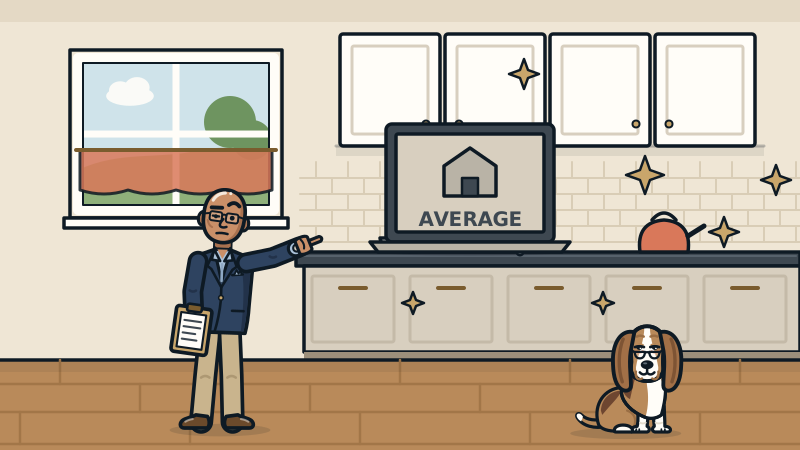
Bankrate says AVMs assume average condition and do not capture upgrades or disrepair. That is the whole problem in one sentence.
In my experience, buyers react to condition more than age. A 1964 ranch with a new kitchen, new baths and a new roof can sell well above a 2003 house with the original builder carpet. A computer reading public records sees two houses with three bedrooms and similar square footage. It has no idea which one smells like fresh paint and which one smells like 2003.
So if you have put real money into the house, a drive-by or a model may undersell it. If the house needs work, a model may oversell it, and the lender's own review may catch that later. Neither surprise is fun when you are counting on the money for a remodel or to pay off a credit card.
A Zestimate on your phone is not the lender's number either. Bankrate notes that online estimates are rough and that a gap between them and the appraised value does not by itself mean the appraisal is wrong.
What to do before you apply
- Ask the lender which valuation it will use at your loan amount. Ask whether you can request a full appraisal if the automated number comes back low.
- Make an upgrade list with dates, rough costs and permits: roof, kitchen, baths, windows, HVAC, solar. Hand it over no matter which method is used.
- Check your public record. If the county still shows two bedrooms after you permitted a third, a model will believe the county.
- Look at recent nearby sales of homes like yours. Bankrate suggests knowing them for context. Closed sales, not list prices.
- Ask about reuse. Bankrate says a recent appraisal from another loan, generally no more than six months old, may be accepted if it meets the lender's guidelines.
- Run your own math at 80% and 85% before you apply, so a value surprise does not wreck the plan.
Key takeaways
- Almost every HELOC gets some kind of valuation, but often not a full appraisal.
- Bankrate's ranges run from $10 to $25 for an AVM to $300 or more for a full appraisal.
- Most lenders cap total borrowing around 80% to 85% of value, so value sets your limit.
- Regulated banks can use an evaluation instead of an appraisal on residential loans of $400,000 or less.
- Automated estimates assume average condition, so give the lender your upgrade list.
People also ask
Can I ask for a full appraisal instead of an automated estimate?
You can ask. Some lenders will order one if you pay for it, especially when you can show upgrades the model missed. Policies vary by lender.
Who pays for a HELOC appraisal?
Usually the borrower, though some lenders absorb the cost of an automated estimate or run promotions. The lender, not you, chooses the appraiser.
Can I reuse the appraisal from my last refinance?
Sometimes. Bankrate says a recent appraisal, generally no more than six months old, may be accepted if it meets the new lender's guidelines. Ask before you pay for a new one.
Sources
Got a question we haven't answered?
Suggest a topic or ask your own appraisal question. The best ones become posts.