How accurate is the Zillow Zestimate?
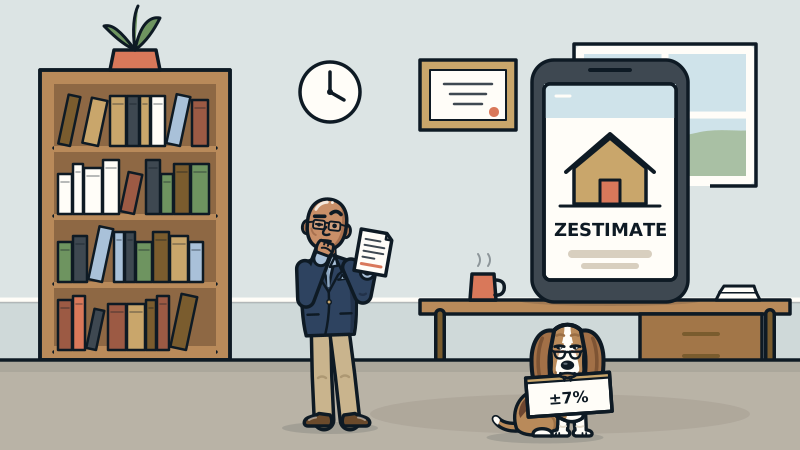
It depends on whether the home is for sale. Zillow reported a nationwide median error of 1.94% for homes on the market and 7.06% for homes off the market (March 2025 data). Median means half of estimates miss by more than that. Zillow also says the Zestimate is not an appraisal and cannot replace one.
What the accuracy numbers actually say
Zillow publishes how far off its estimates tend to be. As reported by The Close using Zillow's nationwide data from March 2025:
- Homes for sale: median error of 1.94%
- Homes not for sale: median error of 7.06%
The word that matters is median. It is the middle. Half of the estimates landed closer than that number, and half missed by more.
Here is a hypothetical. Your house is not for sale and the Zestimate says $1,000,000. A 7.06% error on that is about $70,600. If your house is typical, there is roughly a coin-flip chance the real value is more than $70,600 away from the screen in either direction. That is a nice used car's worth of maybe.
Why it is so much better on listed homes
The gap between 1.94% and 7.06% is the most interesting fact in this whole topic. Why is the estimate almost four times tighter once a house is listed?
Because once a home is on the market, the model gets fresh information: the list price, the photos, the description, the days on market. The Close notes that on-market estimates lean on those listing details, while off-market estimates rely mainly on tax and public records.
Think about what that means. A big part of the accuracy on listed homes comes from knowing what the seller and the agent decided to ask. The estimate gets good right about when you no longer need it to be. It is a weather forecast that becomes very accurate once you look out the window.
For a homeowner who is not selling, refinancing on a hunch, splitting an estate or planning a divorce, the 7.06% number is the one that applies.
Where the Zestimate gets its information
Zillow says the Zestimate uses county and tax assessor records, direct feeds from multiple listing services (MLS), and home details submitted by users. It also factors in market trends, and Zillow says it refreshes estimates multiple times per week.
That data is useful. It is also where the errors come from:
- Remodels the records never saw. The Close points out that renovations missing from public records can lead to undervaluation. The county may still think you have the 1979 kitchen.
- Problems the records never saw. Repairs that were needed but never disclosed, or an awkward layout, can lead to overvaluation.
- Uneven data. Not every MLS shares the same data with Zillow, and accuracy varies by state.
- Unusual homes. Tract homes in planned communities are easier for a model, because their neighbors are near-copies. A one-of-a-kind house on a hillside is not.
What I see in the field
The Zestimate is not my competition. It is a starting conversation. Zillow's own page says it is not an appraisal and cannot be used in place of one, and I agree with them completely.
Here is the difference in plain terms. A model sees records. An appraiser sees the house, then picks the sales a real buyer would have compared it to, and adjusts for what is different using what the market actually paid for those differences. Condition matters more than age to buyers in the markets I work. A model reading year built and square footage cannot see that the 1960s house down the street was taken to the studs and the 2005 house next to it still has every builder-grade fixture.
My approach blends data science with human judgment, and I was teaching it for almost two decades before anyone was calling a spreadsheet AI. Data finds the candidates. Eyes and evidence decide which ones are real.
When the Zestimate and the appraisal disagree
Here is a question appraisers hear all the time, with made-up numbers: "Zillow says $1.15 million and your report says $1.08 million. Who is wrong?"
Sometimes the appraisal is wrong. Appraisers are human, and a report with a bad comp or a missed upgrade deserves a second look. But a gap between a model and a report is not proof of an error by itself. With a 7.06% median miss on off-market homes, a gap of about $70,000 on a house in that price range is ordinary.
The fair test is the evidence. Pull the report and look at the comparable sales. Are they close, recent and similar? Do the adjustments make sense for what buyers in your area actually pay for a bigger lot or a newer kitchen? If you find a better sale the appraiser missed, that is useful. If your only evidence is the screen, it will not carry much weight, because the Zestimate is a summary of the same public data the appraiser already checked, minus the walk-through.
How to use a Zestimate without getting burned
- Treat it as a range, not a number. For an off-market home, think about plus or minus 7% as the middle of the pack, not the worst case.
- Check your home facts. Zillow says updates to your home facts are incorporated into the Zestimate. Wrong bedroom count or square footage? Fix it. Note that Zillow says some changes, like cosmetic ones, may not move the number.
- Look at the actual sales nearby. Find three to five homes that sold recently, are similar in size and condition, and sit close by. Those tell you more than any single estimate.
- Compare more than one estimate. If two models disagree by six figures, that tells you how uncertain the data is.
- Get a real appraisal when money or legal decisions depend on it. Pricing a listing, a trust or estate, a divorce or a family buyout needs evidence someone will sign their name to.
If you only need a solid read without a site visit, I offer a desktop appraisal for that. If you already have an appraisal and want it checked, a desktop review is a second opinion measured against the evidence.
Key takeaways
- Zillow's reported median error is 1.94% for listed homes and 7.06% for homes not for sale.
- Median means half of all estimates miss by more than that.
- Listed homes score better partly because the model can see the list price.
- Zillow says the Zestimate is not an appraisal and cannot replace one.
- Use it as a range, check your home facts, and look at real nearby sales.
People also ask
Why did my Zestimate jump when I listed my house?
Once a home is listed, the model gets the list price, photos and description. On-market estimates lean heavily on that listing information, so the number can move toward the asking price.
Can a lender use a Zestimate instead of an appraisal?
No. Zillow itself says the Zestimate is not an appraisal and cannot be used in place of one. Lenders use their own valuation rules.
How often does the Zestimate update?
Zillow says it refreshes Zestimates for all homes multiple times per week, though updates are occasionally delayed.
Sources
Got a question we haven't answered?
Suggest a topic or ask your own appraisal question. The best ones become posts.