How can I check my home's value myself?
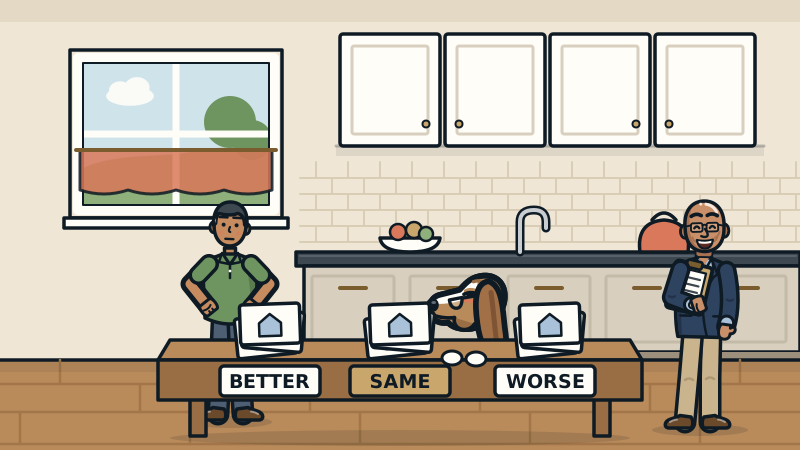
Start with recent sales of homes like yours, close by, and note how each one is better or worse than your house. Then sanity check with two tools: FHFA's House Price Index calculator, which shows average price change since you bought, and online estimates, which Zillow reports miss by a median 7.06% on homes not for sale.
The real answer lives in recent sales
Every method that works, mine included, comes back to one question: what did buyers recently pay for homes like yours, near yours?
Not what the neighbor is asking. Not what your brother-in-law heard at a barbecue. What actually closed. Active listings are wishes. Closed sales are receipts.
You can do a rough version of this yourself. It will not be an appraisal, and it will not hold up for a lender, a court or the IRS. But it will give you a grounded range, which is a lot better than a single number from a screen.
Here is how to do it, then two quick tools to check your work.
How to pull your own comparable sales
- Search sold homes on any major real estate site, filtered to your neighborhood and the last three to six months. If there are too few, widen the time first, then the distance.
- Keep it similar. Same type of home (detached, townhouse, condo), similar living area (within about 20% is a reasonable start), similar bedroom and bath count, similar lot.
- Stay close. Same subdivision or same side of the busy road beats a better match across town. Location is the one feature you cannot remodel.
- Look at the photos. Condition matters more than age to buyers. A remodeled 1960s house can beat an untouched 2005 house, so note which sales were updated and which were original.
- Pick your best three to five and write each one down with its price, date, size, and a short note: "bigger yard, older kitchen, backs to school."
If you can only find sales from a year ago, they still tell you something. Just know the market may have moved since then, which is where the next tool comes in.
Adjust for what is different
No sale is your twin. The trick is to ask, for each one: would a buyer pay more or less for this house than for mine?
- Theirs has a new kitchen and yours does not: their price is probably higher than yours would be.
- Yours has an extra bedroom: your value is probably higher than theirs.
- Theirs backs to a freeway: buyers usually pay less for that.
Professional appraisers measure these differences from actual sales instead of guessing. One way is paired sales, which means finding two sales that are alike except for one feature and seeing what the market paid for that difference. Rules of thumb like "a bathroom is worth $X" fail because the answer changes by neighborhood and price range.
You do not need exact dollars to get a useful result. Sort your sales into three piles: better than mine, about the same, worse than mine. Your value usually sits between the best "worse" sale and the lowest "better" sale. Congratulations, you have bracketed your house, which is the professional word for not making it up.
Check your work with FHFA's House Price Index
The Federal Housing Finance Agency (FHFA) publishes the House Price Index (HPI), a free measure of single-family home price changes. It is a repeat-sales index, which means it tracks the same properties as they sell or refinance over time.
The main purchase-only index is based on conforming, conventional mortgages bought or securitized by Fannie Mae or Freddie Mac. FHFA publishes the HPI at the national, state, metro, county, ZIP code and census tract levels, though its FAQ calls the ZIP and tract versions developmental, and the ZIP version is annual only.
FHFA also offers an HPI calculator that applies the index change between two dates. Here is a hypothetical: you bought for $600,000, and the index for your area rose 30% since then. The calculator would suggest about $780,000.
The catch: FHFA says the HPI measures average price changes. It knows nothing about your new roof, your cracked slab or the dog park they built behind you. It moves your old price forward by the area's average. It does not value your specific home.
Where online estimates fit
Automated estimates are fast and free, and they are fine as one more check. Just know the error range. The Close reports Zillow's nationwide median error at 1.94% for homes on the market and 7.06% for homes off the market, using March 2025 data. Median means half of all estimates miss by more than that.
On a $900,000 house that is not for sale, 7.06% is about $63,500. That is the middle of the pack, not the worst case.
Also skip the assessed value on your property tax bill as a market check. In California, Proposition 13 resets the assessed value mainly when a home changes hands or is newly built, and generally limits yearly increases to 2 percent. If you have owned for a while, that number may be far below market.
If all three of your checks (your own comps, the HPI and an online estimate) land near the same place, you can be fairly confident. If they are far apart, your house may have something the data cannot see, good or bad.
When to stop doing it yourself
A DIY range is perfect for curiosity, for deciding whether to refinance, and for keeping an agent's pitch honest. It is not enough when money or legal decisions ride on the number:
- Setting a list price on a home you are actually selling
- A trust, estate or date-of-death value
- A divorce or a family buyout
- Any dispute where someone else will challenge your number
For those, you want evidence someone signs their name to. If you do not need a site visit, my desktop appraisal uses the information and photos you provide, plus records and market data. Facts over feelings, with a license number at the bottom.
Key takeaways
- Recent, nearby, similar closed sales are the foundation of any home value.
- Sort your comps into better, similar and worse to bracket your value.
- FHFA's HPI calculator moves your purchase price by the area's average change.
- Zillow's reported median error is 7.06% for homes not for sale.
- Use a licensed appraisal when legal or big financial decisions depend on the number.
People also ask
Is the FHFA HPI calculator accurate for my house?
It applies the average price change for an area to your purchase price. It does not know about your upgrades, condition or lot, so it is a check, not a value for your specific home.
Can I use active listings to price my home?
Active listings show the competition, but they are asking prices. Closed sales show what buyers actually paid, so rely on those first.
How many comps should I use?
Three to five good ones beat ten loose ones. Pick sales that are recent, close by, and similar in size, type and condition.
Sources
Got a question we haven't answered?
Suggest a topic or ask your own appraisal question. The best ones become posts.