Can an FHA lender order a second appraisal if the first one is low?
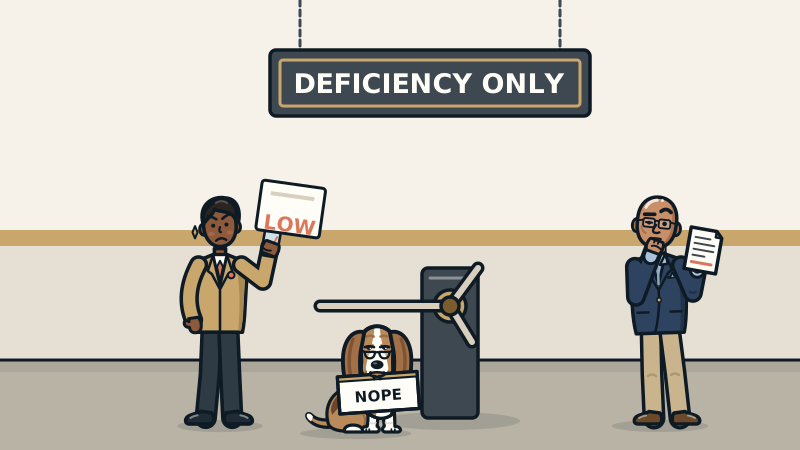
Not because it is low. Under HUD Handbook 4000.1, an FHA lender may order a second appraisal only when the underwriter finds the first one materially deficient and the appraiser cannot or will not resolve it. The lender must document why and pay for the second appraisal. For a low value, ask your lender for a reconsideration of value.
A low number is not a reason to start over
Every low appraisal produces the same wish: can we just get another one? On an FHA loan, the answer is usually no.
HUD Handbook 4000.1 says a second appraisal may only be ordered if the Direct Endorsement underwriter decides the first appraisal is materially deficient and the appraiser cannot or will not resolve the problem. HUD added extra steps to this rule in 2024 with Mortgagee Letter 2024-07, then removed them on March 19, 2025, with Mortgagee Letter 2025-08. The core rule stayed. Disappointment is not a deficiency. Neither is the seller's cousin saying the house next door sold for more.
The rule exists for a good reason. If lenders could order appraisals until one hit the contract price, appraisals would stop meaning anything. FHA closed that door on purpose.
That does not leave you stuck. It means the path runs through the evidence, not through a new appraiser.
What HUD counts as a material deficiency
HUD defines material deficiencies as problems that have a direct impact on value and marketability.
HUD's examples include:
- Readily observable defects affecting the occupants' health and safety that the appraiser did not report
- Outdated or dissimilar comparable sales when more recent or more similar sales were available
- Fraudulent statements or conclusions when the appraiser had reason to know or should have known
The 2024 letter added possible fair housing violations to that list. ML 2025-08 took that addition back out. If you believe a report reflects bias, you can still say so in writing to your lender and file a fair housing complaint with HUD.
Notice the pattern. These are errors in what the report says or leaves out. A value you do not like is not on the list. A report that ignored the three sales on your street in favor of houses across the freeway might be.
The test is whether the problem changes the value or the house's marketability. A typo in the owner's middle name is annoying. It is not material.
If you are a loan officer reading a report and something feels off, write down exactly what it is. A vague sense that the value is light will not get a second appraisal approved. A specific, documented defect might.
What the lender has to do
If the underwriter does find a material deficiency, the handbook puts real obligations on the lender:
- Try the appraiser first. A second appraisal is allowed only when the original appraiser is unable or uncooperative in resolving the deficiency. The normal path is to ask for a fix.
- Document it. The lender must fully document the deficiency and the status of the appraisal in the loan file.
- Pay for it. The lender must pay for the second appraisal. It cannot be passed to the borrower.
Two steps from the 2024 letter are gone. Lenders no longer have FHA permission to skip the original appraiser when they think the problem cannot be fixed, and the restored rule no longer includes the 2024 duty to report replaced appraisals to the state appraiser board.
A second FHA appraisal is still not a casual do-over. It comes with paperwork, and the lender pays for it, which is why lenders do not order them lightly.
Your real tool is a reconsideration of value
If you think the value is wrong, the right move on an FHA loan is a reconsideration of value, or ROV. It asks the original appraiser to look again at specific evidence.
From September 2, 2024, to March 19, 2025, FHA had a uniform borrower ROV process: one request per appraisal, up to five alternative comps, no cost to the borrower, required notices and a before-closing deadline. ML 2025-08 rescinded all of it.
Under the handbook language that applies now:
- The underwriter may request a reconsideration when the appraiser did not consider relevant information
- The underwriter must give the appraiser the relevant data
- The appraiser may charge an added fee if the data was not available on the effective date, but the borrower is not responsible for that cost when the delay was not the borrower's fault
Borrowers can still ask. NAR says borrowers are still entitled to request an ROV and should contact their lender to start one. Each lender sets its own steps, so ask for yours in writing.
Keep it focused either way. A short request with three strong sales beats a long letter with eight weak ones and the word "unfair" in bold.
What to do after a low FHA appraisal
- Read the whole report. Check the square footage, bedroom and bath count, condition notes and the comparable sales.
- Separate errors from opinions. A missed bathroom is an error. A different read of the market is an opinion, and it needs evidence.
- Find better comps. Look for recent, similar, nearby closed sales the appraiser did not use, and keep the list short. Ask your lender if it caps the number.
- Ask your lender for its ROV process, then write a short, factual request and submit it through the lender, not to the appraiser directly.
- If you believe the report is materially deficient, say so to the lender and explain why with specifics.
- Plan for the gap while you wait: renegotiate, bring cash, or use your contract contingency if you have one.
What I see in the field
Most low appraisals are not deficient. Some are. The difference comes down to evidence.
The contract price does not set value. One buyer and one seller agreeing on a number is a data point, not the market. If the comparable sales and the measured adjustments do not support that number, a second appraiser looking at the same sales is likely to land in the same neighborhood.
When an ROV works, it is usually because it handed the appraiser something they had not weighed: a better sale, a factual correction, an upgrade that did not make it into the report. That is facts over feelings, and it is the only kind of argument that moves a number.
Here is what a strong alternative comp looks like when I review one. It closed recently. It is close by, ideally in the same neighborhood and on a similar kind of street. It is about the same size, age and condition. And the person sending it can say in one sentence why it is a better match than a sale the appraiser used.
What does not work is a list of active listings, a Zestimate screenshot or a sale from two years ago with no adjustment for how the market has moved since. An older sale can still tell you something, but only if it is adjusted to today and to the house. Otherwise it is a souvenir.
Key takeaways
- FHA allows a second appraisal only when the first is materially deficient and the appraiser cannot or will not fix it.
- The lender must document the deficiency and pay for the second appraisal.
- HUD rescinded the 2024 FHA ROV process, including the one-request and five-comp limits, on March 19, 2025.
- You can still ask your lender for a reconsideration of value. Ask for its process in writing.
- A low value alone is not a material deficiency.
People also ask
Who pays for a second FHA appraisal?
The lender. HUD Handbook 4000.1 says the mortgagee must pay for a second appraisal ordered because the first was materially deficient.
Is there a limit on comps in an FHA ROV?
Not in HUD's current rules. The one-request and five-comp limits from ML 2024-07 were rescinded on March 19, 2025. Your lender may set its own limits, so ask.
Do I have to pay for an FHA reconsideration of value?
Under the current handbook language, the appraiser may charge an added fee if the data was not available on the effective date, but the borrower must not be held responsible when that was not the borrower's fault. Ask your lender how it handles costs.
Sources
Got a question we haven't answered?
Suggest a topic or ask your own appraisal question. The best ones become posts.