Do I need an appraisal to gift a house to my child?
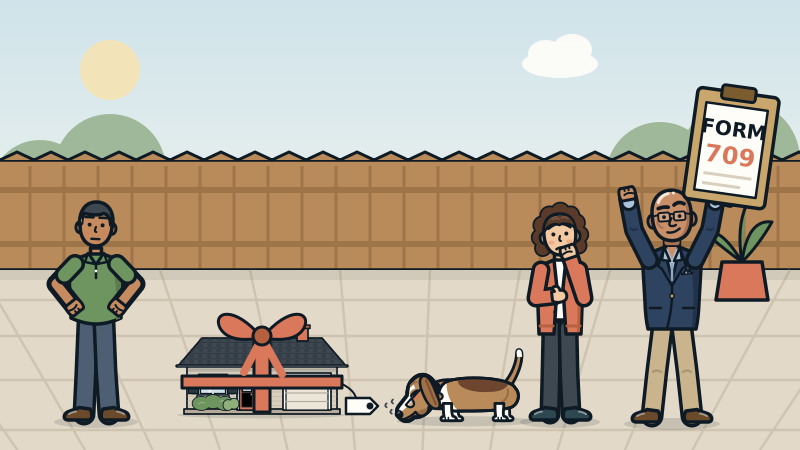
In practice, yes. Almost any house is worth more than the $19,000 annual gift tax exclusion, so the parent generally must file a gift tax return, Form 709. To adequately disclose the gift and start the IRS's time limit for questioning it, that return needs a qualified appraisal or a detailed explanation of how the value was set.
Gifting a house usually means filing a gift tax return
The IRS lets you give up to $19,000 per person per year without filing anything. That annual exclusion is $19,000 for both 2025 and 2026, according to the IRS. A married couple giving together can cover $38,000, but splitting a gift with your spouse requires a return of its own.
A house blows past that number before you finish writing the card. The Form 709 instructions say you generally must file if you gave more than the annual exclusion to any one person other than your spouse. The return is due by April 15 of the year after the gift.
Filing is not the same as paying. The IRS says the basic exclusion amount for 2026 is $15,000,000, after a 2025 law raised it. Gifts above the annual exclusion generally use up part of that lifetime amount first. The donor, not the child, is generally responsible for any gift tax.
Think of it this way: the IRS wants to hear about the gift even when it does not want a check. Tax treatment depends on the facts, so confirm your situation with a CPA or tax attorney.
Adequate disclosure is where the appraisal earns its keep
Here is the part most families never hear about. Under Treasury Regulation 301.6501(c)-1(f), if a gift is not adequately disclosed on the return, the IRS can assess gift tax on it at any time. No deadline. Ever.
Leaving that clock unstarted is like leaving the garage door open for 40 years and hoping nobody notices the bikes.
To count as adequately disclosed, the return or an attached statement must describe the property, identify the parent and the child and how they are related, and either explain the valuation method in detail or include a qualified appraisal. For real estate, the Form 709 instructions also ask for a legal description of each parcel, the street address if it is in a city, and a short statement of any improvements.
A parent could try to write that detailed explanation of value on their own. A qualified appraisal does the job in a form the IRS already recognizes, and it hands your CPA something solid to attach.
Who can do the appraisal, and what it must say
The same regulation spells out who counts as a qualified appraiser for a gift. The person must hold themselves out to the public as an appraiser or perform appraisals regularly, must be qualified for that type of property by background, experience and education, and cannot be the parent, the child, a family member of either, or anyone they employ. Your nephew who sells real estate is out.
The appraisal itself has to include the date of transfer, the date of the appraisal, the purpose, a description of the property, the appraisal process used, the assumptions and limiting conditions, the information considered, the reasoning, the valuation method and the specific basis for the value, such as comparable sales.
That list is basically a description of how I already write private reports. A narrative report walks the reader through the house, the sales that matter and how each adjustment was measured, instead of leaning on "in my opinion." When the IRS asks how you got the number, the report answers.
The value also has to be fair market value, not a family discount. A price a stranger would pay on the open market is the standard. If the house needs a new roof, that shows up in the comparable sales and the condition rating, with evidence, not as a favor to your kid.
The tradeoff: your child keeps your old tax basis
Before you gift, know what your child gives up compared with an inheritance.
The IRS gift tax FAQ says the general rule is that the person receiving a gift takes the same basis as the donor. Publication 551 adds a wrinkle: if the house is worth less than your basis at the time of the gift, the basis your child uses depends on whether they later sell at a gain or a loss. Part of any gift tax paid can also be added to basis.
Inherited property is different. It generally takes a basis equal to its value on the date of death. Here is a hypothetical to show the gap:
| Gifted while alive | Inherited | |
|---|---|---|
| Parent's original basis | $120,000 | $120,000 |
| Value when the child receives it | $1,000,000 | $1,000,000 |
| Child's starting basis | $120,000 | $1,000,000 |
On a later sale, that difference can be a very large taxable gain. Property tax is a separate question too. In California, Prop 19 has its own rules for parent-to-child transfers, and they deserve their own conversation with your attorney.
Steps before you sign the deed
- Talk to your CPA or estate attorney first. Compare gifting now with leaving the house in your estate, including income tax basis and property tax.
- Pick an independent, qualified appraiser. Not a relative and not someone either of you employs.
- Ask for the value as of the date of the gift. If the deed already recorded, a retrospective appraisal can value the house as of that date.
- Give the appraiser the facts: recent upgrades, known problems, permits and the property's legal description.
- Record the deed through your attorney or title company.
- File Form 709 by April 15 of the following year, with the appraisal attached.
- Hand your child a folder with your purchase records, improvement receipts and the appraisal. Their basis starts with your paperwork.
Key takeaways
- A house almost always exceeds the $19,000 annual exclusion, so Form 709 is generally required.
- Filing does not mean owing. The 2026 basic exclusion amount is $15,000,000.
- A qualified appraisal is the cleanest way to adequately disclose the gift and start the IRS clock.
- A gifted house generally keeps the parent's old basis, unlike an inherited one.
People also ask
Can I just use the property tax assessed value?
The return needs a qualified appraisal or a detailed explanation of the valuation method. An assessed value is not fair market value, so ask your CPA before relying on it.
What if I sell the house to my child for less than it's worth?
The difference between the value and the price can be a gift. That is a CPA question, and an appraisal is still how you document the value.
Does my child pay gift tax?
Generally no. The IRS says the donor is generally responsible for paying gift tax, though under special arrangements the person receiving the gift may agree to pay it.
Sources
Got a question we haven't answered?
Suggest a topic or ask your own appraisal question. The best ones become posts.