How do appraisers handle a rising or falling market?
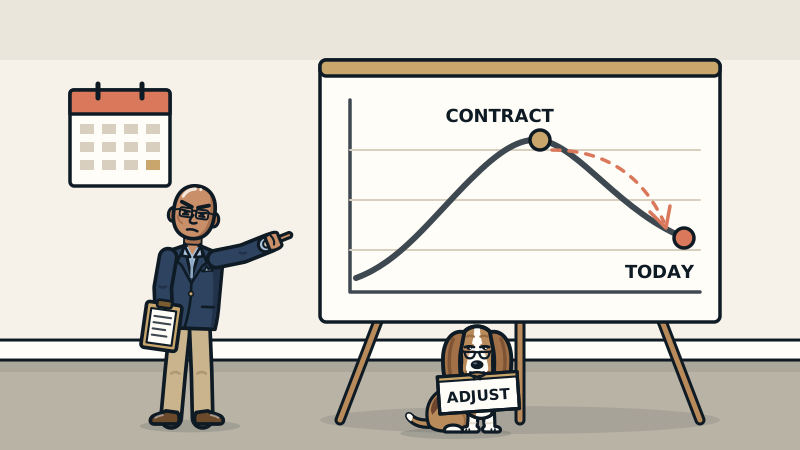
Appraisers check each comparable sale for market change between the date its contract was signed and the effective date of the appraisal. If prices moved, they make a time adjustment. Fannie Mae requires that adjustment, or the lack of one, to be supported by evidence such as price indexes, paired sales or statistical analysis.
An appraisal is a snapshot of one specific day
Every appraisal has an effective date. That is the one day the value is true for. Not last spring. Not next month. One day.
The catch is that the sales an appraiser compares your house to did not happen on that day. A comparable sale (comp) that closed last month probably went under contract a month or more before that. If the market climbed or slid in between, that comp's price is out of date. It is like checking yesterday's forecast and packing for today.
A time adjustment fixes that. It moves each comp's price from its contract date to the effective date: up if the market rose, down if it fell, zero if nothing changed. You will also see it called a market conditions adjustment.
Done well, it is the difference between an appraisal that describes the market and one that describes the market's memory of itself.
What Fannie Mae requires appraisers to do
For loans sold to Fannie Mae, the rules are in the Selling Guide. In plain words:
- Check every comp. The appraiser must analyze each comparable sale for changes in market conditions since its contract date.
- Support the call either way. Time adjustments, or the lack of them, must be supported by evidence. Leaving the line at zero is a decision, not a default setting.
- Show the work. The report must summarize the evidence and describe the data sources, tools and techniques used. Accepted methods include home price indexes, statistical analysis, modeling and paired sales.
- Report the dates. The appraiser should give each comp's contract date and closing date when the contract date is available.
- Use at least 12 months for the big picture. The overall market trend in the report must reflect at least 12 months of data. HousingWire reported that this minimum, along with new reporting language, started February 4, 2025.
Other loan programs, such as FHA, VA and private lenders, have their own rules, so the details depend on who the loan is for.
Why the 12-month trend and the adjustment can disagree
This part confuses a lot of people. The 12-month trend and the time adjustment answer two different questions.
The trend asks where the market has been heading over a full year. The time adjustment asks how much prices moved between one comp's contract date and the effective date.
Fannie Mae says it directly. A market can show a positive trend over 12 months and still be stable, or even declining, during the shorter stretch since a comp went under contract. A comp with a recent contract date will likely get no time adjustment at all, because there is no measurable change to adjust for.
Picture a market that ran up hard in spring and went flat by fall. The year looks great. A comp that signed in September does not care about April. Putting the yearly rate on it overstates value.
The opposite mistake is common too. FHFA research on appraisals from 2018 to 2021 found appraisers adjusted fewer than 10% of comps for much of that period, and when they did, the adjustments ran small. Where a price index predicted a 5% adjustment, the actual adjustment averaged about 3%.
How I read a moving market
I pride myself on adjusting in real time. A 12-month average is easy to defend and often wrong for the house in front of me. Here is what I look at:
- The shortest window the data supports. I test recent windows, like the last 30, 60 and 90 days, before I settle on anything longer. If a short window has too few sales to trust, I show that, and I show what does give the current read.
- The same house, sold twice. When a home sells and then sells again with no major changes, the difference is close to pure market movement. It is a type of paired sale: two sales that differ in one main way.
- Sale price compared to list price. When homes start closing under asking, the market is cooling before the price charts admit it.
- Days on market. The time a home sits before going under contract usually stretches out before prices fall.
- Pending sales and listings. They are not closed sales, but they show where buyers are standing this week.
Then I check the rate against the wider market, so one odd sale cannot set it. Facts over feelings, in both directions. A rising market does not get a free pass, and neither does a falling one.
What agents and loan officers can do
- Know the contract dates. Closing dates are easy to find. Contract dates drive the time adjustment and are harder to get. If you know them for nearby sales, share them through the proper channel.
- Bring recent pendings. Homes that went under contract in the last few weeks are the clearest evidence of where prices sit today.
- Read the time adjustment line. Check whether older comps were adjusted and whether the report explains why or why not. A blank line with no explanation in a moving market is a fair question.
- Ask with evidence, not adjectives. If you think the adjustment is wrong, a reconsideration of value request through the lender should point to sales, indexes or resales of the same house. My market is on fire is a feeling. Three resales with dates is a fact.
- Expect a falling market to cut the other way. When prices drop, older comps get adjusted down. That is the same rule working honestly, even when nobody at the closing table likes it.
A good report should teach you how the market moved. A number with no story behind it is a receipt, not an appraisal. If you cannot tell from the report why a comp was or was not adjusted, the report has more work to do.
Key takeaways
- Every comp must be checked for market change from its contract date to the effective date.
- A time adjustment, or the choice not to make one, has to be backed by evidence in the report.
- The 12-month trend and a single comp's adjustment can point in different directions.
- The best read of a moving market tests the most recent window the data can support.
- Challenge a time adjustment with dated sales and resales, not opinions.
People also ask
What is a time adjustment in an appraisal?
It is a change to a comparable sale's price to account for market movement between that sale's contract date and the appraisal's effective date. It can be positive, negative or zero.
Do appraisers use list prices to adjust for a rising market?
Listings and pending sales can support the analysis, but closed sales remain the main evidence. Pendings are useful because they show where buyers are agreeing to prices right now.
Can I ask the appraiser to add a time adjustment?
You can ask through the lender with a reconsideration of value request. It works best when it includes recent sales, resales of the same homes or index data that show the change.
Sources
Got a question we haven't answered?
Suggest a topic or ask your own appraisal question. The best ones become posts.