Do appraisers use pending sales and active listings?
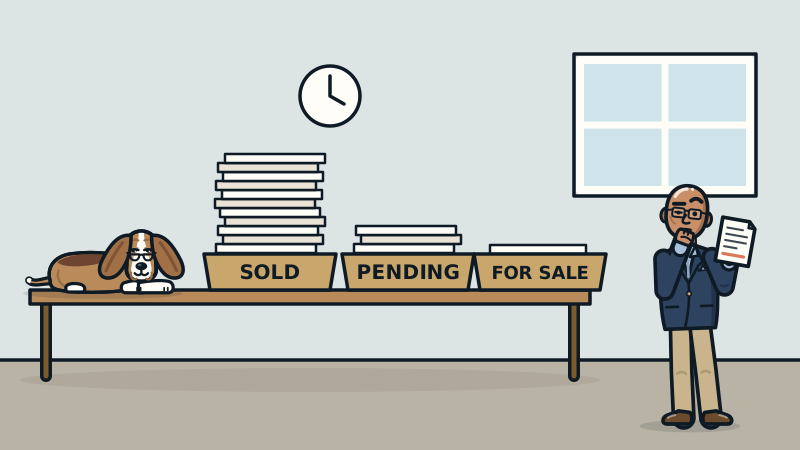
Yes, but mostly as supporting data. Fannie Mae requires at least three closed comparable sales, and allows contract offerings and current listings to support the analysis. Pending sales help show where the market is going, and listings show the competition. In some new projects, two pendings can replace one closed sale.
What the lender rules actually say
Agents ask me this one a lot, usually right after they send me a pending sale they are very excited about. Good news: I look at it. Here is what the rules say I can do with it.
For loans sold to Fannie Mae, the Selling Guide requires a minimum of three closed comparables in the sales comparison approach. It then says contract offerings and current listings can be used as supporting data, if appropriate.
So closed sales are the foundation. Pendings and listings are the supporting cast. They can show up on the grid, but they do not replace the three closed sales the guide requires in a normal assignment.
Other loan programs, such as FHA, VA and non-QM, have their own rules, and private work like estate or divorce appraisals is not bound by Fannie Mae at all. If you need to know exactly what a given loan requires, the lender's guidelines govern.
One more piece of the same guide is worth knowing. Fannie Mae says sales that closed within the last 12 months should be used, but the most recent sale is not always the best one. Its own example favors a nine-month-old sale with a time adjustment over a one-month-old sale that needs a pile of other adjustments. Recent matters. Similar matters too. When a pending sale is both, it is worth a close look even before it closes.
The new construction exception
There is one place where pending sales can do more. Fannie Mae allows an exception when the subject is in a new project, subdivision or PUD and is one of the first units to sell.
In that case, the appraiser may use two pending sales in the subject's project in place of one settled sale. The appraiser still has to use at least three settled comparable sales from outside the subject's project.
That makes sense. When a builder is selling the first phase, there may be no closed sales inside the gates yet. The pendings in the project tell you what buyers are agreeing to pay for that product, in that location, from that builder. The outside closed sales keep the analysis tied to the wider market.
It is the appraisal version of tasting the soup before it is done. You learn something real, but you still check the recipe.
Why pendings and listings matter so much in a moving market
Closed sales are history. A sale that closed last week was usually negotiated a month or more before that. In a market that is turning, that lag matters.
Fannie Mae's guidance on adjustments says time adjustments should be supported by other comparables, such as sales and contracts, whenever possible. It also accepts home price indexes, paired sales and other analysis, as long as the appraiser explains the method. Contracts are part of the preferred evidence.
Here is how I think about each piece:
- Closed sales tell you what the market paid.
- Pending sales tell you what buyers are agreeing to pay now, even if the final price is not public yet.
- Active listings tell you what buyers can choose instead. They often act like a ceiling. A buyer rarely pays more for your house than for a similar one down the street that is priced lower.
I pride myself in reading the market in real time. If the pendings and listings say the market shifted in the last 60 days, a report built only on six-month-old closings is describing a market that no longer exists.
How I use a listing without trusting the asking price
An asking price is a wish with a lockbox. It is not a sale. So I do not drop a list price onto the grid and call it evidence.
What I do instead is estimate where that listing is likely to close. I measure the sale-to-list ratio, meaning sale price divided by list price, on recent sales of similar homes. Then I apply it to the asking price. If similar homes have been closing at about 97% of list, a hypothetical $900,000 listing points to roughly $873,000, not $900,000.
With pendings, the contract price is usually not public until closing. Appraisers may call the listing agent to ask about terms, credits and the number of offers. If you are the agent, answer what you can share. It helps. If you can't share the price yet, sharing whether it went over or under asking still gives the appraiser direction.
Listings and pendings also go after the closed sales on my grid, not mixed in with them. A reader should never have to check a status field to figure out which numbers actually closed.
What agents can do to help
- Send pendings with context. Include list price, days on market, number of offers and any credits, if you are allowed to share them.
- Flag the listings that compete directly with the subject. Note condition and any reason a buyer would pick one over the other.
- Point out listings that are not comparable. A listing priced high and sitting for 90 days tells a different story than one that went pending in a weekend.
- Send it early. Give the packet at the inspection or through the lender before the report is written.
- Do not ask for a number. Give evidence and let it speak. Federal rules bar pressuring an appraiser toward a value.
And when a pending you sent finally closes, tell the lender. A closed sale is worth more than a pending one, and timing can matter if a reconsideration of value is needed later.
Key takeaways
- Fannie Mae requires at least three closed comparables.
- Pending sales and listings can be used as supporting data.
- In a new project, two pendings may replace one closed sale, with three closed sales from outside.
- Contracts and sales are the preferred support for time adjustments.
- A list price is not a sale. Good appraisers estimate where it is likely to close.
People also ask
Can an appraisal use only pending sales?
Not for a typical Fannie Mae loan. At least three closed comparables are required, with pendings and listings used as support.
Do expired listings matter to an appraiser?
They can. A home that sat and expired at a certain price can show where buyers would not go, which helps frame the top of the range.
How old can closed comps be?
Fannie Mae says sales closed within the last 12 months should be used, though an older sale with a time adjustment can sometimes be more comparable than a newer one.
Sources
Got a question we haven't answered?
Suggest a topic or ask your own appraisal question. The best ones become posts.