How far away can comps be in an appraisal?
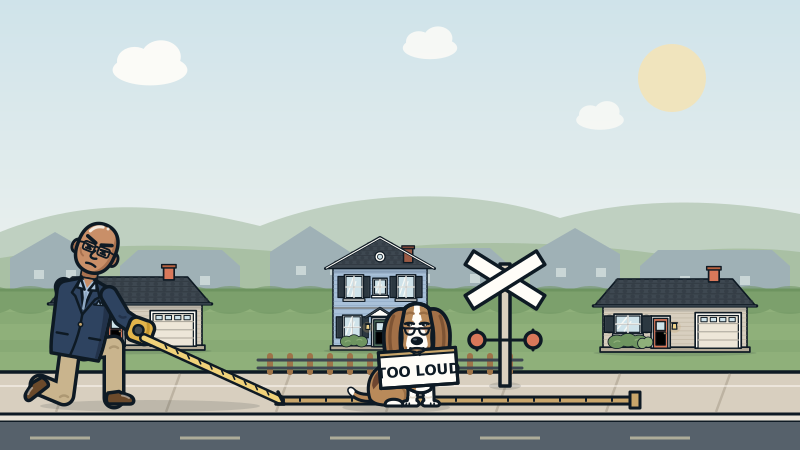
There is no fixed mileage limit in Fannie Mae's rules. Sales from the subject's own neighborhood and market area should be used when possible, and every comp's distance is reported as a straight line with a direction. Farther comps are allowed, especially in rural areas, when they give credible results and the appraiser explains why they were chosen.
There is no magic mile
Every agent has heard it from somebody: comps have to be within one mile. Some people say half a mile. The uncle who knows the market says you can use anything in the same zip code, including the house he sold in 1994.
Fannie Mae's comparable sales guidance does not set a mileage limit. What it does set is a reporting rule. The appraiser has to state the distance in miles, measured in a straight line between the two properties, with a direction attached. Its own example is "1.75 miles NW."
Individual lenders and appraisal management companies can add their own guidelines on top of Fannie Mae's. Those are their rules, and they vary. If someone tells you a one-mile limit is a Fannie Mae rule, ask them to show you where it is written. It is not in the comparable sales section.
One more detail matters here. Straight line means as the crow flies. A comp can be 0.4 miles away on paper and a 15-minute drive around a ravine in real life. The crow does not care about traffic. Buyers do.
The neighborhood matters more than the tape measure
Distance is the easy number. Location is the hard one. Fannie Mae says comparable sales from the same market area should be used when possible, and that sale activity from within the neighborhood is the best indicator of value.
That is why a sale three blocks away can be a worse comp than one a mile and a half away. Picture two hypothetical streets. One sits on the same side of the freeway, in the same school boundary, with the same kind of houses. The other is closer but backs onto a rail yard. The closer one wins on the map and loses with buyers.
Fannie Mae does allow comps from a competing neighborhood, meaning an area buyers treat as a real alternative. There are strings attached:
- The appraiser must say the comps come from a competing neighborhood.
- The report has to explain how that neighborhood compares and address the differences.
- The appraiser must not stretch the subject's neighborhood boundaries just to swallow the comps they picked.
That last rule exists because a neighborhood map should not grow like a waistband at Thanksgiving.
Rural properties play by the same rules with longer roads
Out in the country, the nearest truly similar sale might be miles away. Fannie Mae recognizes this. Rural properties often have large lots, and when the comparable sales are a considerable distance away, those sales can be used if they produce credible results.
The trade is explanation. The report must explain why those particular comps were selected. Fannie Mae even admits that where sales are scarce, properties that are not truly comparable may simply be the best available. That is honest, and it puts the burden where it belongs: on the appraiser to show the work.
If you list rural property, expect comps that look far by suburban standards. A 5-acre parcel with a barn and a well is not going to have a twin next door. It may not have one in the next valley. What it needs is a clear story of why each sale was picked and how the differences were handled.
What I see in the field
Facts over feelings. The right comp is the one buyers would actually have shopped against the subject, not the one closest to the mailbox.
When I have to go farther out, I do not guess what the location difference is worth. I measure it. Paired sales help here: two similar homes that sold around the same time, one in each area, show what buyers paid for the location itself. When I have enough sales, I check that number against the wider market too, so one odd sale does not set the rate.
I see two common mistakes. The first is grabbing the nearest sales even when a busy road or a school line separates them from the subject. The second is going far for a better price without saying why. Both fail for the same reason. The report does not explain the choice, and an unexplained choice is the first thing an underwriter circles.
Distance is never the problem by itself. Silence about distance is.
What to do if you are sending the appraiser comps
Agents can share sales with an appraiser through the proper channels. If you do, make them easy to use. Here is a checklist:
- Start inside the subject's own neighborhood. Those sales carry the most weight.
- Name any competing neighborhoods and say why buyers treat them as a real alternative: same schools, same housing type, same price level.
- Flag the barriers. Freeways, rail lines, commercial strips and school boundaries change value, even over short distances.
- Keep it recent. Fannie Mae says sales that closed within the last 12 months should be used, though an older sale can be used if the appraiser explains why. Adjusted to today, an older sale can still tell you something.
- Send closed sales first. On a Fannie Mae loan, a report needs at least three closed comparables. Actives and pendings help show direction, but they do not replace closings.
- Add the facts, not the hype. Upgrades, condition, concessions and anything odd about the sale. A sale with a seller credit needs that credit disclosed.
A tidy comp packet with reasons attached gets read. A list of 40 addresses titled "use these" gets the same look as a timeshare flyer.
Key takeaways
- Fannie Mae sets no mileage limit for comps. Lender overlays are separate and vary.
- Distance is reported in miles, as a straight line, with a direction.
- Same-neighborhood sales come first. Competing neighborhoods are allowed but must be named and explained.
- Far comps, common in rural areas, are fine when they produce credible results and the choice is explained.
People also ask
How many comps does an appraisal need?
Fannie Mae requires at least three closed comparable sales in the sales comparison approach. Appraisers often add more, including active or pending listings, to show where the market is heading.
Is distance measured by driving or straight line?
Fannie Mae requires a straight-line measurement between the properties, reported in miles with a direction, such as 1.75 miles NW.
Can an appraiser use a comp from another city?
Yes, if it sits in a competing market area buyers treat as a real alternative. The appraiser has to identify it as a competing neighborhood and explain the differences.
Sources
Got a question we haven't answered?
Suggest a topic or ask your own appraisal question. The best ones become posts.