How much does a home appraisal cost?
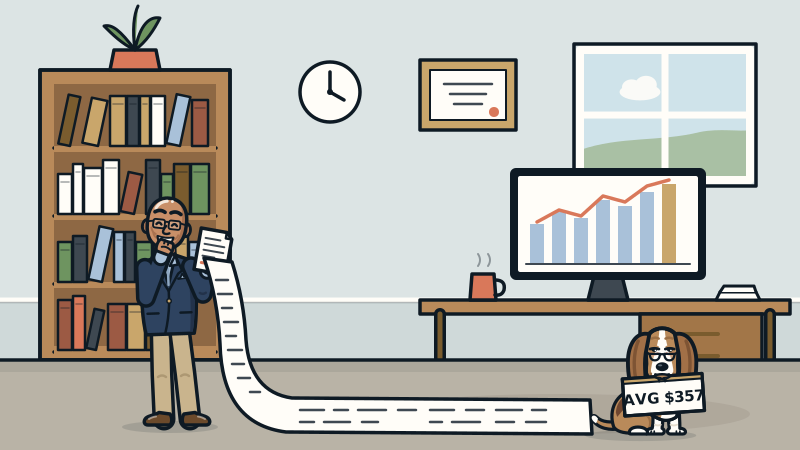
A typical single-family appraisal costs a few hundred dollars. Bankrate, using 2025 Angi data, puts the average at $357, with most between $314 and $423. Big cities, large or unusual homes, poor condition, few nearby sales and government-backed loans can push the fee higher. Seller-ordered pre-listing appraisals often run more.
The national numbers, and why yours may be different
Here are the published figures, and whose numbers they are:
- Bankrate (Angi 2025 data): average of $357 for a single-family home, with a typical range of $314 to $423. Cleveland averages about $325. Seattle averages about $500.
- Rocket Mortgage: a 2026 national average of $359.
- Redfin, for pre-listing appraisals a seller orders: about $450 on average, with most between roughly $300 and $550 and some as high as $900.
Notice the spread between Cleveland and Seattle. A national average is a little like a national average shoe size. It is a real number, and it fits almost nobody.
If you live in an expensive metro area, assume you are on the upper end of those ranges or above them. Your fee follows the cost of doing business where you live, and the amount of work your particular house takes.
What makes an appraisal cost more
The fee tracks time and difficulty. Bankrate lists the main drivers, and they match what I see:
- Location. Higher cost-of-living areas and larger cities cost more.
- Size. A bigger house takes longer to measure, photograph and analyze.
- Condition. A home with serious repair needs takes more documentation.
- Few comparable sales. Comparable sales (comps) are recent nearby sales of similar homes. When a house is rural, custom or one of a kind, finding and adjusting comps takes real research.
- Loan type. FHA and VA appraisals may cost a bit more than conventional ones because they carry extra property requirements.
- Access. Bankrate even notes weather like deep snow can raise costs.
Redfin adds that larger homes, unique properties and multi-unit buildings can cost significantly more. A duplex is two houses' worth of rent analysis wearing one roof.
Who pays, and who picks the appraiser
On a purchase or refinance, the lender orders the appraisal and the borrower usually pays for it as part of closing costs.
You do not get to pick the appraiser on a loan. Federal rules require the lender to keep the appraiser independent, which usually means the order goes through a third party such as an appraisal management company. Bankrate also notes that federal law requires appraiser fees to be reasonable and customary for the area.
When a homeowner orders an appraisal outside a loan, the homeowner is the client and pays directly. That covers pre-listing work, estates and trusts, divorce, and tax or planning questions. Those reports are often more involved, which is part of why they can cost more than a standard lender appraisal.
When paying for a private appraisal is worth it
A few hundred dollars sounds like a lot for a report, until you compare it to the price of guessing. Pricing a house $50,000 too high can mean weeks of sitting, price cuts and buyers who wonder what is wrong with it. Pricing it too low leaves money on the table that never comes back.
Here is where I see owners get the most out of an appraisal they order themselves:
- Before listing, when the online estimates disagree with each other and the neighbor who "knows the market" disagrees with all of them.
- Estates and trusts, when heirs need a value as of a date of death. Your CPA or attorney can tell you what the tax side requires.
- Divorce or a buyout between family members, where both sides need a number built on evidence instead of feelings.
- Unusual homes with an ADU, acreage or a major remodel, where the automated tools have the least to go on.
In each case, you are paying for facts over feelings. That is usually the cheapest line item in the whole deal.
What you actually get for the fee
It is easy to think you are paying for an hour of someone walking around with a tape measure. That part is the easy part.
Behind the visit, the appraiser pulls sales, checks public records, confirms details with agents, measures market trends and works out adjustments. An adjustment is the dollar difference the market puts on a feature, like an extra bathroom or a better location. Good adjustments are measured from real sales, not pulled from a rule of thumb.
Then it all has to be written up so an underwriter who has never seen your street can follow the logic. A good report teaches the market. It shows you why the number is the number.
I would rather pay a little more for that than save $50 on a report that reads like a fortune cookie.
How to keep your appraisal cost and delays down
- Ask for the fee in writing when you apply, and ask whether it is collected up front or at closing.
- Ask about rush fees. A tight closing date can add cost. Order early when you can.
- Have access ready on the first visit: gates unlocked, pets put away, attic and crawl space reachable. A second trip can cost money and time.
- Hand over a list of improvements with dates: roof, windows, kitchen, systems, permits. It saves research time and it helps the facts show up in the report.
- For a pre-listing or private appraisal, tell the appraiser up front about anything unusual: an ADU, extra acreage, units, or a big remodel. Quoting the right scope from the start avoids surprises.
One more thing. Price shopping is fine for a private appraisal. Just compare the scope, not only the fee. Two reports with the same price can be very different products.
Key takeaways
- Published national averages sit near $360 for a single-family appraisal.
- Location, size, condition, scarce comps and FHA or VA loans can push the fee up.
- On a loan the lender orders the appraisal and the borrower usually pays.
- Seller-ordered pre-listing appraisals average about $450 per Redfin, with complex homes higher.
People also ask
Do I get a copy of the appraisal I paid for?
Yes, on a first mortgage. Federal rules require the lender to give you a free copy promptly when it is done, or at least three business days before closing, whichever comes first.
Does a higher appraisal fee mean a higher value?
No. The fee is set by the work involved, never by the value. An appraiser who tied the fee to the result would be breaking the rules.
Can I use my own appraisal for a mortgage?
Generally not for a conventional loan. Fannie Mae does not let lenders use appraisals ordered by the borrower or other interested parties. The lender orders its own.
Sources
Got a question we haven't answered?
Suggest a topic or ask your own appraisal question. The best ones become posts.