How much value does an ADU add in an appraisal?
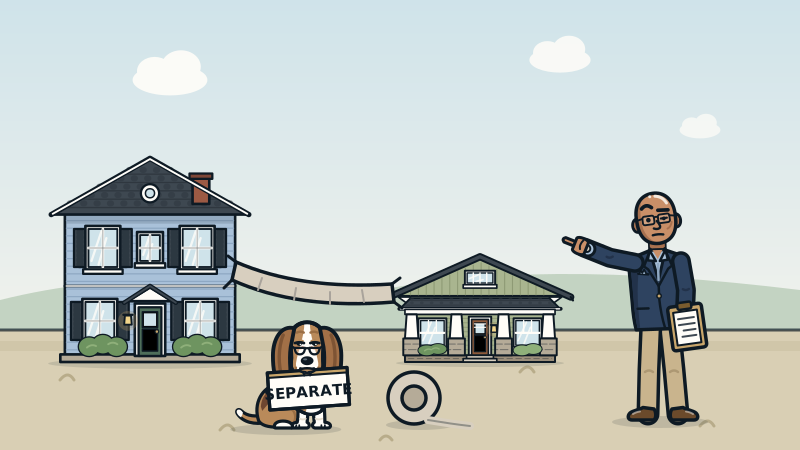
There is no fixed dollar amount. An ADU is valued on its own line in the appraisal, separate from the main house's square footage, and the adjustment comes from what local buyers actually paid for similar homes with and without ADUs. Because ADU sales are still thin, appraisers often have to look further back in time to find them.
An ADU is not extra square footage on the main house
This is the first thing I tell every investor who calls about an ADU. The backyard unit does not get added to the size of the main house. Ever.
Fannie Mae's rules say an ADU's living area should not be included in the finished above-grade square footage of the primary dwelling. It gets reported and adjusted on a separate line in the sales comparison grid. The one exception is an ADU inside or part of the main house, with interior access and above grade.
That matches my own rule. A detached structure never counts in the main house's square footage. A 2,000-square-foot house with a 600-square-foot cottage out back is a 2,000-square-foot house with a cottage. It is not a 2,600-square-foot house, no matter how the listing reads.
Fannie Mae also defines what counts as an ADU. It needs basic living, sleeping, cooking and bathroom facilities, on the same parcel as the main home. A detached studio with no kitchen is still worth something, but it gets valued like any other outbuilding, at whatever the market pays for it.
Why there is no national price tag
You will see numbers floating around. Here is a real one. FHFA looked at California purchase appraisals on loans backed by Fannie Mae and Freddie Mac. In 2023, the median appraised value of homes with ADUs was $1,064,000. Homes without ADUs had a median of $715,000.
That does not mean an ADU adds $349,000. Those are two different groups of houses. Homes with ADUs may sit on bigger lots, in pricier neighborhoods, or be bigger homes to begin with. FHFA itself says the ADU data is limited, may contain data entry errors, and needs further analysis. Comparing those two medians to price a backyard unit is like comparing the average price of cars with sunroofs to cars without and calling the gap the price of a sunroof.
The value of an ADU depends on the market it sits in. In one neighborhood, buyers pay a lot for rental income or space for a parent. In another, they treat a cottage as a nice-to-have. The only honest way to know is to measure it locally.
How an appraiser actually measures the ADU
The method is the same one I use for any feature: find sales that show the market's reaction.
- Paired sales. Two similar homes in the same area, one with an ADU and one without, sold around the same time. The difference in price, after adjusting for other differences, points to what buyers paid for the ADU.
- The wider market. When the subject's own street is too thin, I look across a larger area and more sales to confirm the rate. A number that only shows up in four sales is not proven.
- Older sales, adjusted forward. FHFA found ADUs were only 2.9% of California appraisals in 2023. Fannie Mae allows an aged closed sale to qualify as a comparable when the property has an ADU, and active or pending listings can be shown as extra support for marketability. An older sale can still tell you a lot if it is adjusted to today's market and to the house.
Fannie Mae also requires the report to describe the ADU and analyze its effect on value and marketability. A one-line "ADU adds value" with no support should not pass.
Permits and zoning matter
An ADU built without approval is not automatically worthless, but it does change how the appraisal works.
Fannie Mae's rules cover an ADU that zoning does not allow under any circumstance. For the loan to be eligible, the lender has to confirm the ADU won't put a future insurance claim at risk, the use has to fit the neighborhood and market, and the appraisal has to say plainly that the use does not comply with zoning. The report must show the improvements are typical for the market through at least two comparable sales with the same noncompliant use, with at least three closed sales in total. Older sales are acceptable if recent ones are not available.
The appraiser also has to decide whether the property is a one-unit home with an ADU or a 2–4 unit property. Fannie Mae points to things like separate utility meters, a separate postal address and whether the unit can legally be rented. That call can change the loan, the forms and the comps.
For the permit side, ask your city or county building department. For loan rules on counting ADU rent, ask your loan officer, because they vary by program.
What to do before your ADU is appraised
- Gather the paperwork: permits, final sign-off, plans, and the completion date.
- Write down what it has: bedrooms, bathroom, kitchen, separate entrance, separate meter, separate address if any.
- List the rent if it is leased, and how long it has been rented.
- Unlock it. Fannie Mae requires the ANSI measuring standard for ADUs on interior and exterior inspection appraisals, so the appraiser needs to get inside and measure.
- Share local ADU sales you know about, even older ones. Thin data is the hardest part of this work, and every real sale helps.
- Do not count the ADU in the main house's size in your listing or your notes. It confuses buyers and sets the wrong expectation.
What I see in the field
The biggest gap I see is between what an ADU cost to build and what the market will pay for it. Construction cost and market value are different questions. A $300,000 build can add less than $300,000 in value, or more, depending on who buys in that neighborhood and why. (That number is a hypothetical, not a price list.)
The second gap is between the owner's math and the buyer's math. The owner counts every dollar of rent. The buyer may count the ADU as a home office with a shower. The appraisal has to reflect the buyer, because the buyer is the market.
When an investor brings me an ADU project, I want to see the sales before I say anything about value. Facts over feelings, even when the feeling is a gorgeous little cottage with string lights.
Key takeaways
- An ADU never counts in the main house's square footage. It gets its own line.
- There is no national dollar value for an ADU. It is measured from local sales.
- FHFA's California medians compare different homes, not the value of an ADU.
- Thin data means older ADU sales may be used, adjusted to today.
- Unpermitted or zoning-noncompliant ADUs face extra lender rules.
People also ask
Does an attached ADU count as square footage?
Under Fannie Mae's rules, an ADU inside or part of the main home with interior access and above grade can be part of the main dwelling. Otherwise it is reported on a separate line.
Is my house with an ADU a duplex for appraisal purposes?
It depends on the facts. Fannie Mae has the appraiser look at things like separate meters, a separate address and whether the unit can legally be rented.
Will an unpermitted ADU kill my loan?
Not always, but it adds conditions. For an ADU zoning does not allow, Fannie Mae requires comparable sales with the same noncompliant use and confirmation that insurance claims are not at risk.
Sources
Got a question we haven't answered?
Suggest a topic or ask your own appraisal question. The best ones become posts.