Can I use the sale price or Zillow instead of an inherited house appraisal?
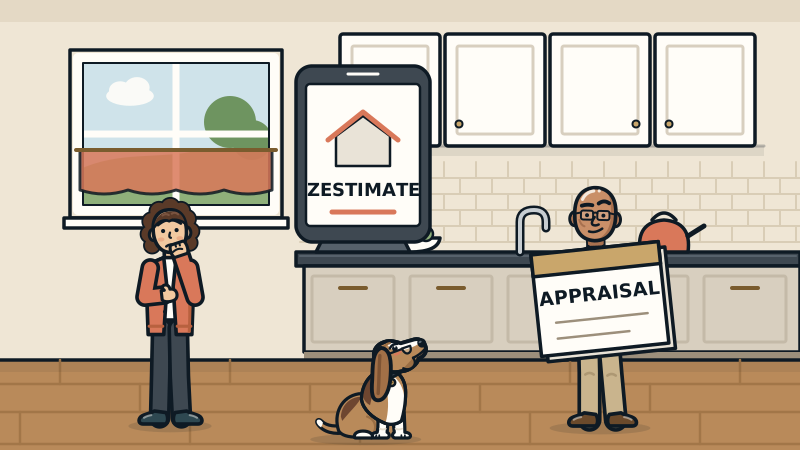
The sale price sometimes can. Zillow and the tax bill usually cannot. Kiplinger reports an arm's-length sale within six to twelve months, in a stable market with no changes to the house, can be strong evidence of date-of-death value. Assessments run low, agent opinions may not hold up with the IRS, and Zillow says a Zestimate is not an appraisal.
Each shortcut gets a different grade
When a parent dies, nobody wants another bill or another appointment. So it is natural to ask whether you can grab a number you already have. Here is how the three usual shortcuts score:
| Shortcut | Can it stand in for an appraisal? |
|---|---|
| Your own sale price | Sometimes, if the sale was arm's length, close to the date of death, in a stable market, with no changes to the house |
| Zestimate or other online estimate | No. Zillow says it is not an appraisal and cannot be used in place of one |
| Tax assessed value | No. It is usually well below market value, especially in California |
The value you need is the fair market value on the date of death, because that generally becomes your tax basis. Basis is the starting number used to figure your gain when you sell. A weak basis number is a weak tax return.
My view is facts over feelings. Any of these numbers can be a clue. Only one kind of evidence is built to answer the actual question: what would a willing buyer have paid a willing seller for this house, as it was, on that date?
When your own sale price can work
Kiplinger reports that the IRS and the Tax Court frequently accept the actual closing price as strong evidence of date-of-death value, as long as a few things are true. The sale happened within roughly six to twelve months of the death, the local market stayed stable, and the house was not changed in a big way before it sold.
The sale also has to be a real market sale. Federal estate tax rules define fair market value as the price between a willing buyer and a willing seller, neither forced to act and both reasonably informed. The same rule says value is not set by a forced sale price (Treasury Regulation 20.2031-1(b)).
That rules out a lot of family deals. Selling the house to your cousin for a handshake price is not arm's length. Dumping it to the first cash buyer because the estate needed money by Friday may not reflect market value either. And if you sold to a flipper who mailed you a postcard with a picture of a sad house on it, well, that is a story for your CPA.
Why the sale price can still miss
Even a clean sale can fall apart as evidence. Here is what I see in the field:
- The market moved. A sale eight months after death in a market that rose or fell sharply is not the same as a sale on the date of death. The gap has to be measured, not assumed away.
- The house changed. New paint, new floors and a staged living room sell a different house than the one that existed on the date of death.
- The sale was long after. Past about a year, the sale is an old clue, not proof.
- Someone needs a formal report anyway. Kiplinger notes an appraisal may still be needed for an estate tax return, a probate inventory or a dispute.
None of this means the sale is useless. A sale of the house itself is one of the best clues I can get. I simply have to test it against what other similar homes sold for around the date of death, and adjust for any changes and any market shift in between.
Why Zillow and the tax bill do not hold up
Zillow is clear about this. Its own page says the Zestimate is not an appraisal and cannot be used in place of one. It is a computer estimate that never walked through Mom's kitchen and does not know about the cracked foundation or the 2019 remodel.
The tax assessed value is worse for this job. In California, the assessed value is built from a base year value, and the state constitution limits yearly increases to that base value to 2 percent. If your parents bought decades ago, the assessment may look like a price from a different century, because it partly is.
Kiplinger says assessments are usually significantly lower than market value. A low number feels nice on a property tax bill. On a basis, it means more taxable gain when you sell. Agent price opinions are better than the tax bill, but Kiplinger reports they lack the formal method federal tax law expects, and they may not hold up under IRS scrutiny.
What to do instead
- Write down the date of death and the date and price of any sale.
- Save the sale documents, including the listing, the offer, the settlement statement and any repair credits.
- Gather photos from before any work was done. Old listing photos count.
- Ask your CPA whether the sale price alone is enough for your situation or whether a formal appraisal is needed.
- If you need an appraisal, order a retrospective one as of the date of death. If the house has already sold or been changed, a desktop appraisal can work from photos and records of how it stood on that date. At ValuedAudit, desktop and hybrid mean the same product: no site visit, built from what you share plus records and market data.
- Let the sale help. Give the appraiser your sale details. A good report will use it as evidence, not ignore it.
This is general information only. Tax treatment depends on your facts, so confirm with a CPA or tax attorney.
Key takeaways
- An arm's-length sale close to the date of death, in a stable market with no changes, can be strong evidence of value.
- A forced or family sale price may not reflect fair market value.
- Zillow says a Zestimate is not an appraisal. Tax assessments usually understate value.
- When in doubt, a retrospective appraisal can use your sale as evidence and test it.
People also ask
Is a CMA from my agent enough for an inherited house?
Kiplinger reports a CMA lacks the formal method federal tax law expects and might not hold up under IRS scrutiny. They are useful for pricing a listing, not for proving basis.
What if I sold the house to a family member?
A family sale may not be arm's length, so it is weaker evidence of fair market value. An appraisal as of the date of death is the safer route.
Can I get an appraisal after the house already sold?
Yes. A retrospective appraisal can value the house as of the date of death, and your sale becomes one more piece of evidence.
Sources
Got a question we haven't answered?
Suggest a topic or ask your own appraisal question. The best ones become posts.