Do interest rates affect home values?
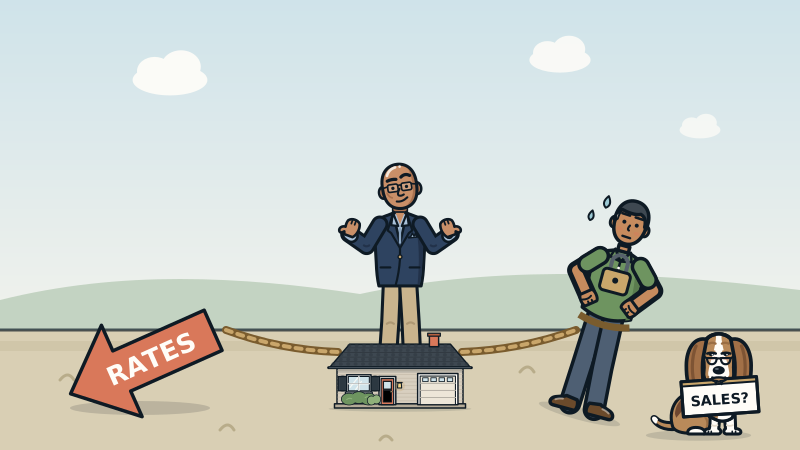
Yes, but not in a straight line. Higher rates shrink what buyers can afford, which pushes prices down. They also keep owners with cheap loans from selling, which cuts supply and pushes prices up. An FHFA study found the supply effect was bigger, so prices rose overall during the 2022 to 2023 rate spike.
Rates pull on prices from two sides
Everyone's uncle has a theory about rates. Rates go up, prices crash. Simple. Except the last few years did not follow the uncle's script, and there is a good reason why.
Rates work on the market in two ways at once. First, the payment. When rates rise, the same monthly budget buys less house, so buyers can pay less. That pushes prices down. Second, supply. An owner sitting on a low-rate loan does not want to trade it for a high one, so they stay put. Fewer homes for sale means more competition for the ones that are listed. That pushes prices up.
Which force wins depends on the market and the moment. That is why I never assume. I measure what the sales are doing.
What the FHFA research found about the lock-in effect
The Federal Housing Finance Agency published a working paper in March 2024 called The Lock-In Effect of Rising Mortgage Rates. It looked at what happened when rates jumped after 2022. Here is what it found:
- About 1.33 million home sales did not happen between the second quarter of 2022 and the fourth quarter of 2023, because owners were locked in by their old rates.
- That drop in supply raised home prices by 5.7%.
- The direct effect of higher rates lowered prices by 3.3%.
- For each percentage point that market rates sat above an owner's own rate, the chance that owner sold dropped by 18.1%.
Put the two price numbers side by side and you see the punch line. Higher rates did push prices down, but the shortage of sellers pushed harder. The golden handcuffs turned out to be a pretty good price support.
How a rate change hits a buyer's budget
Here is a hypothetical, just to show the math. Take an $800,000 loan on a standard 30-year fixed mortgage, principal and interest only:
| Rate | Monthly principal and interest |
|---|---|
| 6.00% | about $4,796 |
| 7.00% | about $5,322 |
One point of rate costs this buyer more than $500 a month. A buyer with a fixed monthly limit either borrows less, puts more down, or looks at smaller houses. That is the downward pull on price, and it shows up first in showings and offers, not in closed sales.
Buyers notice payments before headlines do. A buyer who was approved at one rate and then sees it move a point before locking can lose a bedroom off the wish list overnight.
What I see in the field when rates move
An appraiser does not add or subtract a line on the grid called "interest rates." Rates show up in the sales themselves. When rates climb, I usually see it first in the softer signals: fewer offers, longer days on market, more price cuts, more seller credits.
Those credits matter. A seller who pays down the buyer's rate is effectively paying part of the price. That is a concession, and in my view it is not worth dollar for dollar. The adjustment is whatever the market actually reacted with, and that has to be measured from real sales.
This is also why I read the market in real time. A 12-month average can hide a turn that happened in the last 60 days. If rates jumped three months before the appraisal, I want to know what sold in the most recent window the data can support, not what sold before buyers felt the new payment. A good report should teach you that, along with the number.
What to do if you are buying, selling or refinancing
- Sellers: price off the most recent closed and pending sales, not last spring's peak. If rates rose since your neighbor sold, the buyer pool changed even if the house next door did not.
- Sellers offering credits: know that a rate buydown or closing cost credit is part of the deal the appraiser looks at. It does not automatically raise the value.
- Buyers: get preapproved at the current rate and watch the monthly number, not the price alone. A quarter point can move your range more than a bidding war.
- Loan officers: when rates spike, expect more contracts with concessions. Make sure the appraiser has the full contract and any addenda.
- Homeowners refinancing: your value comes from what similar homes sold for, not from the rate on the new loan.
- Everyone: ignore anyone who says rates guarantee a crash or a boom. The research shows both forces at work at the same time.
Why rates and prices can rise together
People expect prices to fall the moment rates climb. Sometimes they do, locally. But the FHFA paper explains why national prices can keep rising: when millions of owners refuse to give up a cheap loan, the shelves stay thin. Buyers who must move, for a job, a baby or a divorce, still need a house, and they compete for whatever is listed.
The FHFA paper measured how much each force mattered from 2022 to 2023, and the supply squeeze won. That does not mean it wins every time or on every street. When both forces are pulling, the result can be small moves and mixed signals, which is exactly when a lazy average misleads people.
Your neighborhood can tell a different story than the national number. A starter-home area full of payment-sensitive buyers can feel rates harder than a high-end area where many buyers pay cash. Which is the whole reason value is measured locally, from sales, and not guessed from a mortgage rate on the evening news.
Key takeaways
- Higher rates lower what buyers can pay, which pushes prices down.
- Higher rates also keep owners from selling, which shrinks supply and pushes prices up.
- FHFA found the supply effect (+5.7%) beat the direct rate effect (-3.3%) in 2022 to 2023.
- Appraisers see rates through sales, days on market and seller credits, not a rate line.
- Your local market can react differently from the national numbers.
People also ask
Will home prices drop if rates go up?
Not necessarily. Higher rates reduce buying power, but they also reduce the number of sellers. Which effect wins depends on your local market, and it shows up in recent sales.
Does a lower rate raise my appraisal?
Not directly. The appraisal is based on what similar homes sold for. Lower rates can bring more buyers and stronger sales over time, and those sales then feed future appraisals.
Is a seller-paid rate buydown counted in the appraisal?
The appraiser reviews the contract, including concessions. Credits are analyzed based on how the market actually reacts to them, not added to the price dollar for dollar.
Sources
Got a question we haven't answered?
Suggest a topic or ask your own appraisal question. The best ones become posts.