Is my home value dropping?
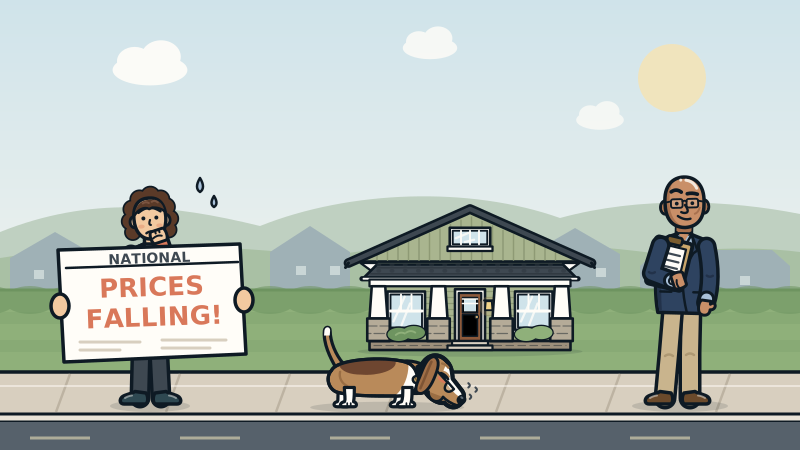
It depends on where you live. Zillow's September 2026 report showed typical U.S. home values up 1% from a year earlier, while 17 of the 50 largest metro areas were down. National numbers rarely match one street, so the real test is what homes like yours sold for recently, nearby.
What the national numbers said in fall 2026
Two big measures came out between late September and early October 2026. They told a similar story: slow growth overall, with soft spots.
- Zillow, September 2026: the typical U.S. home value was $366,913, up 1% from a year earlier and down 0.5% from August. Newly pending sales fell 8.5% from a year earlier. Zillow tied the slowdown to high mortgage rates and the usual fall slowdown. It cited a 7.28% mortgage rate from Freddie Mac.
- S&P Cotality Case-Shiller, July 2026: the national index was up 1.9% from a year earlier. The 20-city index was up 2.5% and the 10-city index was up 3.4%.
One more detail from S&P: after inflation, home prices had declined for 14 months in a row as of July 2026. Your house can be up in dollars and still be losing ground. It is the housing version of a raise that does not cover the grocery bill.
Some markets are down and some are not
Zillow counted 17 of the 50 largest metro areas with typical home values below a year ago. The list included Dallas, Houston, Atlanta, Phoenix, Seattle, Denver, Austin, Las Vegas and San Jose.
The Bay Area, where I work, split down the middle. Zillow had San Jose down 0.2% from a year earlier and San Francisco up 3.7%. Two big cities about an hour apart, moving in opposite directions.
Case-Shiller showed the same spread across its 20 cities. Chicago led at 6.9%, then New York at 5.8% and Cleveland at 4.2%. Seattle was weakest at negative 1.6%, followed by Las Vegas at negative 1.3% and Denver at negative 1.1%.
A national headline is an average of hundreds of local stories. Yours is one of them, and it may not be the one on the evening news. Your uncle who reads the headline and announces a crash at Thanksgiving is working from the average too.
Why your street can move differently than your metro
A metro number blends condos, starter homes, luxury homes and everything in between. Those groups do not always move together. Entry-level homes can draw a crowd while big homes sit, or the other way around.
Timing matters too. Case-Shiller's July numbers were released at the end of September, and they reflect closings from earlier months. Closings reflect contracts signed before that. By the time a headline reaches you, the market it describes has had time to change its mind.
And no index knows your house. It does not know you redid the kitchen, or that the house next door has stored a boat in the driveway since the last housing cycle. A single home's value comes from sales of similar homes, nearby, recently. Everything else is background music.
In my experience, buyers react to condition more than age. A well-updated older house can hold its value in a soft market better than a newer house that has not been touched. The index cannot see that difference. Comps can.
Signs your local market is softening
Prices are usually the last thing to move. Here is what tends to change first, and what I watch when I read a market in real time:
- Price cuts. Zillow reported 27.4% of listings had a price cut in September 2026, up from 26.2% a year earlier. Check the share near you.
- Days on market. When homes take longer to go under contract than they did a few months ago, buyers have more choices.
- Sale price compared to list price. Homes that closed over asking and now close under asking are a turn in progress.
- Inventory. Nationally, Zillow had active listings up 2.5% from a year earlier, the 34th straight month of annual gains. San Jose inventory was up 10.5%, while San Francisco was down 12.3%.
- Pending sales. Fewer contracts today means fewer closed sales to support prices next month.
None of these alone proves a drop. Together, measured over the last few months instead of the last year, they show which way the wind is blowing.
How to check your own home's value
- Pull sales of similar homes in your neighborhood from the last three to six months. Similar means size, bedrooms, lot and condition. The house with the same front door color does not count.
- Look at contract timing. A sale that closed last week may have been priced two months ago.
- Look at what is for sale now. Active listings are the competition. If they keep cutting prices, the market is negotiating on your behalf whether you like it or not.
- Treat online estimates as a rough range. They move with the data they receive and can trail a turn.
- Get an appraisal when the number matters. For a sale, refinance, divorce or estate, you want a value backed by evidence. At ValuedAudit, a desktop appraisal works without a site visit: you share what you know about the house and photos if you have them, and I work from records and market data.
Value is not a mood. If one neighbor says prices are crashing and another says they are booming, both of them need comps.
Does a dip matter if you are not selling?
If you plan to stay put, a small dip is mostly a number on paper. You do not lose anything until you sell or borrow against the house.
It does matter when a value has to be proven. A refinance, a home equity line, removing mortgage insurance, a divorce buyout or settling an estate can all depend on an appraised value as of a certain date. In those cases, the value on that date is what counts, so the timing of the appraisal matters.
Talk to your loan officer before you order anything on a loan, and to your attorney or CPA on a divorce or estate. Then let the sales do the talking.
Key takeaways
- In reports released in fall 2026, national home values were up about 1% to 2% a year, but many metros were down.
- In the Bay Area, Zillow had San Jose slightly down and San Francisco up in September 2026.
- Price cuts, days on market and sale-to-list ratios often move before prices do.
- Your home's value comes from recent nearby sales of similar homes, not a national index.
People also ask
How often do home values change?
Prices can shift month to month, and fall and winter often bring a seasonal slowdown. That is why recent sales and pendings say more about today than a yearly average.
Is Case-Shiller or Zillow more accurate?
They measure different things on different schedules. Case-Shiller's July 2026 numbers came out at the end of September, while Zillow's September typical home value came out in early October. Neither one values a specific house.
Should I sell before values drop further?
That depends on your local market and your own plans, not the national headline. Look at your area's recent sales, price cuts and pendings, and get an evidence-based value before you decide.
Sources
Got a question we haven't answered?
Suggest a topic or ask your own appraisal question. The best ones become posts.