Why do jumbo loans require two appraisals?
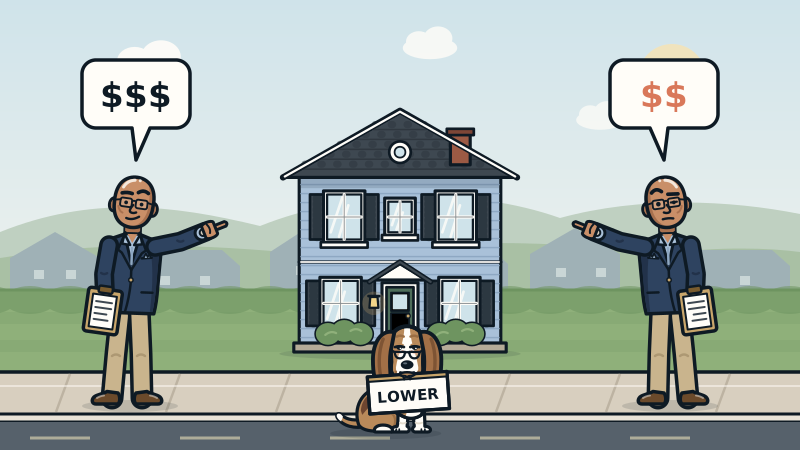
They don't always. A second appraisal on a jumbo loan is a rule set by the lender or the investor buying the loan, not a federal requirement. It usually kicks in above a certain loan amount, and many programs then use the lower of the two values. The extra appraisal is there because a bigger loan means a bigger risk.
First, what makes a loan jumbo
A jumbo loan is a mortgage bigger than the conforming loan limit, the maximum Fannie Mae and Freddie Mac can buy. For 2026, the Federal Housing Finance Agency set that limit at $832,750 for a one-unit home in most of the country.
In high-cost areas the limit goes higher, up to a ceiling of $1,249,125 for a one-unit home, which is 150% of the baseline. Alaska, Hawaii, Guam and the U.S. Virgin Islands have their own higher figures. Your county's exact number is on FHFA's published list.
Borrow one dollar over your county's limit and you have left conforming land. Fannie and Freddie's rule book no longer runs the show. The lender or the investor who buys the loan writes the rules, and those rules are usually stricter, because nobody wants to own a $2 million mistake.
Two appraisals is an overlay, not a law
There is no federal rule that says every jumbo loan needs two appraisals. When you hear that, what you are hearing is an overlay: an extra requirement a lender or investor adds on top of the basics.
That is why your friend's jumbo loan needed one appraisal and yours needs two. Different lender, different program, different trigger amount. Some programs never require a second report. Some require it on every loan above a set size. Some only require it on refinances, flips or certain property types.
The logic is risk. On a high-value home, there are often fewer truly similar sales nearby, and the appraiser has to use more judgment. Judgment is where two careful people can land in different places. A second appraisal is the lender's way of checking that the first one was not an outlier on the high side.
The best way to find out is boring and reliable. Ask your loan officer for the program's appraisal section before you write the offer.
What one real jumbo program requires
To make this concrete, here is what one lender's published guide says. Towne Mortgage's Core Jumbo Program Guide is a good example of how specific these rules get:
- When: a second appraisal for purchases over $1,500,000 and refinances over $1,000,000, plus all 2-unit properties and qualifying flips.
- Which value counts: the lower of the two appraisals.
- Who: the second appraiser must be different and not affiliated with the first appraiser or that appraiser's company. Ordering both through the same AMC is allowed.
- No hand-me-downs: transferred appraisals or reports done for someone else are not eligible.
- Age limit: appraisals must be dated within 120 days before the note date, and an update cannot stretch that.
- Depth: a full interior and exterior appraisal with at least six comparable sales, and no inspection waivers or exterior-only reports.
That is one program. Yours may set the trigger lower, higher or not at all. The point is that these rules are written down, so get them in writing early.
Why the lower value usually wins
If one appraisal says $2,400,000 and the other says $2,300,000, a lower-of-two program lends on $2,300,000. That can feel unfair. It is not personal. The lender is buying insurance against being wrong on the high side.
For a buyer, this matters in two places. Your down payment math is based on the lower number. And if the contract price is above that lower value, you are covering the gap or renegotiating.
Here is how I look at it. The contract price does not set value. One buyer and one seller agreed on a number, and that is a data point, not the market. Two independent appraisals that land near each other are strong evidence. Two that land far apart are a sign the house is hard to value, and that is worth knowing before you own it.
A spread between two reports is not proof that either appraiser blew it. It usually comes from different comparable sales choices or a different read of the property's condition. If one report has a real factual error, that is what a reconsideration of value is for.
What to do if your loan needs two appraisals
- Ask for the trigger in writing. Get the loan amount where a second appraisal starts and whether the program uses the lower value.
- Budget for two fees. Ask your loan officer who pays and when.
- Order early. Two appraisers means two schedules. Do not let them crowd your contingency deadline.
- Watch the 120-day clock or whatever age limit your program uses, especially on a long escrow or a new build.
- Do not plan on reusing an appraisal from another lender. Many jumbo programs will not take a transferred report.
- Give both appraisers the same facts sheet: upgrades with dates, permits, square footage records and any recent sales you think matter.
- Plan the gap before it happens. Talk with your agent about what you will do if the lower value comes in under the price.
What I see in the field
In the San Francisco Bay Area, high-value homes are not rare, but truly similar sales can be. A view lot, a custom build or a big remodel on a short street may have only a handful of real comparables. That is exactly where adjustments have to be measured from actual sales instead of guessed.
The appraisals that hold up are the ones that teach the market. They show which sales were used, why, and what the market actually paid for each difference. Facts over feelings. When both appraisers do that, the two numbers tend to tell the same story.
The appraisals that cause trouble are the ones that lean on price per square foot like it is a law of physics. A 4,000 square foot house is not worth twice a 2,000 square foot house just because the calculator says so.
Key takeaways
- A jumbo loan is above the conforming limit: $832,750 for a one-unit home in 2026, up to $1,249,125 in high-cost areas.
- Two appraisals are a lender or investor overlay, and thresholds vary by program.
- Many programs use the lower of the two values for the loan.
- Some programs reject transferred appraisals and cap report age, often at 120 days.
- Get the program's appraisal rules in writing before you write the offer.
People also ask
Who pays for the second appraisal on a jumbo loan?
It depends on the lender and the program. Ask your loan officer before the appraisals are ordered, so the cost shows up on your loan estimate instead of surprising you at closing.
Can I choose the second appraiser?
No. Appraiser independence rules apply to jumbo loans too. The lender or its AMC selects both appraisers, and some programs require the second appraiser to be unaffiliated with the first.
What if the two appraisals are far apart?
Many programs simply use the lower value. If you believe the lower report has a factual error or missed better comparable sales, ask your lender about a reconsideration of value.
Sources
Got a question we haven't answered?
Suggest a topic or ask your own appraisal question. The best ones become posts.