Do I need an appraisal when a parent's house is in a living trust?
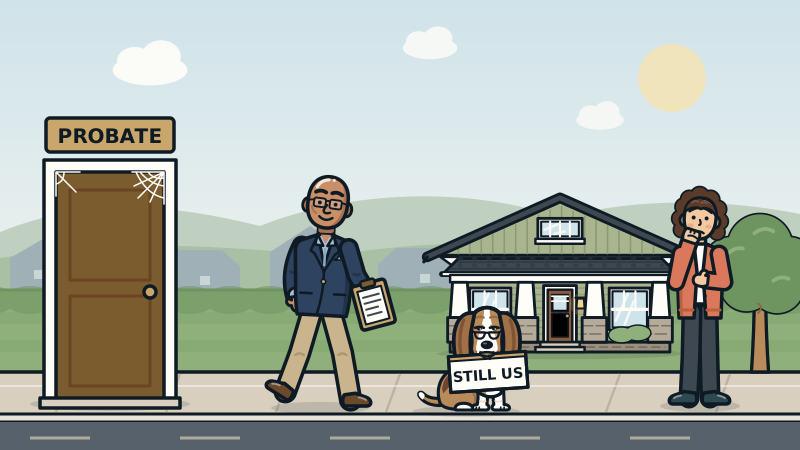
Usually, yes. A living trust avoids probate, but the house still generally takes a new tax basis equal to its fair market value on the date of death, whether or not it went through probate. A date-of-death appraisal documents that value for basis, for dividing the trust fairly and for any later sale.
Avoiding probate does not avoid the value question
Your parents did the smart thing. They put the house in a living trust so the family could skip probate. Congratulations, you skipped the courthouse. You did not skip the math.
Federal tax law says property acquired from someone who died generally takes a basis equal to its fair market value on the date of death (Internal Revenue Code section 1014(a)). That rule cares about the death, not the paperwork. A house that passes through a trust gets the same treatment as one that goes through probate.
Basis is the starting number used to figure gain when the house sells. If the trust or the beneficiaries sell later, someone will need to prove what the house was worth on the date of death. A trust document does not include that number. The market does, and an appraisal is how you write it down.
Three jobs the appraisal does for a trustee
As a successor trustee, you are suddenly in charge of a house, a set of beneficiaries and a lot of opinions. The appraisal helps with all three.
- Tax basis. It documents the date-of-death value the CPA will use when the house is sold, so gain is figured from the right starting point.
- Fair division. If one sibling keeps the house and the others get cash or other assets, everyone needs to agree on what the house is worth. A neutral appraisal gives the family one set of facts instead of four Zillow screenshots.
- Sale pricing. If the house is going on the market, a current value helps set a realistic list price. A date-of-death value and a current value can be different numbers, especially if months have passed.
One appraisal can sometimes answer two of those questions, if it is ordered with both dates in mind. Tell your appraiser everything you need before the work starts, so it gets scoped once instead of twice.
Here is how the date-of-death part works. It is a retrospective appraisal, meaning a value as of a past date. I look at sales of similar homes that closed around the date of death, the market trend at that time and the condition of the house on that date. Then I adjust each sale for its differences from the house, using what the market actually paid for those differences, and show the reader every step.
If the house was remodeled, emptied or damaged after the death, the appraisal has to describe it as it was, not as it is. Old photos, listing photos and receipts help a lot. A shoebox of dated pictures can be worth more to me than a stack of opinions.
The probate referee is an option, even without probate
California has state-appointed appraisers called probate referees. The State Controller's Office says they provide prompt, low-cost appraisals of estate assets, and that their services are also available for non-probate trust administration.
So a trustee has choices. You can hire a probate referee, or you can hire a private appraiser who is state certified for residential property. Either way, ask what the report will contain. A value with no comps attached is hard to defend if a beneficiary or the IRS asks questions later.
What I see in the field: the house is usually the biggest asset in the trust, and it is the one most likely to start a family argument. Nobody fights over the toaster. They fight over the house, and they fight harder when the value came from nowhere. A report that shows the sales, the adjustments and the reasoning settles a lot of those fights before they start.
Prop 19 and the property tax side
There is a California property tax question too. Under Proposition 19, a transfer of the family home from parent to child can qualify for the parent-child exclusion from reassessment, within limits. The Board of Equalization says transfers of property held in a trust are eligible, as long as the other requirements are met. It also says that for an inheritance, the date of transfer is the date of death.
A few of the requirements, per the BOE:
- The home must have qualified for the homeowners' or disabled veterans' exemption based on the parent's ownership and occupancy.
- The child must make it their principal residence within one year and file for the exemption within one year.
- The exclusion claim is generally due within three years of the transfer, or before a transfer to a third party, whichever is earlier.
- The exclusion has a value limit tied to a base amount of $1 million, adjusted every other February 16.
Those details depend on timing and on who receives the home. This is general information only. Confirm your situation with a CPA, tax attorney or the county assessor.
What a successor trustee should do first
- Get the date of death and several copies of the death certificate.
- Photograph the house before anything changes. Before the cleanout, before the painter, before your brother-in-law takes the good tools.
- Decide what the appraisal is for: basis, division, sale price or all three. Tell the appraiser.
- Choose a referee or private appraiser, and ask to see a sample report.
- Consider a desktop appraisal if the house has already changed. At ValuedAudit, desktop and hybrid mean the same product: no site visit, built from what you share about the home plus records and market data.
- Look at Prop 19 deadlines early if a child plans to move in.
- Keep the report with the trust records and give a copy to the CPA.
Key takeaways
- A trust avoids probate, but the house still generally gets a date-of-death value basis.
- A date-of-death appraisal supports basis, fair division and pricing.
- California probate referees are available for trust administration, and so are private certified appraisers.
- Prop 19 can apply to homes held in trust, with occupancy and filing deadlines.
People also ask
Does the trustee have to use a probate referee for a trust?
The State Controller describes referee services as available for non-probate trust administration. A trustee can also hire a private state-certified appraiser.
Can the appraisal be done months after the death?
Yes. A retrospective appraisal values the house as of the date of death using sales from that period, even if the report is written later.
Do we need a new appraisal to sell the trust house?
Not always, but a date-of-death value and a current market value can differ. If time has passed, a current value helps set the list price.
Sources
Got a question we haven't answered?
Suggest a topic or ask your own appraisal question. The best ones become posts.