What do appraisal condition ratings C1 to C6 mean?
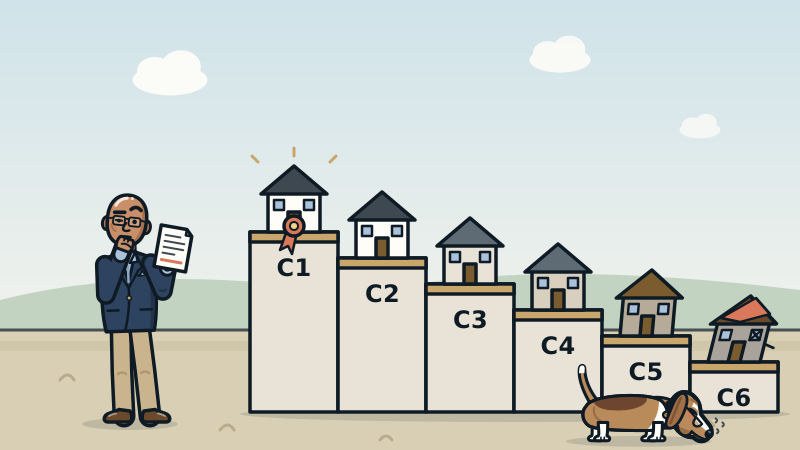
Condition ratings run from C1, a brand new home that has never been lived in, to C6, a home with severe damage that is not fit to live in. C2 is like new, C3 is well maintained, C4 shows normal wear, and C5 needs significant repairs soon. Quality ratings, Q1 to Q6, grade how well the house was built.
Condition is about wear, quality is about how it was built
Every appraisal for a Fannie Mae or Freddie Mac loan uses two report card scales. The C scale grades condition: how worn the house is right now. The Q scale grades quality: how well it was designed and built to begin with.
The two get confused all the time. A custom home with marble everywhere can be high quality and in rough condition if nobody has touched it since the first Bush administration. A basic tract home can be modest quality and in great condition because the owner fixes things the day they break.
On both scales, 1 is the top and 6 is the bottom. Golf scoring, basically. Lower is better, and nobody is happy with a 6.
The definitions below come from Freddie Mac's published UAD 3.6 condition and quality ratings, the version used on the new appraisal form. UAD 3.6 keeps the same 1 to 6 scales but rewrites the definitions to make the lines between them clearer, and it adds separate interior and exterior ratings alongside the overall rating. Freddie Mac says UAD 3.6 is mandatory for all new appraisal reports submitted on or after November 2, 2026.
The six condition ratings in plain English
| Rating | What it means |
|---|---|
| C1 | Brand new. Completed within the past 12 months, never occupied, no wear. The foundation has to be entirely new construction. |
| C2 | Like new. Built within the past 36 months and lightly used, or fully remodeled to the studs with new major components. No deferred maintenance, no repairs needed. |
| C3 | Well maintained with minimal wear. Either older parts have been cared for and show little wear, or major parts like the roof, kitchen or baths were updated, short of a full remodel. |
| C4 | Adequately maintained with moderate wear from normal living. Some minor or cosmetic deferred maintenance. Most components are mid life. Dated but fully working kitchens and baths fit here. |
| C5 | Significant wear from poor maintenance. Still livable and structurally sound, but some components are worn out or missing and need repair or replacement soon. |
| C6 | Severe neglect. Damage or defects that affect soundness or structure. Not suitable to live in until major items are fixed. |
Notice that a rebuilt house generally cannot be C1 if it keeps any of the old foundation or structure. Under Freddie Mac's definitions, a home built on the footprint of an older one in the past 36 months can land at C2 instead.
Where the lines get fuzzy
Most homes I see live in C3 and C4, and the line between them is where most arguments happen.
The difference usually comes down to whether major parts of the house have been updated and whether there is visible deferred maintenance. Freddie Mac's examples help. C3 might have a newer roof, newer mechanicals, newer flooring or a remodeled kitchen or bath. C4 shows things like minor wall or trim damage, worn carpet, and kitchens and baths that are dated but still work.
C4 to C5 is the next line. C5 examples include a roof that is badly worn but not leaking yet, floor coverings that are worn through or missing, and kitchens or baths that work but have damaged or missing cabinets or counters.
Then there is C6, which is not subtle. Active roof leaks, a failing foundation, no working kitchen or bathroom. Fannie Mae requires a C6 house to be appraised subject to repairs that bring it to at least C5, and it will not buy a loan on a C6 property until that happens. The raccoons living in the attic do not get a vote.
The six quality ratings, briefly
Quality is judged on an absolute basis, and a house has to meet most of the criteria for a rating, not every single one.
- Q1: One of a kind, custom designed, exceptional materials and workmanship. Very rare.
- Q2: High quality, often custom or complex plans, high end materials and more detail.
- Q3: Beyond standard plans, often semi custom, with a mix of premium and standard materials.
- Q4: Standard plans built many times over, widely available materials.
- Q5: Basic design that meets minimum building standards. Plain, not substandard.
- Q6: Lacks basic design and may not meet local building standards. Rare.
Quality rarely changes. Condition changes every time someone remodels a kitchen or ignores a leak. That is why condition is the line you can actually do something about.
What I see in the field
Buyers react to condition more than to age. A 1960s house rated C3 because of a new kitchen, baths and roof can sell for more than a 2005 house rated C4 that still has every original builder finish. That is why the condition line on an appraisal can carry real money.
But the letter does not set the price. The market does. I do not assume that each step up the ladder is worth some fixed percentage. I measure what homes in each condition actually sold for in that neighborhood, using side by side sales where I can find them. Sometimes the market barely tells a four year old house from a brand new one. Sometimes it pays a lot for the jump from C4 to C3. You find out by looking, not by guessing.
I also anchor that ladder on the subject house itself. Each adjustment on the grid should answer one question: how much better or worse is this comparable than the house being appraised?
How to help the appraiser get the rating right
- Fix small things that work badly. Drips, loose railings and dead bulbs read as deferred maintenance.
- Fix anything that touches safety or structure first. Leaks and rot are the fast road to a repair condition.
- Write down every update with a date. Roof, windows, HVAC, kitchen, baths, flooring. "Recently updated" is the language of C3, so prove it.
- Keep permits and invoices handy. They are evidence. Your memory of "around 2017, I think" is not.
- Clear access to the attic, crawl space, panel and water heater so nothing has to be assumed.
- Read the condition comments in your report. If the appraiser missed a documented update, ask the lender about a reconsideration of value with the proof attached.
Key takeaways
- C1 is brand new and never occupied; C6 has severe damage and is not fit to live in.
- Most existing homes are rated C3 or C4, and updates plus maintenance decide which.
- Q1 to Q6 grades how the house was built, which rarely changes.
- A C6 home must be appraised subject to repairs before Fannie Mae will buy the loan.
- The rating letter does not set the price; what similar homes sold for does.
People also ask
Can a remodeled house be rated C1?
Generally no. Under Freddie Mac's UAD 3.6 definitions, C1 requires an entirely new foundation and construction. A full remodel to the studs within 36 months can qualify as C2.
Is C4 a bad condition rating?
No. C4 means adequately maintained with normal wear, and it is common for lived-in homes. Fannie Mae treats homes rated C1 through C5 as eligible in as-is condition, as long as any problems are minor and do not affect safety, soundness or structure.
Do condition ratings apply to manufactured homes?
Under UAD 3.6, yes. The ratings now apply to all residential property types, including manufactured homes, which the older version did not cover.
Sources
Got a question we haven't answered?
Suggest a topic or ask your own appraisal question. The best ones become posts.