What does days on market mean, and how long is too long?
Days on market (DOM) is how long a home sits listed on the MLS before the seller accepts an offer. Redfin says listings over 60 days are generally considered stale. The better test is local: compare your home to the median for similar homes that recently sold nearby, since a normal pace in one area is slow in another.
How the days on market clock works
Days on market is the number of days a home is listed before it goes under contract. Redfin explains that the clock starts when the property is listed on the multiple listing service (MLS) and stops when the seller accepts an offer.
That is it. It does not count the weeks the seller spent deciding on paint colors, the month the sign sat in the garage, or the time the house spent on a neighborhood group chat. Only time on the MLS counts.
It also stops at the accepted offer, not at closing. So a house that went pending in 9 days and took 45 days to close still shows a short DOM. Keep that in mind when you compare it to closing timelines, which are a different number.
The relisting trick, and why it rarely fools anyone
Here is a move every agent has seen. A listing gets stale, so it gets pulled and put back on as "new." On public sites, Redfin says DOM resets when a home is relisted after being taken down. The counter goes back to zero and the house looks fresh.
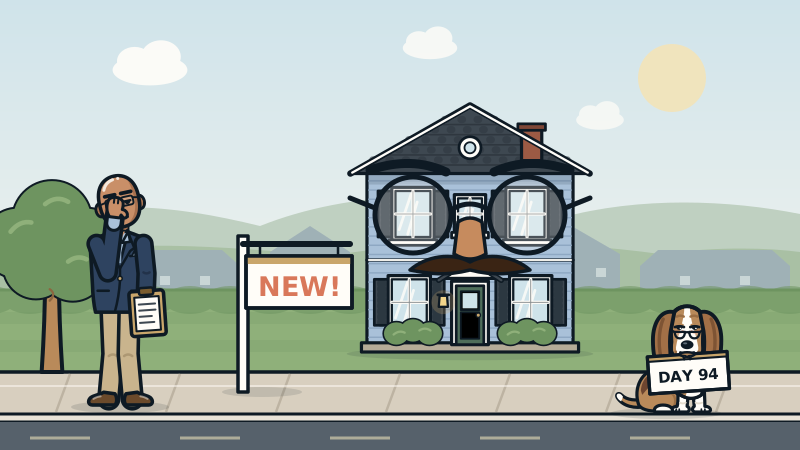
The people who matter are not fooled. Redfin notes that agents can see the full MLS history, which tracks cumulative days on market (CDOM) even after relisting. Buyer agents see it. Appraisers see it. It is like putting on a fake mustache to re-enter a party: technically new, still obviously you.
There is also a blind spot. Redfin says Private Exclusive and Coming Soon listings do not display insights like days on market or price drops. A house marketed quietly before it hits the MLS can carry a short public DOM, so the number tells you less about how hard it really was to sell.
How long is too long?
Redfin's rule of thumb is that listings on the market more than 60 days are generally considered stale. That is a fair national guidepost. It is not the number I would use for your house.
Too long is relative to the pace of your market. A national number blends hot city blocks with slow rural roads, so it tells you very little about your street. In a neighborhood where similar homes go pending in a week, day 30 is a problem. In a rural market where 90 days is normal, day 30 is a Tuesday.
The test I use is simple:
- Find recent sales of homes like yours in your area.
- Look at their median DOM. Median means the middle one, so a single outlier does not skew it.
- Compare. If you are well past that median with few showings, the market is telling you something about price, condition or presentation.
Waiting it out has a cost. Zillow Research found in 2016 that homes that sold almost right away went for about 1% below list, while the homes that sat longest, around 11 months on average, sold about 12% below list. Zillow said that is a pattern, not proof of cause. It is still a pattern worth respecting.
What days on market tells a buyer
If you are buying, DOM is one of the few numbers that tells you how much room you may have to talk. A home that went live last Thursday with five showings booked for Saturday is not the place to open 10% under asking. A home on its third price cut and its second listing agent might be.
Look at CDOM, not the public counter. Ask your agent to pull the full MLS history, including price changes and any earlier listing periods. A house that shows 12 days on a public site and 140 days in the MLS history is a very different negotiation.
Then ask why. Sometimes a long DOM means the price was too high and nothing else. Sometimes it means buyers found something in the inspection and walked. A canceled escrow in the history is worth a polite question. The answer may be nothing, like a buyer who lost a job, or it may be a foundation report you will want to read before you write an offer.
What I see in the field
When I appraise a home, days on market is part of reading the market, both for the comparable sales and for the area as a whole. DOM is one of the clearest signals of whether buyers are competing or waiting.
I look at it in real time. A 12-month average can hide a shift. If homes were going pending in two weeks in spring and are now sitting for six, a lazy annual number makes the market look calmer than it is. I would rather test the most recent window the data can support and show you what it says.
Long DOM on a comparable also changes how I read its price. A house that sold after 120 days and two price cuts tells a different story than one that sold in a weekend with multiple offers. Both are real evidence. They just say different things about where the market stood.
And a long DOM on your own listing does not lower your value by itself. It is a symptom. The cause is usually price, sometimes condition, occasionally photos taken with a flip phone.
What to do if your listing is sitting
- Check the local median DOM for similar homes sold in the last few months, not the national number.
- Read the showing feedback honestly. "Loved it, but" followed by the same complaint three times is data.
- Compare your price to what actually closed, not to other active listings. Active listings are hopes. Closed sales are facts.
- Fix what buyers keep mentioning if it is cheap and fast: paint, lighting, a broken fence.
- Adjust price with evidence, not by a round number that feels good. If the closed sales say a lower bracket, get there in one clear step.
- Do not count on a relist to hide history. CDOM follows the house in the MLS.
- Consider a pre-listing appraisal if you want an independent read on price before the next move.
Key takeaways
- Days on market runs from the MLS listing to the accepted offer, per Redfin.
- Redfin says over 60 days is generally stale, but your local pace is the real test.
- Relisting resets public DOM, but the MLS still tracks cumulative days on market.
- Long DOM is a symptom. The cause is usually price.
People also ask
Does days on market include the time a house is pending?
No. Redfin says the DOM clock stops when the seller accepts an offer, so time spent in escrow is not counted.
What is CDOM in real estate?
CDOM is cumulative days on market. It is the total time a home has been listed across relistings, and agents can see it in the MLS even when public sites reset the count.
Does a high DOM lower my appraisal?
Not directly. The appraisal is based on comparable sales and market conditions. Long DOM is a sign of how the market is reacting to the price, which is why appraisers watch it.
Sources
Got a question we haven't answered?
Suggest a topic or ask your own appraisal question. The best ones become posts.