Does a detached ADU count in the home's square footage?
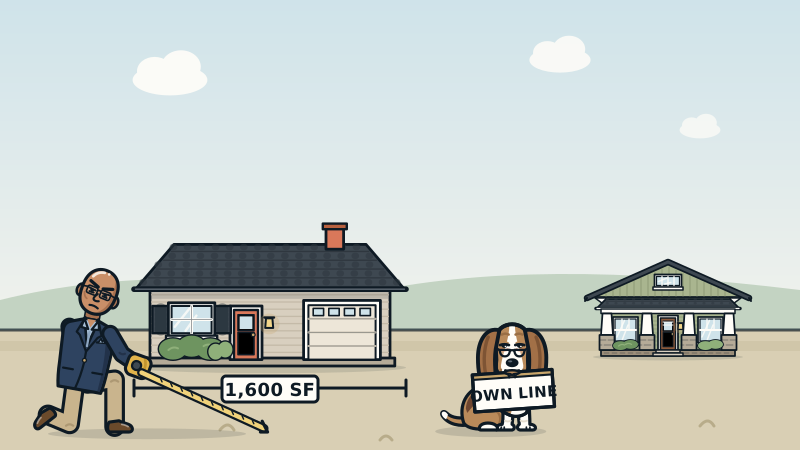
No. A detached ADU is never added to the main home's square footage. Fannie Mae has appraisers report it on its own line, outside the main home's finished area and room counts, and adjust it at whatever local buyers pay for it. Only attached space with interior access that meets the measuring rules can count.
The cottage out back is not part of the living room
Here is a listing I see in some form every month. "Charming 2,050 square foot home!" Then you walk it. The house is 1,600 square feet. The other 450 are a cottage across the patio, next to the lemon tree.
That is not a 2,050 square foot home. It is a 1,600 square foot home with a 450 square foot cottage. Those are two different products, and buyers pay for them in two different ways.
Fannie Mae's rules are clear on this. The living area of an ADU should not be included in the finished above-grade square footage of the primary dwelling. Any detached structure with finished area goes on a separate line of the adjustment grid, and it stays out of the main home's square footage and room counts.
My own rule is shorter: detached structures never count in the main house's square footage. Not on the subject, not on the comps, not when the seller really, really wants them to.
Why one wrong number breaks the whole price
Square footage is not a decoration on the listing. It drives the price per square foot that everyone quotes, and it decides which sales look comparable.
Say, hypothetically, the 1,600 square foot house above gets priced against 2,000 square foot homes because somebody added in the cottage. Now the comps are the wrong size. The price per square foot looks low, so the list price looks like a bargain. Then the appraiser measures the main house, finds 1,600, and every number built on 2,050 falls over at once.
The room count follows the same basis. If the only second bathroom is in the cottage, the main house has one bathroom. The cottage has its own. Telling buyers the house is a two-bath sets up a conversation nobody enjoys during the inspection period.
It works the same way on the comps. A sale that reported its cottage in the main home's total has to be put back on the right basis before it can be compared. If the listing never split the two numbers and the records only carry a combined figure, that sale may not be usable for measuring size at all. Bad inputs do not average out. They just hide.
What attached or converted space can count
Not every extra room gets kicked out. Space attached to the house can count in the main home's square footage, but only if it passes the tests. Fannie Mae requires appraisers to measure under the ANSI standard (a national method for measuring homes). In plain words, here is what that means for the main home's count:
- It has to be above grade. If any part of a level sits below grade, Fannie Mae treats that level as below grade. It gets reported separately.
- It needs direct interior access. A finished room attached to the house that you can only reach from outside is reported on its own line as noncontinuous finished area.
- The ceiling has to be tall enough. Fannie Mae's ANSI guidance says finished areas need a ceiling of at least 7 feet. With a sloped ceiling, at least half the room has to reach 7 feet, and no part of the finished area can be under 5 feet.
- It cannot be an ADU. An ADU inside or attached to the house stays off the main home's total unless it is within or part of the primary dwelling, with interior access and above grade.
Finished space with interior access that misses the ceiling rule is reported separately as nonstandard finished area, and the appraiser has to say why and account for what it adds. A converted attached garage you reach from the kitchen can count if it really is finished living space that meets these tests. A converted detached garage is a detached structure. It gets its own line, like the cottage.
How the ADU actually gets its value
Pulling the cottage out of the square footage does not erase it. It just puts it where it belongs, on its own line, at the number the market proves.
Fannie Mae requires the appraisal to describe the ADU and analyze its effect on value and marketability. That analysis comes from evidence, not a rule of thumb:
- Paired sales. Similar homes nearby, some with ADUs and some without, that sold around the same time. Once the other differences are adjusted for, the gap points to what buyers paid for the unit.
- The wider market. If the street is too thin, I look across a larger area with more sales to confirm the rate. A number that only shows up in four sales is not proven.
- Rent. If the unit rents, what similar units rent for helps show what it is worth to a buyer. When a lender counts ADU rent, Freddie Mac's checklist asks for at least three comparable rentals to support the market rent.
- Permits and zoning. A permitted unit, a legal nonconforming unit and one zoning does not allow are valued and underwritten differently.
For how much ADUs add, and why there is no national price tag, see How much value does an ADU add in an appraisal?
What agents should do before the listing goes live
- Write two numbers. "1,600 square foot main home plus a 450 square foot detached ADU." Follow your MLS rules on which field gets which figure.
- Count rooms the same way. Bedrooms and bathrooms in the cottage belong to the cottage. List them with the cottage.
- Check the county record. Assessor and MLS figures sometimes lump everything together. Know which number you are quoting.
- Gather the permits for the ADU and any conversion, with final sign-off dates.
- Price against the right comps. Compare the main house to main houses, then show what local ADUs sold or rented for.
- Open up the cottage. The appraiser needs to measure it too, just on a different line.
If you want the full set of rules on one page, my free guide What Counts as Living Area walks through it, with examples.
What I see in the field
Most of the trouble starts with honest people repeating a number they found. The county record carries a combined total, the listing copies it, and the buyer's agent prices off it. Nobody lied. Everybody just trusted the first number on the page.
So I read each record on its own terms. Does this listing's square footage include the cottage or not? Sometimes the listing text says so plainly. Sometimes the photos give it away, like when the 'family room' has a bathtub and a separate front door.
The good news for sellers is that an ADU priced on its own line often makes the case better than a padded square footage ever could. Buyers can see exactly what they get: a house, plus a place for a parent, a tenant or a home office with a shower. Facts over feelings, and two honest numbers beat one inflated one.
Key takeaways
- A detached ADU never counts in the main home's square footage.
- It goes on its own line in the appraisal, along with its own bedrooms and bathrooms.
- Attached space can count only if it is above grade, has interior access and meets the ceiling rules.
- The ADU's value comes from local paired sales, rents and permits, not a national number.
- List two numbers: the main home and the ADU.
Get the best posts once a week.
Priced Right is one email a week with the most useful appraisal and pricing posts and what the market is doing. Never more than one a week. Unsubscribe anytime.
People also ask
Does a converted garage count as square footage?
An attached converted garage can count if it is finished living space with interior access that meets the measuring rules. A converted detached garage never counts in the main home. It is valued on its own line.
Does the bathroom in my ADU count toward the home's bath count?
Not in the main home's count. Fannie Mae keeps detached structures out of the main home's room counts, so the cottage's bathroom is reported with the cottage.
Why does the county record show a bigger number than my appraisal?
Assessor records sometimes carry one combined figure for every building on the lot, or are simply out of date. The appraiser measures and reports the main home and any detached space separately.
Sources
Got a question we haven't answered?
Suggest a topic or ask your own appraisal question. The best ones become posts.