Does a finished basement count as square footage in an appraisal?
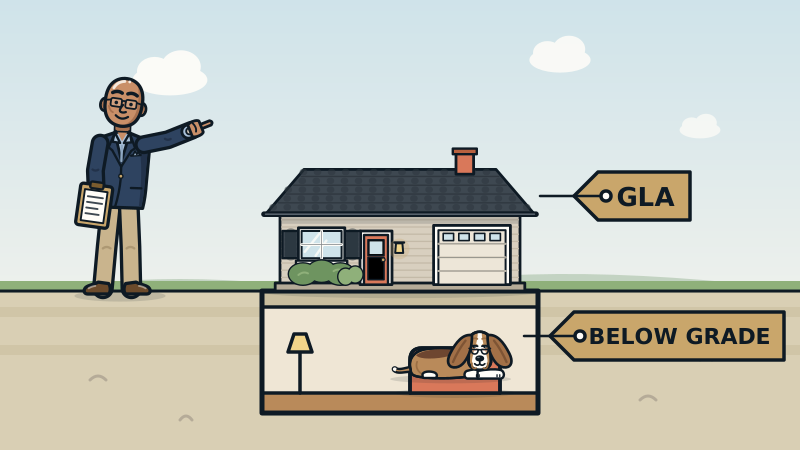
No, not in the main living area. Under Fannie Mae and Freddie Mac rules, any level that is partly below ground is below grade, even if it is finished and has windows. That space is measured and reported on its own line, then adjusted separately. It can still add real value. It just is not counted as above-grade square footage.
Why your basement is not in the living area number
On an appraisal, the big square footage number is gross living area (GLA). For a house, that means finished space above ground. Fannie Mae and Freddie Mac both require appraisers to measure homes using the ANSI Z765 standard. Fannie Mae made it mandatory in April 2022. Freddie Mac followed in November 2023.
The rule is short. A basement is any area partly or fully below grade, regardless of finish. It gets reported as below-grade finished area, not GLA.
That means the basement with the new carpet, the wet bar and the 85-inch TV that the whole family watches the game on is still a basement in the report. Paint does not change gravity. Neither does a sign that says "Man Cave, Est. 2019."
This is not the appraiser taking away your space. It is a separate column. The space is still measured, still described and still valued. It just lives on its own line.
What about a walkout basement?
This is the question I hear most from owners of hillside homes. You open the back door of the lower level and walk straight onto the patio. It feels like a first floor. It has a view. It has sunlight.
The ANSI standard still treats that level as below grade if any part of its perimeter wall sits below the ground surface. Fannie Mae says the same thing in plain terms: a level is below grade if any portion of it is below grade, and a partly below-grade walkout with finished rooms is not included in the above-grade square footage.
So the front half of the lower floor tucked into the hill decides the whole level. The patio side does not get a vote. Yes, it feels unfair. The view is real and the buyers will love it. The fix is to give that space its proper value on its own line, not to sneak it into the GLA.
One more rule: for above-grade space to count as GLA, ANSI requires a ceiling height of at least 7 feet, and no part under 5 feet can be included. Finished space that does not meet the standard gets reported as finished area that is not GLA.
How a finished basement still adds value
Fannie Mae says below-grade finished rooms may add substantially to the value of a home, especially when the finish quality is high. The appraiser reports that area separately and adjusts for it on the basement and finished rooms below-grade line of the sales comparison grid.
Here is how that plays out. Say your house has 1,800 square feet above ground and a 900-square-foot finished basement. A comparable sale (a nearby home that sold, called a comp) has the same 1,800 above ground but an unfinished basement. The appraiser does not call your house 2,700 square feet. Instead, the comp gets an upward adjustment on the basement line for the difference in finished area and finish level.
How big is that adjustment? It depends on your market, and I will not hand you a national dollar figure, because there is no honest one. The amount should come from what buyers in your area actually paid for finished basements. The cleanest way to see that is paired sales: two similar homes, one with a finished basement and one without, sold around the same time. The difference in price is the market talking.
A basement square foot usually does not sell for the same price as an upstairs square foot. Sometimes it is close. Sometimes it is not close at all. That is exactly why it gets its own line.
Why your listing and your appraisal show different numbers
This is where the panic phone calls come from. The listing says 2,700 square feet. The appraisal says 1,800. Somebody assumes the appraiser forgot a floor.
Usually nobody forgot anything. A listing, a builder brochure or a tax record may count total finished area, including the basement. The appraisal follows the measurement rules the lender requires. Two different questions, two different answers.
Fannie Mae also requires appraisers to be consistent. If a house is used as a comp in more than one report, its room count and square footage should not change from one report to the next. That consistency is what makes the comparison fair. Your basement gets compared to other basements, and your upstairs gets compared to other upstairs.
If the appraisal treats a level as below grade and you think none of it is below ground, that is a fair question to raise. Bring facts: a photo of the foundation line, a survey or a plan. "It feels like a first floor" will not move the needle. A photo showing the whole perimeter wall above ground might.
What to do before your appraisal
- Make every basement room accessible. Unlock storage rooms and clear a path. If the appraiser cannot see a finished room, it is hard to give it credit.
- List what was finished and when. Flooring, drywall, egress windows, bathrooms, heating and cooling. Dates and permits help.
- Have your permits ready. Finished space with permits is easier to describe with confidence. Missing permits raise questions.
- Know your ceiling heights. Low spots and soffits matter for how finished space is reported.
- Do not argue the basement into the GLA. Instead, point the appraiser to nearby sales with finished basements. That is the evidence that supports the adjustment.
- Ask your agent which number the MLS uses. Then you will not be surprised when the report shows a smaller GLA.
Key takeaways
- Any level partly below ground is below grade, even a walkout with big windows.
- Below-grade finished area is measured and reported on its own line, not in GLA.
- A finished basement can still add real value through its own adjustment.
- The size of that adjustment should come from local sales, not a national rule of thumb.
- Listing and tax record square footage often include the basement. The appraisal usually will not.
People also ask
Does an unfinished basement add value?
It can, because buyers in some markets pay for storage and future space. Like finished area, the amount has to be measured from local sales, and unfinished area is reported separately from finished area.
Does a basement bedroom count in the bedroom total?
On Fannie Mae and Freddie Mac reports, below-grade rooms are reported with the below-grade area, not in the above-grade room count. The room still matters to buyers and gets considered on the basement line.
Do these rules apply to every appraisal?
The ANSI rule applies to Fannie Mae and Freddie Mac loans on single-family homes, with exceptions where state law requires another standard. Other loan programs and private appraisals may follow different instructions, so ask what the client requires.
Sources
Got a question we haven't answered?
Suggest a topic or ask your own appraisal question. The best ones become posts.