What is the FHA 90-day flip rule?
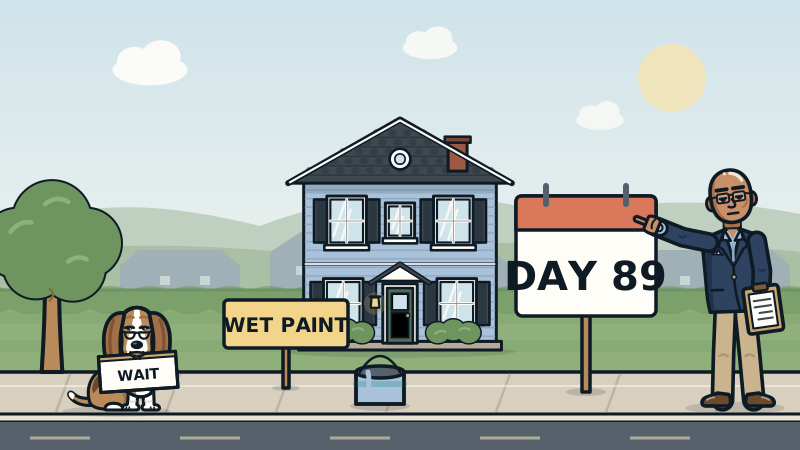
Under FHA rules, a home resold within 90 days of when the seller acquired it is not eligible for an FHA-insured loan. The clock runs from the seller's settlement date to the date the buyer's contract is signed. From 91 to 180 days, a price 100% over what the seller paid triggers a second appraisal.
How the 90 days are counted
The rule lives in federal regulations at 24 CFR 203.37a, and the counting is more specific than most people expect.
- Start: the date the seller acquired the property, which the rule defines as the settlement date.
- End: the date the sales contract that leads to the FHA loan is executed. Not the closing date. The contract date.
If the resale contract is signed within 90 days of the seller's acquisition, the property is not eligible for FHA insurance. Here is a hypothetical: an investor closes on a house March 1, and an FHA buyer signs a contract May 20. That is 80 days. No FHA loan, no matter how nice the new floors are.
The rule also says the buyer must be purchasing from the owner of record, and the deal cannot involve a sale or assignment of the sales contract. That shuts the door on FHA buyers taking an assigned contract from a wholesaler. The lender has to document ownership with something like a sales history report or a recorded deed.
Day 89 and day 91 look alike on a calendar. To FHA, they are different planets.
Days 91 to 180, and the rest of the first year
After day 90, the property is generally eligible, but the rule keeps watching.
From 91 to 180 days: if the resale price is 100 percent over the seller's purchase price, HUD requires the lender to get additional documentation, and that documentation must include an appraisal from another appraiser. The lender may also document that the higher value came from rehabilitation of the property. HUD can move that 100 percent trigger anywhere from 50 to 150 percent through a Federal Register notice.
From 91 days to 12 months: HUD may also require more proof of value when the resale price is 5 percent or more above the lowest sales price in the prior 12 months. At HUD's discretion that can include a second appraisal. If the extra documentation supports a value more than 5 percent below the first appraisal, the lower value sets the maximum mortgage. HUD has to announce those requirements in the Federal Register before they take effect.
After 12 months: the property is eligible.
Read the FHA rule alongside your lender's own overlays. Some lenders add their own restrictions on top.
Exceptions to the flip rule
The time limits do not apply to every resale. Under section 203.37a(c), they do not apply to:
- HUD sales of its own REO (bank-owned) homes, and certain HUD sales in revitalization areas
- Sales of single-family REO homes by other federal agencies
- Sales by HUD-approved nonprofits that bought HUD homes at a discount with resale restrictions
- Homes the seller acquired by inheritance
- Homes bought by an employer or relocation agency to move an employee
- Sales by state- and federally-chartered financial institutions and government-sponsored enterprises
- Sales by local and state government agencies
- Sales in federal disaster areas, but only when HUD announces it by notice
The inheritance exception surprises people. An heir who inherits a house and sells it a month later to an FHA buyer is not flipping. They are just trying to get the lawn mowed by someone else.
What I see in the field
From the appraiser's chair, a flip has to prove its value the same way any house does: with comparable sales (recent sales of similar homes nearby) that look like the finished product. What the flipper paid, and what they spent, are history. They are not the value.
A quick resale at a big markup is not automatically a problem. Buyers react to condition more than age, and a real renovation can move a house from the bottom of the neighborhood to the top. The market just has to show it. If renovated homes on similar streets sold in that range, the value holds up.
What does not hold up is cosmetic work priced like a gut remodel. Gray paint and new hardware are nice. They do not double a house in four months by themselves. When a second appraiser is involved, they look at the evidence independently, and an inflated number tends to fall apart under two sets of eyes.
One more note: FHA is not the only rule about quick resales. Under Regulation Z, certain higher-priced mortgage loans need two written appraisals when the seller acquired the home within 90 days and the price is more than 10 percent higher, or within 91 to 180 days and the price is more than 20 percent higher. The lender can charge the borrower for only one of them. Check which rules apply to the loan in front of you.
What to do if you're buying or selling a flip with FHA
- Find the seller's acquisition date on the title report or recorded deed. That is day one.
- Count to the contract date, not the closing date. If it lands at 90 days or less, FHA is off the table for that contract.
- If you're the seller and the date is close, wait to sign an FHA contract, or accept a buyer using other financing.
- Check the 100 percent test for days 91 to 180. If the price doubled, expect a second appraisal.
- Document the rehab: invoices, permits, before and after photos and the scope of work. That is what supports the higher value.
- Make sure the seller is the owner of record. No assigned contracts with FHA.
- Ask the lender about overlays before the offer goes in.
Key takeaways
- A home resold within 90 days of the seller's acquisition is not eligible for FHA insurance.
- The clock runs from the seller's settlement date to the buyer's contract date.
- From 91 to 180 days, a 100 percent price jump triggers extra documentation, including a second appraisal.
- Inherited homes, bank and government sales, and relocation sales are among the exceptions.
People also ask
Does the FHA flip rule apply to conventional loans?
No. Section 203.37a is an FHA rule. Conventional and other loans have their own requirements, and a separate federal rule can apply to certain higher-priced loans.
Is the 90 days counted to closing or to the contract?
To the contract. The resale date is the date the sales contract that results in the FHA loan is executed.
Can an heir sell to an FHA buyer right away?
Yes. Properties the seller acquired by inheritance are exempt from the time restrictions.
Sources
Got a question we haven't answered?
Suggest a topic or ask your own appraisal question. The best ones become posts.