Why isn't my insurance number the same as my home's value?
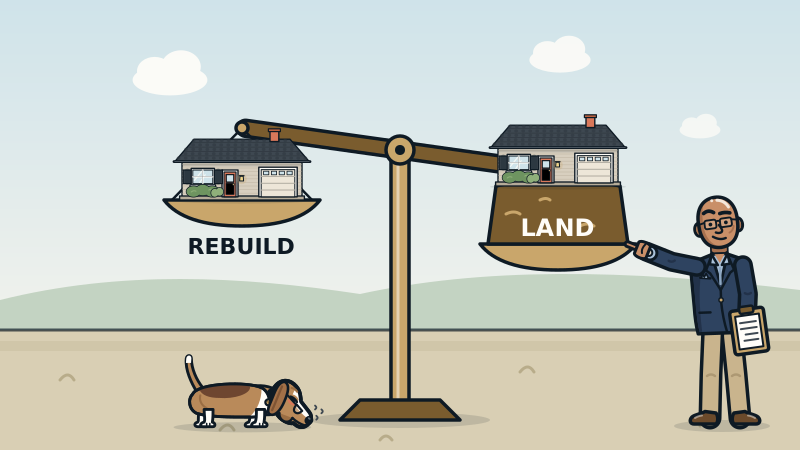
Because they answer different questions. Your dwelling coverage is meant to pay to rebuild the structure: labor, materials, permits, debris removal. Market value is what a buyer would pay for the whole property, land included. In California, the land and the rebuild cost can move in very different directions.
Two numbers, two different questions
Your insurance policy asks: if this house burned to the slab tomorrow, what would it cost to build it again? Your appraisal asks: if this property sold today, what would a typical buyer pay?
Federal banking rules define market value as the most probable price a property should bring in a competitive and open market, with a buyer and seller acting prudently and knowledgeably. That price covers everything the buyer gets: the house, the lot, the location, the school district and the view of the neighbor's boat that has not moved since 2019.
Replacement cost is about the building. California's rule for insurance rebuild estimates, 10 CCR 2695.183, says the estimate must be based on the cost to rebuild or replace the structure. It also says the estimate shall not be based on the resale value of the land, or on the amount of any loan.
So when the two numbers do not match, nothing is broken. You are comparing the price of a cake to the price of the bakery.
What a California rebuild estimate has to include
When an insurer or agent gives you a replacement cost estimate in California, the regulation sets out what goes in it. The estimate must include the costs that would reasonably be incurred to rebuild the insured structure in its entirety, including:
- Labor, building materials and supplies
- Overhead and profit
- Demolition and debris removal
- Permits and architect's plans
It also has to consider the features of your house, such as the foundation, frame, roofing, siding, slope, square footage, location, number of stories and interior finishes. It cannot take a deduction for physical depreciation. You must get a copy, and it has to itemize those cost categories.
One catch: the same rule says the insurer or agent is not required to estimate replacement cost for you, set your limit, or tell you whether your limit is enough. The limit on your policy is still your decision. Read the estimate like you would read a contractor's bid. If it thinks your hillside custom home is a flat-lot tract house, the number is probably wrong.
Why the gap can be huge in California
Land is the big reason. In many California neighborhoods, a large part of what buyers pay is for the lot and its location. Insurance does not rebuild land, because the land is still there after a fire. It just has a lot less house on it.
Two hypotheticals show how far apart the numbers can drift:
- Expensive dirt. Say a 1,400-square-foot 1950s ranch sits on a lot close to good jobs and good schools. It might sell for far more than it would cost to rebuild, because buyers are mostly paying for the location. The insurance number can sit well below market value and still be right.
- Expensive rebuild. Say an older house with custom finishes sits on a hillside lot in a quieter market. Rebuilding it today, with demolition, permits, current codes and a tricky slope, could cost more than the whole property would sell for. Here the insurance number can sit above market value and still be right.
The rule itself recognizes one more factor: an estimate has to account for whether the house is a single custom build or one of many tract homes built the same way. Building one house costs more per foot than building fifty of them in a row.
Why the cost approach in an appraisal is not an insurance estimate
People sometimes flip to the cost section of an appraisal and call their insurer. Please don't. That section was built for a different job.
The cost approach in an appraisal estimates what it would cost a buyer to build a substitute house, then subtracts depreciation for wear, layout problems and outside issues like a busy road, then adds the value of the site. Fannie Mae says the approach depends on valid cost estimates, proper depreciation and accurate site values. It does not require the cost approach at all except for manufactured homes, and it says an appraisal that relies only on the cost approach is not acceptable.
An insurance rebuild estimate does the opposite on two key points. It leaves the land out, and California's rule says it cannot subtract depreciation. It also adds things an appraisal's cost section may never price in detail, like tearing out what is left after a fire and hauling it away.
My position is simple: the appraisal answers the market value question, and I support that number with sales. Your insurance limit should come from a rebuild estimate built for that purpose. Using one for the other is like using your bathroom scale to check your tire pressure.
Questions to ask your insurer or agent
- Can I see the itemized replacement cost estimate? In California you are supposed to get a copy.
- Does it describe my actual house? Check square footage, stories, foundation, roof type, slope and finish level. Bring your list of upgrades.
- When was it last updated? The rule requires insurers to keep their cost sources and methods current, but it does not require a new estimate for you every year. Ask for one after a remodel or addition.
- Do I have extended replacement cost? This kind of coverage can pay above your dwelling limit, up to a set extra amount, if rebuilding costs more than expected. The California Department of Insurance says SB 876, signed in September 2026, requires insurers to offer extended replacement cost coverage when a policy is written, starting January 1, 2027.
- What about building code upgrades? Rebuilding to today's codes can cost more than putting back what you had. Ask how your policy handles that cost.
Coverage terms vary by policy, so go over the details with a licensed insurance agent or broker before you change your limits.
Where a market value appraisal still helps
There are times you need the market value number next to the rebuild number. Some insurance placements ask for both. Lenders, trusts and estates often need market value for their own reasons. And after a loss, owners sometimes want to know what the lot and the damaged property would sell for as is, so they can weigh rebuilding against selling.
For those questions, I offer desktop appraisals. At ValuedAudit, desktop and hybrid mean the same thing: no site visit. You send what you know about the house, photos if you have them, and the pros and cons you are aware of. I pair that with records and market data and the evidence-based methods I have taught and used for almost two decades.
What a desktop appraisal does not do is replace your insurer's rebuild estimate. Two good numbers, two different jobs. For the tax side of the same idea, see appraised value vs assessed value in California.
Key takeaways
- Dwelling coverage is meant to rebuild the structure. Market value includes the land.
- California's rule says a rebuild estimate cannot be based on land value or your loan balance, and cannot subtract depreciation.
- The cost approach in an appraisal is not an insurance estimate. It subtracts depreciation and adds land.
- Ask for your itemized estimate, check it against your real house, and ask about extended replacement cost.
- Your policy limit is your decision, so review it with a licensed agent or broker.
Get the best posts once a week.
Priced Right is one email a week with the most useful appraisal and pricing posts and what the market is doing. Never more than one a week. Unsubscribe anytime.
People also ask
Should my dwelling coverage equal my home's sale price?
Not necessarily. Sale price includes land, which insurance does not rebuild. Coverage should be tied to the cost to rebuild the structure, which can be higher or lower than the sale price.
Does my lender's appraisal tell me how much insurance to buy?
No. A lender appraisal is an opinion of market value for the loan. The insurance limit should come from a replacement cost estimate built for that purpose.
What if my estimate seems too low?
Ask your insurer or agent to review it. Give them corrected facts like square footage, upgrades, roof type and slope, and ask for an updated itemized copy.
Sources
- Cal. Code Regs. tit. 10, section 2695.183: Standards for Estimates of Replacement Value
- California Department of Insurance: Governor signs SB 876, the Disaster Recovery Reform Act (September 29, 2026)
- Fannie Mae Selling Guide B4-1.3-10: Cost and Income Approach to Value
- 12 CFR 34.42: Definition of market value
Got a question we haven't answered?
Suggest a topic or ask your own appraisal question. The best ones become posts.