Why price your home with evidence before the market prices it for you?
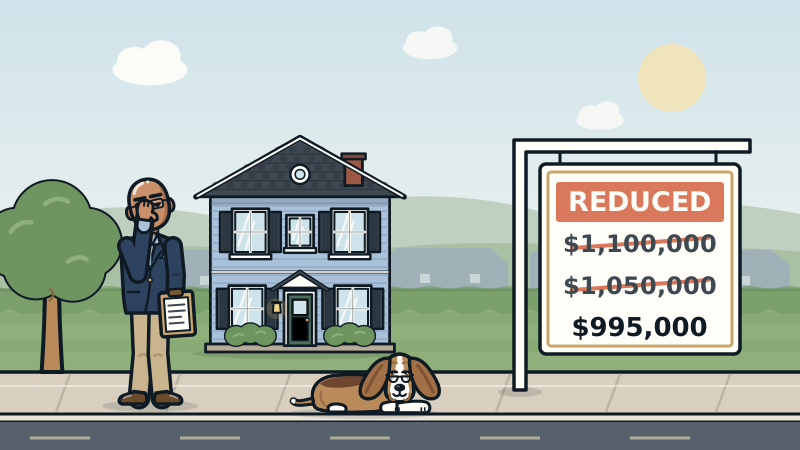
Because the market will correct a wrong price anyway, and it charges you in days on market, price cuts and lost bargaining power. A pre-listing appraisal or Market Intelligence report shows the supported range, what each feature is worth in your market and how long similar homes take to sell, before your first showing.
The market will price your house either way
Every list price is a guess until buyers respond to it. If the guess is right, showings come, offers come and the house goes under contract. If the guess is high, the market corrects it. It just does it slowly, in public, and on your time.
That correction is not free. Buyers who scroll past a high price in week one do not come back to check on you in week four. The listing goes stale, the price comes down, and now the buyers who are left know you are tired.
Pricing high to leave room to negotiate is like buying jeans a size too small to motivate the diet. It feels like a plan. It rarely works out the way you pictured.
The alternative is to price from evidence before the listing goes live. Not from the Zestimate, not from the neighbor who swears his house sold for more, and not from what you need to buy the next place. From what similar homes actually sold for, adjusted to yours and to today's market.
What a market correction usually costs
Zillow published a study in 2016 that tracked how long homes sat and how close they sold to their list price. Homes on the market about seven days typically sold at list. Homes on for about two months (56 days) sold about 5% below list. Homes on for 11 months (324 days) typically sold about 12% below list.
Do the math on a hypothetical $1,000,000 listing. If it follows that pattern, two months on market lines up with a sale around $950,000. That is $50,000, plus two extra months of mortgage, taxes, insurance and keeping the house spotless for strangers.
The same study found that homes that sold 10% below list stayed on the market about five times longer than homes that sold at list. Read that carefully. Those homes usually were not underpriced. They asked too much, sat and got marked down.
Time on market is not only about price. Bad photos and odd floor plans slow things down too. But price is the one thing the seller sets on day one. I go deeper on the data in does overpricing a house hurt the final sale price.
Then the buyer's appraisal checks your price again
Say a high price does find a buyer. The house still has to appraise. The buyer's lender orders its own appraisal, and Fannie Mae's rules say lenders may not use appraisals ordered by the borrower or other interested parties, which includes the seller and the real estate agent. So your pre-listing report does not replace that one.
That appraiser reads the contract, but the contract price does not set the value. One buyer and one seller agreeing to a number is one data point. The value comes from what the wider market paid for similar homes. If the sales do not support the price, the value will not be there, and you are back to negotiating, this time with a closing date bearing down.
This is where pricing with evidence pays off twice. A list price built on the same kind of sales an appraiser will use is much less likely to get cut down in escrow. And if the buyer's appraisal does come in low, you already have documented sales and analysis your agent can hand the buyer's side for a reconsideration of value.
What an evidence-first report shows you
A good pre-listing report does more than hand you a number. It teaches you your own market before you are standing in it. Here is what I build into a Market Intelligence report:
- The value and the range, from adjusted sales, each one brought forward from the day its price was agreed to today's market.
- What each feature is worth here: bedrooms, bathrooms, square footage, lot size and more, measured from local sales instead of a national rule of thumb.
- The listings that did not sell. Expired, withdrawn and canceled listings show where buyers looked and said no. That is often where your ceiling is.
- The typical marketing time for your home's own segment, not the citywide average.
- The overpricing penalty and price-cut timing in your market: what homes that launched too high lost, and when listings here usually cut.
If you need a formal appraisal instead, for an estate, a trust, a divorce or a dispute with a co-owner, the same evidence goes into a full appraisal report. For when that is worth the fee, see is a pre-listing appraisal worth it.
How to use the evidence once you have it
- Read the whole report with your agent, and not only the last page. You want to know which sales drove the range and why.
- Pick a list price inside the supported range on purpose, with a reason for where it sits: condition, view, a busy street, a better lot.
- Fix the cheap things the report flags before you list, if they matter to buyers in your segment.
- Set a check-in date based on the typical marketing time for homes like yours. If showings and feedback are behind by then, adjust early.
- Keep the report handy for escrow. If the buyer's appraisal comes in low, the sales are already gathered.
- Hand the appraiser a fact sheet when the buyer's appraisal is scheduled: upgrades with dates, permits and known issues.
What I see in the field
I have watched plenty of sellers learn their market's opinion the expensive way. The house did not get worse while it sat. Its square footage, its kitchen and its lot stayed exactly the same. What changed is that buyers had weeks to compare it to everything else for sale and decide what it was worth to them.
The market is a brutally honest focus group, and it charges by the day.
The sellers who do best treat pricing as a research question, not a vote. They want to see the sales, the adjustments and the listings that failed, so they understand why the price is the price. Then, when a buyer pushes back, they are not defending a feeling. They are pointing at evidence the market already produced. Facts over feelings, before the sign goes in the yard.
Key takeaways
- A wrong list price gets corrected by the market, and the correction costs time, money and bargaining power.
- In Zillow's 2016 study, homes on the market about two months sold about 5% below list.
- The buyer's lender orders its own appraisal, and the contract price does not set the value.
- A pre-listing report shows the supported range, what features are worth locally and how long homes like yours take to sell.
- Price inside the evidence on purpose, and know your check-in date before you list.
Get the best posts once a week.
Priced Right is one email a week with the most useful appraisal and pricing posts and what the market is doing. Never more than one a week. Unsubscribe anytime.
People also ask
Is a Market Intelligence report the same as an appraisal?
No. It is a research report prepared by a licensed appraiser that shows the range, feature values and market timing. When you need a formal appraisal for an estate, trust, divorce or dispute, order an appraisal.
Can I list above the range the report shows?
You can list wherever you want. The report tells you what the evidence supports and what homes that launched too high in your market went through, so you know the risk before you take it.
Will the buyer's appraiser use my pre-listing report?
Not as the loan appraisal. Fannie Mae does not allow lenders to use appraisals ordered by the seller or the agent. But the sales and analysis in it can support a reconsideration of value if the buyer's appraisal comes in low.
Sources
Got a question we haven't answered?
Suggest a topic or ask your own appraisal question. The best ones become posts.