Is price per square foot a good way to value a home?
Not by itself. Price per square foot treats every square foot as equal, so it ignores lot size, location, views, condition and outside influences like a busy street. It also swings with home size. Appraisers use it as a quick screen at most, then value a home from adjusted comparable sales.
Why price per square foot feels so convincing
Price per square foot is easy. Take the sale price, divide by the living area, and you get one tidy number. It fits on a flyer. It fits in a text message. Your neighbor can do it on a napkin at a barbecue, and he will.
The trouble is that one number hides everything that made the sale price what it was. A buyer did not pay for 1,800 square feet. They paid for 1,800 square feet on that lot, on that street, in that condition, with that view of either the hills or the freeway sound wall.
Price per square foot quietly assumes all of those things are the same as your house. They almost never are. That is why I treat it like a smoke detector: useful for telling you something might be off, useless for telling you what the house is worth.
The five things price per square foot ignores
Jay Voorhees, a mortgage lender who appraised homes earlier in his career, lists the usual suspects in a short post on the JVM Lending blog. He says the method misses lot size, updating, views, external influences and big differences in home size. I agree with every one of them.
- Land. A home on a one-acre lot sells for more partly because of the acre. Divide that price by the house size and the dirt gets credited to the drywall.
- Location. Two houses of the same size can sit three blocks apart and one backs onto a park while the other backs onto a gas station.
- Views. A view does not add a single square foot, but buyers pay for it anyway.
- Condition and updates. A remodeled kitchen and new baths change the price far more than they change the floor plan.
- Outside influences. Traffic, train tracks, power lines and commercial neighbors all show up in price, not in square footage.
Why small houses look expensive and big houses look cheap
This one fools even experienced agents. In most markets, the land and the basic parts of a home (a kitchen, a bathroom, a driveway, a roof) carry value no matter how big the house is. Spread that value over fewer square feet and the per-foot number climbs. Spread it over more and the number drops.
Say two houses sit on similar lots on the same street. One is 1,200 square feet and one is 2,400 square feet. The bigger house will usually sell for more in total, but rarely for twice as much. So its price per square foot comes out lower, even though nothing is wrong with it.
Now picture a seller with the big house who looks up the small house's sale, multiplies its per-foot price by 2,400, and starts shopping for a boat. That is how a listing sits for 90 days. Voorhees makes the same point from the other direction: a smaller comparable in an area with high land values gets an artificially high per-foot price.
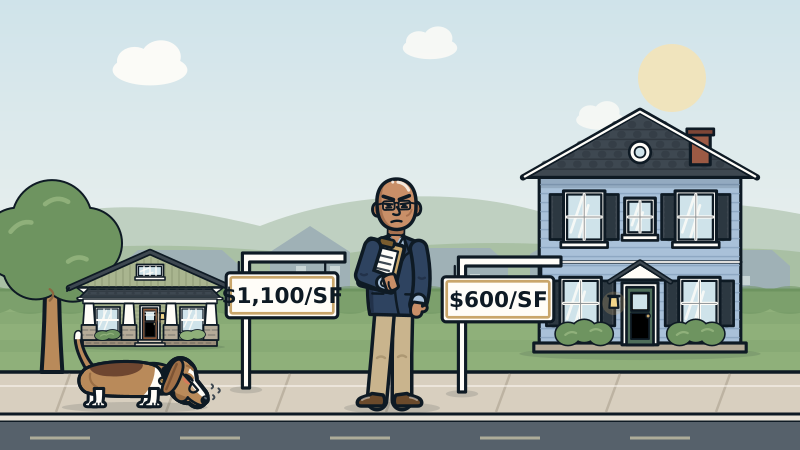
The cartoon on this post is only a slight exaggeration. A tiny house on a big lot can post a per-foot number that makes a mansion look like a bargain.
What the rules say appraisers must do instead
Lenders who sell loans to Fannie Mae have to follow its Selling Guide, and the guide is clear on this. Adjustments in an appraisal must reflect the market's reaction to a difference between homes. The appraiser is expected to analyze the market for competitive properties, not grab a handy number.
Fannie Mae even gives an example that sounds like it was written about price per square foot. It says it would be inappropriate for an appraiser to give a $20 per square foot adjustment based on a rule of thumb when market analysis shows the adjustment should be $100 per square foot. That is Fannie Mae's illustration, not a rate for your market. The point is the method: measure what buyers actually paid for the difference.
That fits how I work. Adjustments come from real sales, often paired sales (two similar homes that differ mainly in one feature, so the price gap shows what that feature is worth). The size adjustment for extra living area is almost always much smaller than the neighborhood's average price per square foot, for the same reason big houses look cheap per foot.
What I see in the field
When a seller tells me their home is worth a certain amount "because the street sells at $X a foot," I ask one question: which houses made that average? Usually it is a mix of small and large homes, old and remodeled, on different lot sizes. The average is real. It just does not describe any one house.
Here is what I actually do. I find the sales that are most like the subject, then adjust each one for the differences that the market shows matter: location, site, view, condition, quality, size, rooms and amenities. The value comes from where those adjusted sales line up, not from multiplying an average by a floor plan.
I still glance at price per square foot. If a comparable's per-foot price is far above or below the others, that tells me to look harder at it. Maybe it has a pool, a view or a brand new kitchen. Maybe it was a family sale. The number raises the question. The sales answer it. Facts over feelings, and averages are neither.
How to use price per square foot without getting burned
- Compare like with like. Only look at homes within a few hundred square feet of yours, on similar lots, in the same pocket of the neighborhood.
- Separate the remodeled homes from the original ones. Mixing them is how you end up overpricing a dated house or underpricing a redone one.
- Check the lot. If a comparable's lot is much bigger or smaller, its per-foot price is carrying land value that your house may not have.
- Look at the range, not the average. A spread from $650 to $1,050 per foot on one street is telling you the houses are different, not that the market is confused.
- Use it to spot outliers. A sale far outside the range deserves a closer look before you use it or toss it.
- Price from adjusted sales. When it is time to set a list price or argue a value, line up the closest sales and adjust for real differences.
Those dollar figures in step 4 are a made-up example, not a market report. Your street will have its own range, and that range is the most useful thing price per square foot will ever tell you.
Key takeaways
- Price per square foot treats every foot as equal, and buyers do not.
- Lot size, location, views, condition and outside influences all hide inside the average.
- Smaller homes usually show a higher price per foot and larger homes a lower one.
- Fannie Mae requires adjustments that reflect the market's reaction, not rules of thumb.
- Use price per square foot to spot outliers, then value from adjusted comparable sales.
People also ask
Do appraisers use price per square foot?
Many glance at it to check whether a comparable looks out of line. The value itself comes from comparable sales adjusted for the differences the market shows matter.
Why is my home's price per square foot lower than my neighbor's?
Often because your house is bigger. Land and basic features carry value regardless of size, so spreading the price over more square feet lowers the per-foot number.
Does adding square footage add the average price per foot?
Usually not. The market typically pays less for extra living area than the neighborhood's average price per foot, and the actual amount has to be measured from local sales.
Sources
Got a question we haven't answered?
Suggest a topic or ask your own appraisal question. The best ones become posts.