Do solar panels increase appraised value? Owned vs leased
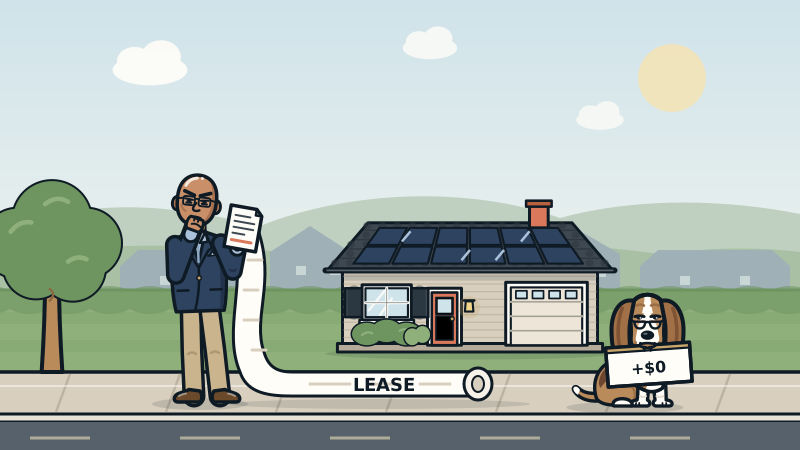
Owned solar panels can add appraised value, but only as much as buyers in your market actually pay for them. Leased panels and panels under a power purchase agreement are personal property, so they add nothing. Panels financed separately, often with a UCC filing, usually add nothing either until the lien is cleared.
Who owns the panels decides almost everything
Before I measure anything on a solar house, I ask one question: who owns those panels? The answer decides whether they are part of the house or just a very expensive tenant living on your roof.
Fannie Mae's rules split solar into a few buckets:
- Owned outright. You paid cash, or paid off the loan. The panels are part of the real estate, and normal appraisal rules apply. They can add value.
- Leased or under a power purchase agreement (PPA). A solar company owns the equipment and sells you the power or rents you the panels. Fannie Mae says these are personal property and are not included in the appraised value.
- Financed separately. You took a solar loan, and the lender's paperwork treats the panels as its collateral, often through a UCC filing (a public notice that a lender has a claim on the equipment). Fannie Mae says separately financed panels must not contribute to the value unless the loan documents show the panels cannot be repossessed in a default. When the panels secure a non-mortgage debt, the lender tells the appraiser not to give them any value.
Plenty of owners believe they own their system when they actually signed a 20-year lease at a kitchen table. The panels look exactly the same either way. The contract does not.
Owned panels still have to earn their value
Here is where people get disappointed. Even owned panels do not get added at what you paid for them.
Fannie Mae is direct about it. An appraiser may not adjust for solar on a dollar-for-dollar basis using the equipment and installation cost. The appraiser also may not simply add up the expected energy savings over the life of the system and call that the value. The rule is that the appraiser must analyze how the market reacts to the feature.
Fannie Mae also says the value of energy features varies across the country because of climate, utility costs and how buyers react to the cost. A system in a hot inland area with high power bills may matter to buyers much more than the same system under a foggy sky.
That lines up with how I work on every feature, not only solar. The invoice tells me what you spent. The market tells me what it is worth. Those are two different numbers, and only one goes on the appraisal.
How I measure what solar is worth in your neighborhood
I treat owned solar like any other feature on the adjustment grid. I look for what buyers actually paid.
- Find sales with and without solar. The best evidence is two similar homes, one with owned panels and one without, that sold close in time. That is called a paired sale.
- Clean up the other differences. If the solar house also had a bigger lot or a newer kitchen, I adjust those out first so the solar is the main thing left.
- Check more than one pair. One pair can be a fluke. I want several, and I check them against the wider market, not only the subject's own street.
- Use the cost or income view only as backup. Fannie Mae allows those approaches to support the analysis, but not to replace the market's reaction.
Sometimes there are not enough solar sales nearby to measure much at all. When that happens, a careful appraiser says so in the report instead of inventing a number. A guess wearing a calculator is still a guess.
What to give the appraiser before the visit
Documentation is the difference between solar that gets considered and solar that gets a shrug. If I cannot tell who owns the system or how much it produces, I cannot give it much weight. Have this ready:
- Proof of ownership: the purchase contract and proof the loan is paid off, or the lease or PPA if there is one
- System size in kilowatts (kW)
- Install date and the panel and inverter manufacturer
- Production data: actual output from the monitoring app or utility bills, or the installer's projection if the system is new
- Warranties on panels, inverter and workmanship, plus whether they transfer
- Any UCC filing and the payoff letter if you are clearing it
If your system is financed with a UCC filing, talk to your loan officer early. Paying off the solar loan before closing may change whether the panels can be counted. Your lender decides how that works on your loan, not the appraiser.
One more tip: print the first page of each document. Nobody has ever been sad to receive a clear one-page summary.
What I see in the field
The most common surprise is ownership. Owners say they own the panels, and then the paperwork says lease. That is not the owner's fault. Solar sales pitches can be fast, and the word lease does not always appear in big letters.
The second surprise is that owned solar can add value but rarely matches the install cost. That is normal. A new roof does not appraise at its invoice either. Buyers pay for what they want, at the price they want, and that is the number the appraiser is supposed to find.
The third is leased panels at sale time. Whatever happens to the lease when the house sells is written into the lease and the purchase contract. That is a question for the agents, the solar company and escrow, not something the appraiser can add to the value.
Facts beat feelings on solar the same way they do everywhere else. Bring the paperwork, and let the sales do the talking.
Key takeaways
- Leased and PPA solar panels are personal property and add nothing to appraised value.
- Separately financed panels, often marked by a UCC filing, usually cannot add value while the lien stands.
- Owned panels can add value, but only what local buyers actually pay, never the install cost.
- Hand the appraiser ownership papers, system size, install date, production data and warranties.
People also ask
Do leased solar panels lower my appraisal?
Fannie Mae says leased panels are not included in the appraised value. The lease itself can matter to buyers and lenders at sale time, which is a contract and underwriting question, not an appraisal adjustment.
Can I pay off my solar loan so the panels count?
Possibly. Clearing the lien can change how the panels are treated, but your lender sets the rules for your loan. Ask your loan officer before the appraisal is ordered.
Is there a standard dollar amount solar adds to a home?
No. Fannie Mae says the contribution varies with climate, utility costs and buyer reaction. The appraiser has to measure it from local sales.
Sources
Got a question we haven't answered?
Suggest a topic or ask your own appraisal question. The best ones become posts.