What is a home appraisal, and why does my lender need one?
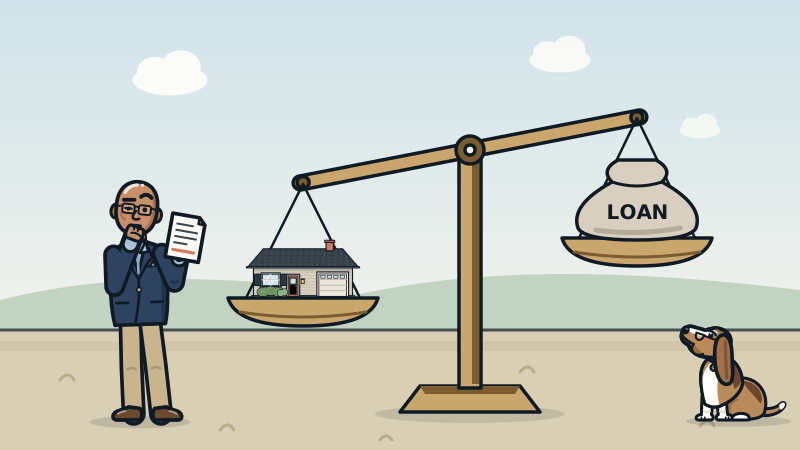
A home appraisal is a written opinion of what a property is worth, prepared by a licensed appraiser who is supposed to be independent of the deal. Your lender needs one because the house is the collateral for the loan. If you stop paying, the house is what protects the lender's money.
An appraisal is an opinion of value, written down and backed up
The Consumer Financial Protection Bureau (CFPB) puts it simply: an appraisal is a written document that shows an opinion of how much a property is worth. It also describes what makes the home valuable and may show how it compares to other homes in the neighborhood.
The key word in that definition is opinion. It is a professional opinion, with evidence behind it, but it is not a sticker price. Nobody at a factory stamped a number on your foundation.
The CFPB also calls an appraisal an independent assessment. That matters. The appraiser does not work for the seller, does not get a bonus if the deal closes, and is not supposed to care whether the number makes anyone happy. In my office, that is the whole job: facts over feelings.
Online estimates, the listing price and your uncle who "knows the market" are all opinions too. The difference is that an appraisal has to show its work.
Your lender needs one because the house is the collateral
Freddie Mac says the main purpose of an appraisal is to help the lender evaluate the collateral for the loan, which is your home. Collateral is the thing the lender can fall back on if the loan is not repaid.
Think about it from the lender's side. They are about to hand a large pile of money to someone they met three weeks ago. Before they do, they want proof that the house could cover that money if things went wrong. A lender lending more than a house is worth is like a pawn shop paying Rolex prices for a watch that says "Rolax."
That is also why the appraised value affects your loan amount. On a Fannie Mae purchase loan, the property value used for the loan-to-value ratio is the lower of the sales price or the appraised value. If you agree to pay more than the appraisal supports, the lender will not stretch the loan to match. The difference usually comes out of your pocket or out of a renegotiation.
What the appraiser actually looks at
Freddie Mac lists the kinds of things that go into the value, and many of them are outside your control: location, lot size, comparable nearby sales and market conditions. Then there is the house itself, including its size, interior, exterior, foundation and overall condition.
Here is how I work through a typical home:
- The property: I measure it, photograph it and rate its condition and quality.
- The neighborhood: What sells here, how fast, and whether prices are rising, flat or falling.
- Comparable sales (comps): Recent sales of similar homes nearby. These are the backbone of most home appraisals.
- Adjustments: No two houses match, so I adjust each comp for differences like size, condition and features. Those adjustments should come from what the market actually paid, not from a rule of thumb.
In the markets I work, buyers react to condition more than age. A remodeled 1960s house can beat a tired 2005 house, and a good appraisal should show why.
Who sets the rules appraisers follow?
Appraisers follow the Uniform Standards of Professional Appraisal Practice, called USPAP. It is published by The Appraisal Foundation, a private nonprofit, and the National Association of Realtors describes it as the generally accepted standards of appraisal practice in the United States.
According to NAR, Fannie Mae, Freddie Mac, HUD (which runs FHA loans) and the VA all require appraisals that comply with USPAP. Federal banking agencies require it too. Appraisers working on mortgage loans have to comply by law.
USPAP does not tell an appraiser what your house is worth. It sets the rules of the game: be impartial, be competent, do the research the job calls for and do not mislead the reader. Then each loan program adds its own rules on top. Fannie Mae, FHA and VA each have their own requirements for things like condition, repairs and how old the appraisal can be.
One more thing: in California, appraisers are licensed by the state. A license is not a guarantee of a great appraisal, but it does mean someone can be held accountable for a bad one.
Does every loan get a full appraisal?
No. The CFPB notes that your lender may also use other ways to check the value of the home. Some loans qualify for a waiver of the traditional appraisal, and others use different types of valuation. Whether your loan gets a full appraisal depends on the loan program, the property and the lender's own rules.
If your loan does get an appraisal, two rights are worth knowing. Under federal rules, on a typical first mortgage you are entitled to a copy of the appraisals and other valuations your lender gets. The CFPB says you should receive them soon after they are completed, and no later than three business days before closing. And you cannot be charged a fee for those copies, though you can be charged a reasonable fee for the appraisal itself.
Read your copy. It is the only document in your loan file that explains, in detail, why your house is worth what it is.
What to do before and after your appraisal
- Ask your loan officer which type of valuation your loan needs. Full appraisal, exterior only, desktop or a waiver. Each one works differently.
- Make access easy. Clear the path to the electrical panel, water heater, attic hatch and any detached buildings. If the appraiser can't see it, they can't give it credit.
- Write down your upgrades. List the roof, windows, kitchen, baths and systems with dates and permits. Hand the list over. It saves guessing.
- Do not try to coach the number. The appraiser is required to be independent. A list of facts helps. A list of hopes does not.
- Read the report when it arrives. Check the basics: bedrooms, baths, square footage, lot size and condition. Mistakes happen, and factual errors are the easiest thing to get corrected.
- If the value is low, talk to your lender first. Ask about their reconsideration of value process and what kind of evidence they accept.
Key takeaways
- An appraisal is an independent, written opinion of value backed by evidence.
- Your lender orders it because the house is the collateral for the loan.
- On a purchase, the loan is based on the lower of the price or the appraised value.
- Appraisers follow USPAP plus the rules of each loan program.
- You have a right to a free copy of the appraisal on most first mortgages.
People also ask
Is an appraisal the same as a home inspection?
No. An inspection looks for problems in the house for your benefit. An appraisal estimates market value for the lender, though the appraiser does note condition issues that affect value or safety.
Who pays for the appraisal?
The borrower usually pays, often through the lender. The CFPB says you can be charged a reasonable fee for the appraisal, but not for copies of it.
Can I use my appraisal to argue my property taxes?
An appraisal can be useful evidence, but property tax value in California follows its own rules. Ask your county assessor what they accept.
Sources
Got a question we haven't answered?
Suggest a topic or ask your own appraisal question. The best ones become posts.