Does living on a busy street lower your home's appraised value?
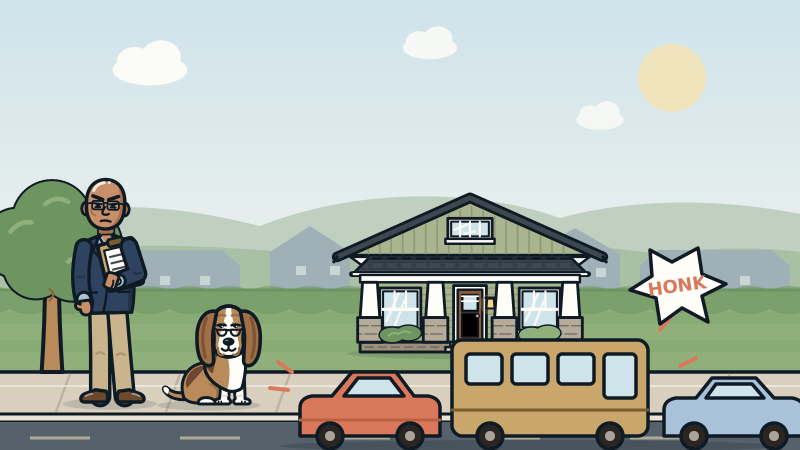
Often, yes. Traffic is a location factor, and buyers usually pay less for a house that fronts or backs to a busy road. One peer-reviewed study found an average discount of about 8.1%. The size of the discount in your market is different and has to be measured from local sales, not borrowed from a study.
Why traffic shows up in the price
Buyers notice noise, headlights, harder left turns out of the driveway and kids playing near a road that never sleeps. They notice it at the showing, and they notice it again when they write the offer.
Appraisers treat this as part of location. A location adjustment covers differences in how desirable or useful a property's location is. A quiet cul-de-sac and a four-lane road can be two blocks apart and still sit in different worlds.
Fannie Mae's sample pages for the redesigned appraisal report even show a site influence row with a "Busy Roadway" entry rated "Adverse." That is the official way of saying what every listing agent already knows: the house with the bus stop in the front yard will need a little help.
What the research found
The study most people quote is by James E. Larsen, published in 2012 in Transportation Research Part D. It looked at 9,670 home sales from January 1998 to March 2011 in a relatively small U.S. city.
- Homes fronting or next to a high-traffic street sold, on average, at about an 8.1% discount compared with similar homes that were not.
- Among homes on or next to high-traffic streets, more traffic meant lower prices. Each doubling of traffic volume was linked to about a 2.1% lower selling price on average.
That is useful. It shows the effect is real and that it grows with the traffic. But be careful with it. It is one city, one time period and one set of buyers. Your city is not that city.
I have seen people take a study like this, multiply 8.1% by their purchase price and call it a day. That is not an appraisal. That is a calculator with confidence.
How an appraiser actually measures it
The discount for a busy street changes from place to place. In a tight market with almost nothing for sale, buyers may grumble and pay up anyway. In a slower market, the busy-street house is often the last one to sell. The adjustment has to come from local evidence.
The best tool here is paired sales: two similar homes in the same area that sold around the same time, one on the busy road and one on a quiet street. The difference in price, after adjusting for anything else that differs, is the market telling you what the traffic costs. Several pairs that agree are much stronger than one.
When one road does not have enough sales, I widen the search to other busy roads in the same part of town and check whether the pattern holds there too. If the side by side pairs and the wider set of sales disagree, the one built on more sales gets more weight. One lucky pair is a story. Twenty sales pointing the same way is evidence.
The direction of the adjustment confuses people, so here it is plainly. Adjustments are made to the comparable sale (the comp), not to your house. If you are buying on a quiet street and a comp sits on a busy road, that comp gets adjusted upward, because it sold for less than it would have on your quiet street. If you are buying on the busy road and the comp is on a quiet street, the comp gets adjusted downward.
And if the comp is on the same busy street as your house, there is no traffic difference to adjust for. Same road, same noise, same line on the grid.
Not every busy street costs the same
"Busy" covers a lot of ground. A collector street with steady daytime traffic is not the same as a six-lane road with trucks at 2 a.m. A house that sides to a busy road with a tall wall may feel different from one whose front door opens onto it.
Things I look at:
- Does the house front the road, side to it or back to it?
- Is there a wall, a frontage road or a big setback?
- Is there a stoplight, a bus stop or a commercial driveway right there?
- Can you get in and out of the driveway safely?
- Did similar houses on this same road sell for less than nearby houses on quiet streets?
That last question decides it. My opinion of the noise does not set the adjustment. Neither does yours. The sales do.
What to do if you are buying on a busy street
- Visit at rush hour. Sunday at 10 a.m. is when every busy street pretends to be a country lane.
- Compare apples to apples. Ask your agent for recent sales on the same road and on nearby quiet streets. If busy-road homes sold for less, your offer should reflect that.
- Remember resale. A discount you get when you buy is a discount the next buyer will want too. That can be fine. Just price it in on both ends.
- Expect the appraiser to address location. If the comps all sit on quiet streets and none of them got a location adjustment, ask why.
- Do not overpay to win. A bidding war on a busy-street house can push the price past what the evidence supports. The contract price does not set value. The market does.
- Check the noise inside. Close the windows and listen. Newer windows and walls can change how the house lives, even if they do not change the address.
A busy street is not a dealbreaker. Plenty of people buy there on purpose and get more house for the money. Just make sure the price knows where the house is.
Key takeaways
- Traffic is a location factor, and buyers usually pay less for homes on busy roads.
- One study of 9,670 sales found an average discount of about 8.1%, in one small U.S. city.
- Your local discount must be measured with paired sales, not copied from a study.
- A comp on a busy road compared with a quiet-street house gets adjusted upward.
- A comp on the same busy street needs no traffic adjustment at all.
People also ask
Is a corner lot on a busy street worth less?
It can be, if the busy side brings noise or harder access. Corner lots have their own pros and cons, so the effect has to be measured from local sales.
Can a sound wall or new windows erase the discount?
They can soften how the house lives inside, but the location is still the location. Whether buyers pay more for those features is something local sales have to show.
Will a lender refuse a house on a busy street?
Not because of the street alone. The appraiser reports the location influence and adjusts for it, and the value reflects what buyers pay for homes in that setting.
Sources
Got a question we haven't answered?
Suggest a topic or ask your own appraisal question. The best ones become posts.