What does California's AB 948 appraisal bias law require?
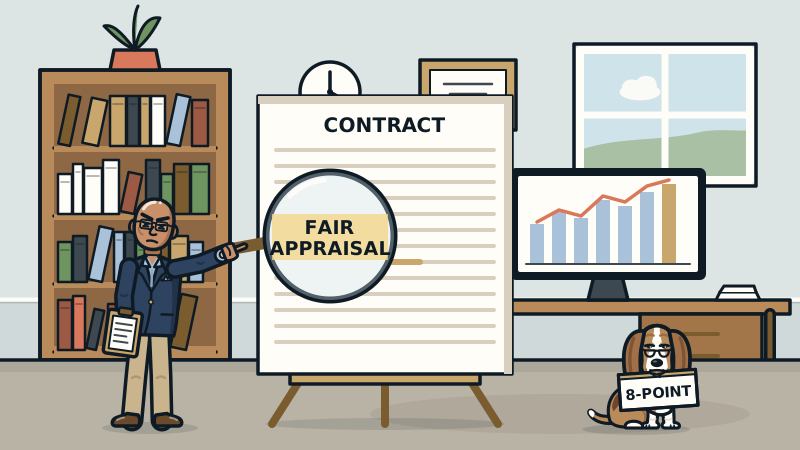
California's AB 948, the Fair Appraisal Act of 2021, requires a notice in every California home sale contract signed after July 1, 2022, and in qualifying refinances, saying appraisals must be unbiased. It bars appraisers from basing value on protected traits and tells you to report concerns to your lender or the Bureau of Real Estate Appraisers (BREA).
AB 948 is a 2021 law with four main jobs
AB 948 is officially called the Fair Appraisal Act. It was signed on September 28, 2021, as Chapter 352 of the Statutes of 2021. People sometimes date it later because the parts they notice, the contract notice and the new training, kicked in during 2022 and 2023.
The law does four main things:
- A notice in sale contracts. Civil Code section 1102.6g requires every contract for the sale of real property after July 1, 2022 to include a fair appraisal notice in at least 8-point type.
- A notice on certain refinances. A licensed lender or broker refinancing a first-lien loan on a home with up to four units has to deliver the same notice, before or with the loan estimate.
- A rule for appraisers. Business and Professions Code section 11424 says an appraiser cannot base a value opinion, in whole or in part, on protected traits of the owners, the occupants or the people who live nearby.
- Changes at BREA. The Bureau of Real Estate Appraisers had to update its complaint form, collect optional demographic data from people who complain, and report that data to the Legislature by July 1, 2024.
It also amended the Fair Employment and Housing Act (Government Code section 12955) to make it plainly illegal for anyone in the appraisal business to discriminate when offering or doing appraisals.
What the notice says, in plain words
You have probably signed this notice already and not noticed. It sits in the contract paperwork with about forty other notices, somewhere between the smoke detector rule and the page your agent flags with a sticky arrow.
The notice says any appraisal of the property must be unbiased, objective and not influenced by improper or illegal considerations. It lists protected traits, such as race, religion, gender, disability and age, among others. Then it tells a buyer or seller who thinks an appraisal was influenced by any of those things what to do: report it to the lender or mortgage broker that hired the appraiser, or file a complaint with BREA.
On a refinance, the notice can be folded into the federal notice that tells you about your right to a copy of the appraisal. That is allowed by the statute, which is why you may see the two printed together.
Here is what the notice does not do. It does not create a new appeal process, set a deadline for the lender, or promise a second appraisal. It is a sign on the wall that points to the exits. The exits themselves are the lender's review process and the complaint routes.
Where the reconsideration of value fits
A lot of people search for an "AB 948 ROV." The reconsideration of value (ROV), a formal request asking the appraiser to look again at specific facts, does not come from AB 948. On most conventional loans it comes from Fannie Mae and Freddie Mac policies, which require lenders to tell borrowers how their ROV process works. I cover those rules in how a reconsideration of value works.
The two fit together like this. AB 948 tells you that bias is illegal and where to report it. The lender's ROV process is how you ask for the value itself to be looked at again on your loan. A BREA complaint is about the appraiser's conduct and license. Each one does a different job:
| Route | What it can do |
|---|---|
| Lender ROV | Ask the appraiser to review specific facts or sales before closing |
| BREA complaint | Investigate the appraiser and discipline a license |
| Civil Rights Department or HUD complaint | Investigate housing discrimination |
Only the first one can change the number on your loan. The others can matter a great deal, but they move at government speed, and escrow does not.
Steps for a California borrower who has a concern
- Get the full report. Not the one-page summary. You need the comps, the adjustments and the comments.
- Write down the specific facts. Page number, the comment or comp, and why it concerns you. Language about the people in a neighborhood instead of the houses is one thing to flag. Better sales that were skipped with no reason is another.
- Send it to the lender in writing, before closing. Ask for its ROV process and say plainly if you believe bias played a part. On a loan, the appraiser works for the lender, so the lender is the channel.
- Add better sales if you have them. Closed, close by, recent and truly similar. Fewer strong sales beat a long list of weak ones.
- File a complaint if you want one. BREA takes complaints on form REA 4001 or online. It must be signed and dated under penalty of perjury. California's Civil Rights Department takes housing discrimination complaints, and state law generally gives you one year from the violation to file there.
- Keep copies of everything, with dates. A clean paper trail does most of the work later.
If you are thinking about a lawsuit, talk to a California fair housing attorney. This post is general information, not legal advice.
What changed on the appraiser's side
AB 948 also changed what it takes to hold a California appraisal license. Starting January 1, 2023, new applicants need at least one hour of cultural competency training. Licensees renewing on the four-year cycle need one hour of cultural competency and two hours of elimination of bias training.
BREA's complaint form changed too. It now asks whether you believe the value is below, at or above market value. It also has an optional question about protected classes, with a "prefer not to disclose" choice. That data is how the state can see patterns instead of guessing at them.
Loan officers should know one more piece. The refinance notice is your shop's job. If your disclosure package for a first-lien refinance on a one to four unit home does not include it, fix that before a borrower or an examiner points it out.
What I see in the field
A good appraisal talks about houses, sales and the market. It does not talk about who lives on the street. That is my test for every comment I write: could I read it out loud to the homeowner without anyone wincing?
When someone raises a concern, the strongest ones are calm and specific. "Comp 3 is two miles away in a different school district, and these two closer sales were skipped" gets a real answer. A long letter full of adjectives gets a long reply full of adjectives, and nothing moves.
Facts over feelings works in both directions. If a value is low because the evidence was ignored, the evidence should fix it. If you want an independent read before you decide what to do, a desktop review checks another appraiser's report against the sales, page by page. And if you suspect something worse than a bad comp, read what to do if you think an appraisal was biased.
Key takeaways
- AB 948, the Fair Appraisal Act, became law in 2021. Its contract notice started July 1, 2022.
- The notice tells you to report bias to the lender that hired the appraiser or to BREA.
- California appraisers cannot base value on protected traits of owners, occupants or neighbors.
- The ROV comes from lender and Fannie Mae or Freddie Mac rules, not AB 948, and must happen before closing.
- A BREA or Civil Rights Department complaint does not change the value on your loan by itself.
Getting this answered in California
AB 948 is a statewide law, so its fair appraisal notice appears in California home sale contracts and qualifying refinances in every county, from Alameda to Riverside. I am a California Certified Residential Appraiser (License AR041465) and appraise homes statewide, including Los Angeles County, Alameda County, Sacramento County, Riverside County. See every area I serve.
Get the best posts once a week.
Priced Right is one email a week with the most useful appraisal and pricing posts and what the market is doing. Never more than one a week. Unsubscribe anytime.
People also ask
Is AB 948 a 2021 or 2023 California law?
AB 948 was signed on September 28, 2021, as Chapter 352 of the Statutes of 2021. Its contract notice started July 1, 2022, and its training rules for appraisers started January 1, 2023, which is why some people date it later.
Does AB 948 give me the right to a second appraisal in California?
No. AB 948 requires a notice and bans bias in appraisals, but it does not promise a second appraisal. Your lender decides that, often through its reconsideration of value process or when there are documented signs of a problem.
Where do I report a biased appraisal in California?
The AB 948 notice points you to the lender or mortgage broker that hired the appraiser and to the Bureau of Real Estate Appraisers. You can also file a housing discrimination complaint with California's Civil Rights Department, generally within one year, or with HUD.
Do California refinance borrowers get the AB 948 notice?
Yes, on a first-lien refinance of a home with up to four units by a licensed lender or broker. It must be delivered before or with the loan estimate, and it can be combined with the federal notice about your right to a copy of the appraisal.
Sources
Got a question we haven't answered?
Suggest a topic or ask your own appraisal question. The best ones become posts.