How do construction loan appraisals work?
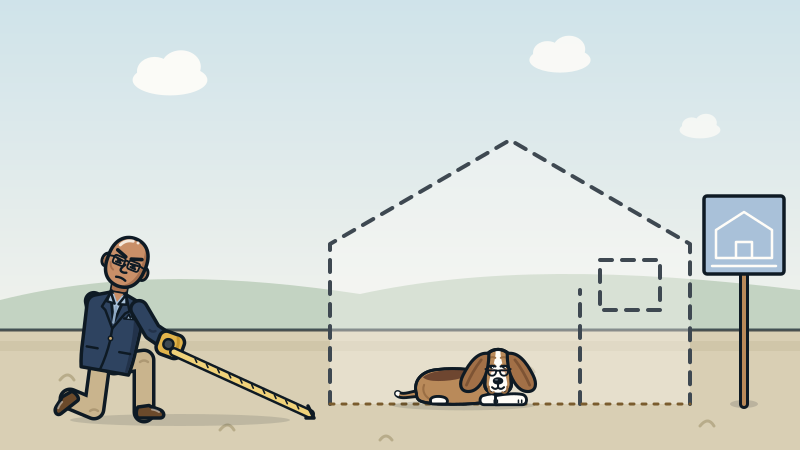
The appraiser values the finished house before it is built, using the plans, specifications and sales of similar completed homes. That as-completed value helps set the loan amount. When construction ends, a completion report confirms the house was built as planned. Fannie Mae and each lender add their own timing and value rules.
The appraiser values a house that does not exist yet
A normal appraisal values the house in front of you. A construction appraisal values a house that is currently a pile of lumber, a permit and a lot of optimism.
Federal banking guidelines for appraisals describe the values a lender may ask for. Usually that includes the current market value as is, plus a prospective market value upon completion. Those prospective values are supposed to be based on current and reasonably expected market conditions, not on hope.
For the as-completed value, Fannie Mae says an appraisal for new construction must be based on plans and specifications, an existing model home or other information that shows the proposed features. In plain words: I value the house on paper, as if it were finished on the effective date, and compare it to similar finished homes that have actually sold.
The as-is value matters too. On many construction loans, the lot or the existing structure is part of the deal, and the lender wants to know what it is worth today.
Cost is not the same as value
This is the part that hurts builders' feelings. What it costs to build a house and what the market will pay for it are two different numbers.
Fannie Mae's rule for single-closing construction-to-permanent loans on a purchase makes the point. The loan-to-value ratio is figured from the lesser of two numbers: the construction cost plus the lot price, or the as-completed appraised value of the lot and improvements. If the finished house appraises below what you are spending, the lender uses the lower number.
For a borrower who already owns the lot (a limited cash-out refinance in Fannie's terms), the loan-to-value is based on the as-completed value, and the borrower must hold title to the lot before the first construction advance.
Here is what I see in the field. The most common gap is overbuilding for the street. A $300,000 kitchen in a neighborhood of modest ranch homes is a beautiful kitchen and a lonely appraisal. The market pays for what buyers in that location have proven they will pay for, and I measure that from real sales, not from the invoice.
The market read has to be current
A construction appraisal is a bet about the future made with evidence from the present. That makes the market read matter more than usual.
I do not settle for a lazy twelve-month average. I test the most recent window the sales can support, because a market that was rising six months ago may have gone flat since. If the trend is changing, the report should say so and show the sales behind it.
Comparable sales (comps) for new construction also need care. The best comps are similar new or nearly new homes in the same area. A remodeled 1960s house can compete with new construction when its condition is close, because buyers react to condition more than age. A tired 2005 house usually cannot, even though it is younger. Which ones belong in the comparison is something I measure from what buyers in that market actually paid, not something I assume.
Builders sometimes want the appraiser to use the one record sale in the zip code. I will look at it. I will also look at every sale that did not set a record.
Timing rules on Fannie Mae construction-to-permanent loans
For Fannie Mae single-closing construction-to-permanent loans, the Selling Guide sets a few rules every builder and loan officer should know:
- Appraisal age. The appraisal's effective date can be no more than four months before the note date, which is the construction loan closing date.
- Completion report. When the house is finished, a Form 1004D must be completed in full, including the appraisal update and the certification of completion.
- If value went down. If the 1004D shows the value declined, the lender must get a new appraisal and requalify the borrower using the updated loan-to-value.
Other loan types work differently. Portfolio lenders, private lenders and other programs set their own rules, and the lender's overlays control. Ask your loan officer for the exact requirements before the appraisal is ordered, not after the framing is up.
What happens at completion
Fannie Mae says the appraiser can complete the completion report section of Form 1004D after an on-site visual inspection. All completion documentation has to include visual proof, such as photos. For new construction, Fannie also allows a borrower and builder attestation letter with interior and exterior photos in some cases, if both parties can sign it.
At the completion visit, I am checking that the house matches what I valued. Same square footage, same layout, same finishes. If the plans showed quartz counters and I find laminate, that is a conversation. If the plans showed four bedrooms and I find three and a home gym that used to be a bedroom, that is a longer conversation.
Changes during construction are normal. Surprises at completion are not fun for anyone. If the design changes, tell the lender and the appraiser early, so the value is based on the house you are actually building.
What to hand the appraiser
- Final plans with floor plans, elevations and the square footage of the living area.
- The specifications or finish schedule: roof, windows, flooring, cabinets, counters, appliances, heating and cooling.
- The construction contract and cost breakdown, including the lot price or the date you bought the lot.
- Permits and approvals that exist so far.
- Site details: lot size, any slope, views, utilities and any separate structures like an ADU, which is valued separately from the main house.
- Similar homes you know of that sold recently. I will check them, and good ones help.
- A heads-up on changes. Any upgrade or cut after the appraisal should go to the lender in writing.
Key takeaways
- A construction appraisal values the finished house from plans and specifications, compared to sold homes.
- Lenders may want both an as-is value and an as-completed value.
- On Fannie purchase loans, LTV uses the lesser of cost plus lot or the as-completed value.
- A Form 1004D at completion confirms the house; a value drop means a new appraisal on Fannie loans.
People also ask
Does the appraiser need to visit the lot before construction?
It depends on the lender and the scope of work. The finished value comes from the plans, but ask your loan officer whether the site itself will be inspected first.
What if my construction appraisal comes in below cost?
On a Fannie Mae purchase, the loan-to-value is based on the lower of cost plus lot or the as-completed value. You may need more cash, lower costs or a plan that fits the market better.
Do I need a new appraisal if construction takes a long time?
It depends on the program. On Fannie single-closing loans, a 1004D at completion updates the value, and a decline triggers a new appraisal.
Sources
Got a question we haven't answered?
Suggest a topic or ask your own appraisal question. The best ones become posts.