Does a pool add value to a home appraisal?
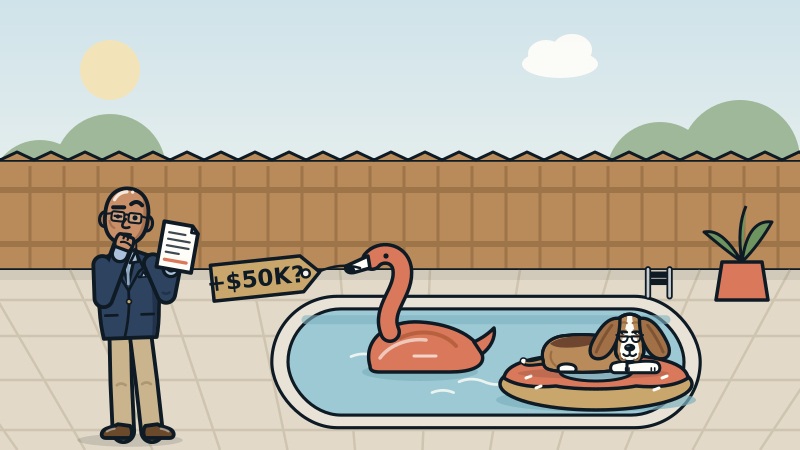
Sometimes. A pool adds appraised value only when buyers in your market actually pay more for homes that have one. In warm areas where pools are common, it may be close to expected. In other markets it adds little. Fannie Mae requires the adjustment to reflect market reaction, so local sales decide.
The honest answer is "it depends," and here is on what
Every seller with a pool has heard a number. Somebody's brother-in-law said a pool adds $50,000. Somebody else said it adds nothing and scares off families with toddlers. Both of them said it with total confidence.
Here is how it really works. Fannie Mae's Selling Guide says adjustments must reflect the market's reaction to the difference between properties. Not the cost of the pool. Not what it would cost to build today. What buyers in your area actually paid for it.
That reaction changes with a few big things:
- Climate. Long, hot summers make a pool useful most of the year. Short summers make it a cover you look at.
- Neighborhood norms. If most nearby homes have pools, buyers expect one.
- Lot size. On a small lot, a pool can eat the only yard there is.
- Price tier. At higher price points, buyers may expect more amenities.
- Condition. A clean, working pool is a feature. A green one is a project.
Why a pool can be an expectation instead of a bonus
Picture two streets. On the first, almost every backyard has a pool. On the second, almost none do.
On the first street, a pool is close to standard equipment. Buyers shopping there assume they are getting one. A house without one may need a lower price to compete, but a house with one is not getting a big premium for having what everyone else has. It is like bragging that your car has doors.
On the second street, the pool is rare. The premium depends on whether pool-loving buyers are shopping there at all. If they are, the house may stand out. If they are not, the pool can sit in the price like an expensive lawn ornament.
This is why a single national figure for pool value is close to useless for an appraisal. The number that matters is the one your own market produced.
How I actually measure what a pool is worth
I start with paired sales. Paired sales means finding homes that are similar in most ways, where one has a pool and one does not, and comparing what they sold for. If similar houses with pools keep selling for more than those without, the market is telling me something.
One pair is a rumor. Several pairs are evidence. I look at as many as the area supports, then check the result against the wider market so one odd sale does not drive the number.
Then I look at the condition of the pool and equipment. A pool with a cracked surface, failing pump or no working equipment does not get the same treatment as one that is ready to swim.
The adjustment can come out positive, close to zero, or, in some markets, negative. Whatever it is, it has to come from what buyers did, not from a rule of thumb.
Above-ground pools and other edge cases
An above-ground pool is generally treated as personal property, not part of the real estate. It can be taken apart and moved, a lot like a trampoline with ambitions. In most appraisals it adds little or nothing.
Portable extras follow the same logic. If it can be unplugged, drained and loaded onto a truck, ask whether it is staying with the house. If it is going with you, it is not part of what I am valuing.
Permits matter too. A pool built without permits can raise questions, and the appraiser has to report what is there and what is known about it. If your pool was permitted and finaled, have that paperwork ready.
Safety features belong in the conversation as well. Fencing, covers and alarms can matter to buyers with young kids, and local rules may require some of them. Check your city or county rules before you list.
Three pool myths I hear every summer
Myth one: the pool is worth what it cost. Buyers do not see your invoice. They see a backyard, compare it to other backyards, and decide what it is worth to them. A pool that cost a fortune can still earn a modest adjustment if the market shrugs.
Myth two: there is a standard percentage. You will find national estimates online, and some of them come from serious sources. They are averages across very different places. Your appraisal has to rest on sales near you, not on an average that includes Phoenix and Minneapolis in the same bucket.
Myth three: the appraiser skipped the pool. When a grid shows a small pool adjustment, or none, that is not the same as ignoring it. It can mean the comparable sales also had pools, so there was nothing to adjust for. Like for like needs no adjustment. Read the comps before assuming the pool went missing.
Facts over feelings applies to backyards too.
What to do before your appraisal
- Make it swimmable. Clean water, working pump and filter, no loose tiles. First impressions show up in photos.
- Gather the paperwork: permits, the year it was built, recent resurfacing, new equipment, heater or solar heating.
- List the upgrades with dates and hand that list to the appraiser.
- Share local sales you know of that had pools, and similar ones that did not. Let the appraiser test them.
- Keep expectations honest. If the pool cost $100,000 to build, the market may not pay $100,000 for it. Cost and value are two different things.
Key takeaways
- A pool adds appraised value only when local buyers pay more for one.
- Where most homes have pools, a pool is closer to expected than to a premium.
- Above-ground pools are generally treated as personal property.
- Fannie Mae requires market-based adjustments, so local paired sales govern.
- Bring permits, dates and equipment upgrades to the appraisal.
People also ask
Can a pool lower my home's value?
It can in some markets, especially where buyers see upkeep and safety as a burden or where the pool takes up most of a small yard. A pool in poor condition can also count against the house.
Should I add a pool before selling?
Rarely for appraisal reasons. Building one costs far more than most markets pay back right away. Add a pool because you want to use it.
Should I fill in my pool before selling?
Talk to a local agent first and look at what sold nearby. Removing a pool costs money and can limit your buyer pool in markets where pools are popular.
Sources
Got a question we haven't answered?
Suggest a topic or ask your own appraisal question. The best ones become posts.