How does LA's Measure ULA mansion tax affect pricing in California?
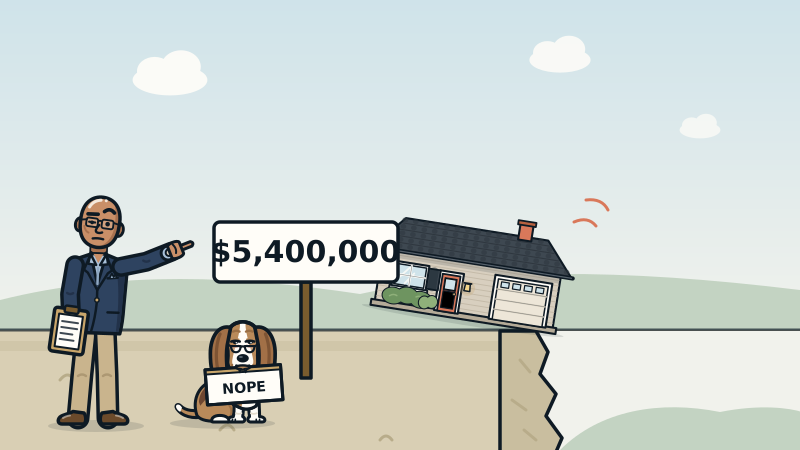
In the City of Los Angeles, California, Measure ULA adds a 4% tax on the full price of sales over $5,400,000 and 5.5% on sales of $10,900,000 or more, for sales closing after June 30, 2026, per the LA Office of Finance. Because it taxes the whole price, sellers often price and negotiate just under each line.
What Measure ULA is and where it applies
Los Angeles voters approved Measure ULA in November 2022. The city calls it the Homelessness and Housing Solutions Tax, and it lives in Los Angeles Municipal Code section 21.9.2(b). It applies to sales on or after April 1, 2023. Everyone else calls it the mansion tax, which is a funny name for a tax that also hits apartment buildings and strip malls.
It is a City of Los Angeles tax. Beverly Hills, Santa Monica, Pasadena and the other cities in Los Angeles County are separate cities with their own rules. A Los Angeles mailing address does not always mean the City of Los Angeles, so check the jurisdiction before you do any math.
The thresholds move every July 1 with the Chained Consumer Price Index. Here is what the LA Office of Finance lists for sales closing after June 30, 2026:
| Sale price | Base city tax | ULA tax | Total city rate |
|---|---|---|---|
| $5,400,000 or less | 0.45% | 0% | 0.45% |
| Over $5,400,000, under $10,900,000 | 0.45% | 4% | 4.45% |
| $10,900,000 or more | 0.45% | 5.5% | 5.95% |
One detail people miss: the city says the ULA tax uses gross value, which includes any loan that stays on the property, such as one the buyer assumes. Who pays is spelled out in the purchase contract, and sellers usually carry it.
Why the line works like a cliff, not a ramp
Most taxes climb like a ramp. Measure ULA drops off like a cliff. The ordinance charges 4% "of the consideration or value," so the moment a sale crosses the line, the whole price gets taxed. The part above the line is not the only part that counts.
Run it. A sale at exactly $5,400,000 owes no ULA tax. A sale at $5,400,001 owes about $216,000. That one extra dollar may be the most expensive dollar in Los Angeles.
Now flip it around and ask what price leaves the seller with the same money as a $5,400,000 sale. Divide $5,400,000 by 0.96 and you get $5,625,000. Anywhere between those two numbers, the seller walks away with less cash than if they had sold for $5,400,000. I call that stretch the dead zone. Nobody wants to own a sale there.
Researchers have noticed. A May 2026 report from the city's Chief Legislative Analyst reviewed a UCLA Lewis Center study that found a drop of roughly 50 percent in sales above the $5 million threshold. The study said the cliff gives owners near the line a reason to keep the price under it or not sell at all.
Watch the calendar too. The city ties the thresholds to when the sale closes, and they reset each July 1. A deal that opens escrow in June and closes in July can land under a different line than the one in the listing plan.
How sellers and buyers price around the line
Once you see the dead zone, the pricing habits make sense. Agents list at $5,395,000 instead of $5,500,000. Buyers know it. Sellers know buyers know it. Everybody is playing poker, and the threshold is face up on the table.
Here is a hypothetical. Say a Brentwood house would bring about $5,550,000 if the tax did not exist. Sold at that price, the seller pays 4% on the whole thing and nets about $5,328,000 before other costs. Sold at $5,400,000, the seller nets $5,400,000. The seller does better at the lower price, so the house sells at the line. The buyer gets a good deal, and the public record shows $5,400,000.
To make sense above the line, a price has to clear the dead zone by a real margin. In practice, that means houses either hug the threshold or jump well past it.
Some people try to slip under the line by moving money into furniture, side agreements or credits. The tax is on the consideration or value of the real property. Whether a deal structure works is a question for your attorney or CPA, not your cousin with the podcast. And any terms that change the real price belong in the contract the appraiser reads.
What I do with sales piled up under the line
When I appraise near a threshold, I often find a stack of sales at $5,350,000 to $5,400,000 and a gap just above. Those are real sales. Buyers and sellers agreed on them with the tax in the room. I do not throw them out, and I do not assume they are wrong.
I also do not assume every house in that stack is worth the same. A cluster at the line can hold houses that would have sold for more without the tax, and houses that just barely got there. The contract price does not set value. The evidence does.
So I read them one at a time. Here is what I check:
- Listing history. Did it list at $5,600,000, sit, and then close at $5,399,000? That tells a different story than a house that listed at $5,395,000 and got multiple offers.
- Sale to list ratio and days on market for listings just above the line versus just below.
- Sales that cleared the dead zone by a wide margin, and what they had that the stack did not.
- Nearby markets outside the city limits, where the line does not exist, as a check on the pattern, adjusted for the location difference.
The reverse matters too. If your house sits outside the City of Los Angeles but the best sales are inside it, sales piled under the line may understate what your house can bring without the tax. Facts over feelings, in both directions.
Is this just a Los Angeles thing?
No. San Francisco also sets its transfer tax by the band the entire price falls into. Its official transfer tax page lists $3.75 per $500 for sales from $1,000,000 to under $5,000,000, and $11.25 per $500 from $5,000,000 to under $10,000,000. That is a jump from about $37,500 to $112,500 at the $5 million mark. Smaller than LA's cliff, but nobody likes falling off a smaller cliff either.
Back in Los Angeles, the rules may change again. The City Clerk's November 2026 ballot materials include Measure TE, a proposed one-time exemption for qualifying sales of homes damaged or destroyed in the January 2025 Palisades Fire. If voters approve it, it would change the math only for those properties. Check the Office of Finance for the rules in effect on your closing date.
What to do if your house is near the line
- Confirm the city. Make sure the property is inside the City of Los Angeles before you plan around ULA.
- Check the threshold for your closing date. The numbers reset every July 1.
- Do the net math. Multiply any price over the line by 0.96 and compare it to the threshold. If the result is lower, you are in the dead zone.
- Price with evidence. A pre-listing appraisal shows whether your house belongs at the line or well past it.
- Keep every term in the contract. Credits, furniture and side deals all get read. Ask your CPA or attorney before you structure anything around the tax.
- Buyers, read the room. A seller with an offer just over the line has a strong reason to take a lower number. That is not a lowball. That is arithmetic.
If you work in the city and want sales read one at a time instead of averaged, see how I work as a Los Angeles County appraiser.
Key takeaways
- Measure ULA applies only in the City of Los Angeles and taxes the whole price once a sale crosses the line.
- For sales closing after June 30, 2026, the lines are $5,400,000 (4%) and $10,900,000 (5.5%).
- Between $5,400,000 and about $5,625,000, a seller nets less than selling at $5,400,000.
- Sales clustered under the line are real sales, but each one still has to be read, not assumed.
Getting this answered in California
Measure ULA applies only to sales inside the City of Los Angeles, and San Francisco has its own transfer tax set by the band the full price falls into. I am a California Certified Residential Appraiser (License AR041465) and appraise homes statewide, including Los Angeles County, San Francisco County. See every area I serve.
Get the best posts once a week.
Priced Right is one email a week with the most useful appraisal and pricing posts and what the market is doing. Never more than one a week. Unsubscribe anytime.
People also ask
Does the LA mansion tax apply to the whole sale price?
Yes. The ordinance taxes 4% or 5.5% of the consideration or value once a sale crosses the threshold. It is not limited to the amount above it. That is why the line acts like a cliff.
What are the Measure ULA thresholds in 2026?
For sales closing after June 30, 2026, the LA Office of Finance lists 4% on sales over $5,400,000 and under $10,900,000, and 5.5% at $10,900,000 or more. The thresholds adjust every July 1 with inflation.
Does Measure ULA apply in Beverly Hills or Santa Monica?
No. Measure ULA is a City of Los Angeles tax. Other cities in Los Angeles County are separate and set their own transfer taxes, so check the city where the property sits.
Will an appraiser lower my value because of the mansion tax?
Not automatically. A good appraiser reads the sales near the threshold one at a time, including listing history and days on market, to see what buyers actually paid for houses like yours.
Sources
- City of Los Angeles Office of Finance: Real Property Transfer Tax and Measure ULA FAQ
- Los Angeles City Clerk: Initiative Ordinance ULA (ballot text)
- Los Angeles Chief Legislative Analyst report, Council File 26-0088-S1 (May 13, 2026)
- Los Angeles City Clerk: Measure TE ballot materials
- City and County of San Francisco: Transfer tax
Got a question we haven't answered?
Suggest a topic or ask your own appraisal question. The best ones become posts.