Price cut or rate buydown: which one survives the appraisal?
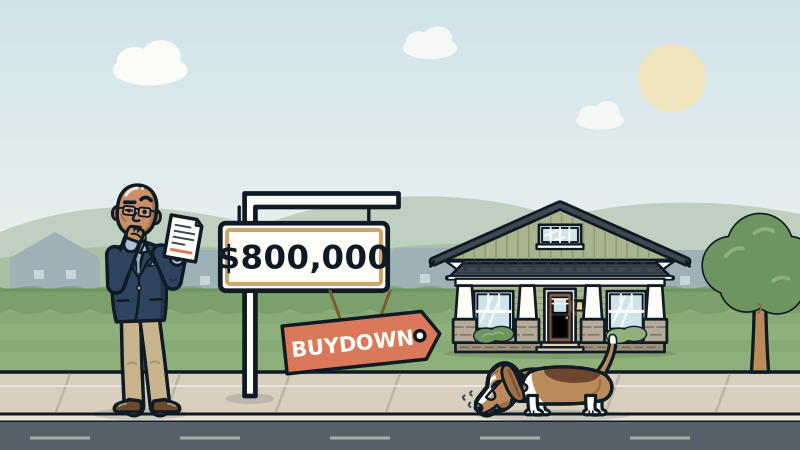
A price cut is the safer bet for the appraisal, because it lowers the number the sales have to support. A seller-paid rate buydown keeps the price higher and counts as a financing concession. It has to be disclosed, it falls under loan limits on seller contributions, and the appraiser looks harder at whether the price is market value.
Two ways to spend the same seller money
When a listing stalls and rates are high, the seller usually has two levers. Lower the price. Or keep the price and pay to lower the buyer's interest rate, which is called a rate buydown.
A permanent buydown uses discount points to lower the rate for the life of the loan. A temporary buydown lowers the payment for the first year or two, then it steps back up to the note rate. The popular one is a 2-1: two points lower in year one, one point lower in year two.
Both levers cost the seller money. Both help the buyer. But the appraiser sees them very differently. One changes the price. The other changes the deal around the price.
The listing agent's version of this argument usually goes, "Keep the price, we'll protect the comps." Hold that thought. We will come back to who is actually protecting what.
What each one does to the appraisal
A price cut lowers the contract price. The appraiser analyzes that contract and then tests it against closed sales. A lower price is easier to support. Fannie Mae uses the lower of the price or the appraised value for loan-to-value, so a price the sales cannot reach costs the buyer either cash or the deal.
A seller-paid buydown leaves the price where it was. Fannie Mae lists interest rate buydowns and other below-market financing as financing concessions. The appraiser reports them and has to consider whether the contract price includes money the seller is effectively handing back.
That does not mean the appraiser subtracts the buydown dollar for dollar. Fannie Mae says dollar-for-dollar deductions are not appropriate unless the analysis shows the market reacted with the full amount. The adjustment is whatever the market actually did, which has to be measured. I go deeper on that in why seller credits are not dollar for dollar.
The short version: a price cut shrinks the question. A buydown leaves the same big question and adds a second one.
The loan has its own limits
On a Fannie Mae loan, a seller-paid buydown is an interested party contribution. The cost counts toward the maximum financing concession, which is based on the lower of the price or the appraised value:
| Occupancy and loan-to-value | Maximum seller contribution |
|---|---|
| Main home or second home, over 90% | 3% |
| Main home or second home, 75.01% to 90% | 6% |
| Main home or second home, 75% or less | 9% |
| Investment property, any loan-to-value | 2% |
Anything over the limit is treated as a sales concession, deducted from the price, and the loan-to-value is recalculated. Contributions also cannot be more than the buyer's closing costs.
Two more Fannie Mae rules matter for a temporary buydown. The lender must qualify the buyer at the full note rate, not the bought-down rate. And temporary buydowns are not allowed on investment property or cash-out refinances. So a 2-1 buydown lowers the early payments, but it does not help a buyer qualify for more house on a Fannie Mae loan.
FHA, VA and other loan programs set their own limits. Check with the loan officer before the counteroffer goes out, not after the appraisal comes back.
The math on a hypothetical $800,000 house
Here is a made-up example to show how the two levers compare. Assumptions: an $800,000 list price, 10% down, a 30-year fixed loan at 6.5%, principal and interest only. A 2-1 buydown on a $720,000 loan costs the seller about $16,400 (the total of the payment savings). Give the price cut the same $16,400.
| 2-1 buydown at $800,000 | Price cut to $783,600 | |
|---|---|---|
| Loan amount | $720,000 | $705,240 |
| Down payment | $80,000 | $78,360 |
| Year 1 payment | about $3,648 | about $4,458 |
| Year 2 payment | about $4,088 | about $4,458 |
| Year 3 to 30 payment | about $4,551 | about $4,458 |
| Price the comps must support | $800,000 | $783,600 |
The buydown wins the first two years by a lot. The price cut wins every month after that, by about $93, plus $1,640 less down. It also asks the appraiser to support $16,400 less.
A permanent buydown sits in between, but how much rate a dollar of points buys depends on the lender's pricing that day. Get a real quote before comparing.
When each one makes sense
- Price cut: when the closed sales are softer than the list price, when the buyer is short on cash, or when the buyer plans to keep the loan a long time. It is also the only lever that fixes an overpriced listing instead of decorating it.
- Temporary buydown: when the buyer expects income to rise, or wants breathing room in the first two years. Do not sell it as "refinance later." Nobody knows where rates go, and the agent who promises that is writing checks the bond market has not signed.
- Permanent buydown: when the buyer plans to keep the loan long enough for the lower rate to pay back the cost.
- A mix: a small cut plus a small credit can keep both numbers inside the limits and inside what the sales support.
For any of these, do the sales check first. If the closed comps already support the list price, a buydown is a financing choice. If they do not, a buydown is just a more expensive way to find out the price was too high.
What I see in the field
Remember "protect the comps"? Here is the problem with it. When a sale closes at $800,000 with a $16,400 buydown, the next appraiser should find that buydown in the record and ask what it did to the price. A concession that is disclosed does not protect anyone's comp. A concession that is hidden misleads every appraisal on the street for the next year.
When I see a buydown on a comp, I do the same thing I do with any concession. I look at similar sales with and without help from the seller and measure whether the help pushed the price up, and by how much. Sometimes it bought almost nothing. Sometimes it bought most of the price. Facts over feelings.
So put the buydown in the MLS, give the appraiser the full contract, and price off the sales. That one survives every appraisal.
Key takeaways
- A price cut lowers the number the closed sales have to support; a buydown does not.
- Fannie Mae treats a seller-paid buydown as a financing concession with limits by occupancy and loan-to-value.
- On a temporary buydown, Fannie Mae qualifies the buyer at the full note rate.
- Concessions on comps are adjusted at the market's reaction, not automatically dollar for dollar.
- Disclose every buydown in the MLS. Hidden concessions mislead the next appraisal.
Get the best posts once a week.
Priced Right is one email a week with the most useful appraisal and pricing posts and what the market is doing. Never more than one a week. Unsubscribe anytime.
People also ask
Does a rate buydown lower the appraised value?
Not by itself. The appraiser still values the house from sales. The buydown is reported as a financing concession, and the appraiser considers whether it pushed the contract price above market value.
Is a 2-1 buydown a sales concession or a financing concession?
Fannie Mae counts seller-funded temporary and permanent buydowns toward its financing concession limit. Any amount over the limit is treated as a sales concession and deducted from the price.
Can the seller pay for a buydown and closing costs at the same time?
Yes, but on a Fannie Mae loan both count toward the same limit, and the total cannot be more than the buyer's closing costs. Check other loan programs with the lender.
Sources
Got a question we haven't answered?
Suggest a topic or ask your own appraisal question. The best ones become posts.