Why did my California appraisal come in exactly at the purchase price?
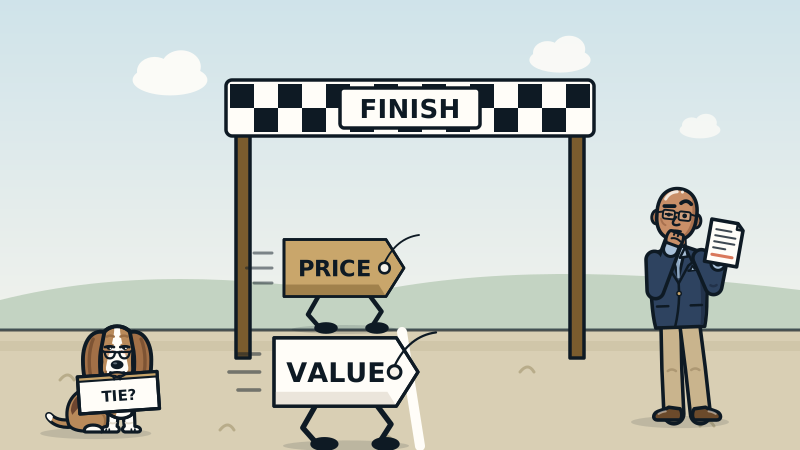
An appraisal that equals the purchase price is common and often honest, because a signed contract is real market evidence and value is a range. FHFA reported that 26.7% of appraisals matched the contract price in 2021. In California, Civil Code section 1090.5 and federal Regulation Z bar anyone from steering an appraiser toward that number.
Landing on the contract price is common, and there is data on it
If your appraisal came back at exactly the price you agreed to pay, you are in big company. The Federal Housing Finance Agency (FHFA) studied tens of millions of appraisals in the Uniform Appraisal Dataset. It reported that in 2021, nationally, 26.7% of appraisals equaled the contract price, 58.1% came in above it and 15.2% came in below it.
That is roughly one appraisal in four landing on the exact dollar. To a buyer, it can feel like the appraiser peeked at the answer key. To a seller, it can feel like a ceiling. Neither reaction is quite right.
A match is not proof of a problem. It is also not proof of value. It is a result, and like every result in a report, it has to be backed by closed sales.
Why a match is often perfectly honest
A signed contract is real market information. In a decent market, the house was listed, buyers toured it, and someone wrote the best offer after seeing the competition. That is close to what the federal definition of market value describes: the most probable price in a competitive and open market, with a buyer and seller each acting prudently and knowledgeably.
Market value is also a range, not a laser point. Say the adjusted comps for a hypothetical 2005 stucco two-story in Riverside land between $625,000 and $655,000, and the house is under contract at $640,000. The contract sits comfortably inside the supported range. The appraiser still has to report one number, and the contract price is a reasonable spot inside that range when the best comps point there too.
There is also a quiet math reason a value above the price does not help. For a purchase, Fannie Mae sets the property value for the loan at the lower of the sales price or the appraised value. A higher appraisal will not grow the loan. It just makes everyone feel richer for about a week.
When a match deserves a closer look
The trouble is not the matching number. It is a matching number with nothing holding it up. Here is a quick check you can run on the sales grid:
| Looks fine | Look closer |
|---|---|
| Adjusted comps fall on both sides of the price | Every adjusted comp sits below the price, yet the value equals it |
| Adjustments go up and down | Nearly every adjustment pushes the comps up |
| Rates match what the market shows | A rate per square foot or a time adjustment shows up with no support |
| Best nearby sales are used | An obvious recent sale next door is missing |
| Seller credits are reported and handled | A large credit in the contract is not mentioned |
| Reconciliation explains the weights | Reconciliation is one line that repeats the price |
If you see several items in the right column, ask questions through your lender. A value stretched to hit a contract is a risk for the buyer, who may be paying more than the sales support, and for the lender, who is lending against it.
The rules that keep the contract from steering the number
Appraisers are supposed to see the contract. They are not supposed to be told what value to find.
- Fannie Mae's Appraiser Independence Requirements allow a lender to give the engaged appraiser a copy of the sales contract on a purchase, but they prohibit providing an anticipated, estimated, encouraged or desired value. They also bar tying the appraisal order or fee to the opinion.
- Federal Regulation Z, section 1026.42, covers consumer loans secured by the borrower's principal dwelling. It bans seeking to influence an appraiser to report a minimum or maximum value. It allows asking the appraiser to consider more information, give more detail or correct errors.
- California Civil Code section 1090.5 applies to anyone with an interest in the transaction. It bars improper influence through coercion, intimidation, instruction and similar means, including making pay depend on the deal closing. It allows sharing the sales contract.
In short, the contract is evidence to test, and a target number is off limits. Anyone who calls the appraiser to say "we just need to hit the price" is asking for the one thing the rules forbid.
What I see in the field
I do not work contingent. My fee never depends on the value or on whether the deal closes. That frees me to treat the contract the way it should be treated: as one claim about value from one buyer and one seller.
My test is simple. If the contract disappeared from the file, would the comps still lead me to the same number? When the answer is yes, a value equal to the price is the honest result, and I say why in the reconciliation. When the answer is no, the value lands where the evidence lands, inside the adjusted range.
Most of the matches I see are fine. The ones that bother me look like a family photo where everyone is leaning toward the center to fit in the frame. Every adjustment leans the same way, and the reasons get vague right at the end. Sales from the market are allowed to disagree a little. When they all agree too neatly with the contract, I want to know why.
What to do if your appraisal matched the price
- Read the whole grid before the last page. Find the adjusted range and see where the price sits in it.
- Check the facts. Square footage, bedrooms, baths, lot and condition for your house and each comp.
- Look for bracketing. Are there sales above and below your home on size and condition?
- Ask about any large, one-way adjustments. Request the support through your lender.
- Loan officers: send the full contract, every addendum and every credit when you order. Missing pieces lead to revisions and delays.
- Sellers: a match does not mean you underpriced. The best way to know your price before listing is an evidence-based pre-listing appraisal.
For the bigger picture on how a signed price fits into an appraisal, read why the contract price does not set the appraised value.
Key takeaways
- About one appraisal in four matched the contract price in FHFA's 2021 national data.
- A match is fine when the adjusted comps support it on their own.
- Look closer when every adjustment pushes up and the comps sit below the price.
- Appraisers may see the contract, but no one may give them a target value.
- For a purchase loan, a value above the price does not grow the loan.
Getting this answered in California
California Civil Code section 1090.5 applies to purchase appraisals in every county, and this post's hypothetical example is a 2005 stucco two-story in Riverside. I am a California Certified Residential Appraiser (License AR041465) and appraise homes statewide, including Riverside County, San Bernardino County, Contra Costa County, Sacramento County. See every area I serve.
Get the best posts once a week.
Priced Right is one email a week with the most useful appraisal and pricing posts and what the market is doing. Never more than one a week. Unsubscribe anytime.
People also ask
Is it suspicious when an appraisal equals the purchase price?
Not by itself. FHFA reported that 26.7% of appraisals equaled the contract price in 2021. It is only a concern when the comparable sales and adjustments do not actually support the number.
Does the appraiser get to see the purchase contract in California?
Yes. Fannie Mae's independence rules and California Civil Code section 1090.5 allow the sales contract to be shared on a purchase. What is not allowed is giving the appraiser a desired or predetermined value.
Why did my appraisal not come in higher than the price?
The appraiser reports the value the comps support, and in many cases the price sits right where they point. Even when the value is higher, Fannie Mae uses the lower of the price or the appraised value for the loan.
Can my agent ask the appraiser to hit the contract price?
No. Asking an appraiser to reach a minimum value is barred by federal Regulation Z and California law. Your agent can send factual information and better sales through the lender's process.
Sources
- FHFA Blog: Exploring Appraisal Bias Using UAD Aggregate Statistics (November 2, 2022)
- CFPB: Regulation Z, 12 CFR 1026.42 Valuation Independence
- California SB 6 (2011, Chapter 716), amending Civil Code section 1090.5
- Fannie Mae: Appraiser Independence Requirements
- Fannie Mae Selling Guide B2-1.2-01: Loan-to-Value (LTV) Ratios
Got a question we haven't answered?
Suggest a topic or ask your own appraisal question. The best ones become posts.