Can a den with no closet still be a bedroom?
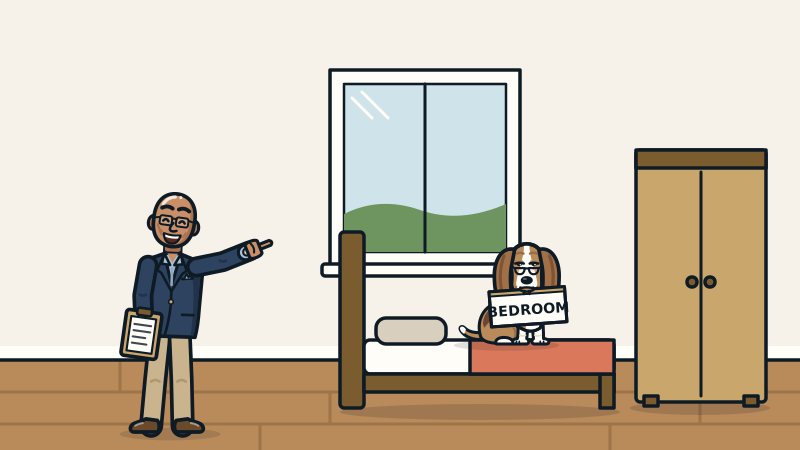
In most of the US, yes. The International Residential Code, which most states build on, does not require a closet in a sleeping room. But it is not the law everywhere. Cities, counties and towns can add their own rules, so check your local building department's printed rules before you count the room. A blog post, this one included, is not the law.
The closet is a habit, not a code rule
Every few months an agent tells me, with total confidence, that a bedroom needs a closet. When I ask which code says so, the answer is usually "everybody knows that."
Everybody knows a lot of things. The building code is not one of them. The International Residential Code (IRC), the model code most states, including California, build their residential codes on, sets rules for habitable rooms and sleeping rooms. A closet is not on the list. The IRC actually lists closets alongside halls and storage spaces as areas that are not habitable space at all.
That covers most of the country, not all of it. States adopt the IRC with changes, and cities, counties and towns can add rules of their own. So do not take this post, or any post, as the law where you live. Before you count a closetless room as a bedroom, read the rule yourself in your city, county or town's printed building code, or call the building department and ask where it is written. If they say a closet is required, follow them.
So my position is simple. A room without a closet can count as a bedroom. A dresser and a wardrobe from a big-box store hold sweaters just fine. The fire department never asks where you hang your jacket.
For the deeper version, with the safety rules laid out in full, see What counts as a bedroom in an appraisal? This post is the quick one you send to the seller who is about to hire a carpenter to frame a closet nobody asked for.
What actually makes a room a bedroom
Here is the agent checklist. These are the questions I ask about a den before I count it.
- Is it big enough? The 2021 IRC says habitable rooms need at least 70 square feet of floor area and must be at least 7 feet in any horizontal direction. A 6-foot-wide room is a hallway with ambition.
- Can you get out in a fire? Every sleeping room needs an emergency escape opening, usually a window. Under California Residential Code R310 that means a net clear opening of at least 5.7 square feet (5 for a grade-floor opening), at least 24 inches high and 20 inches wide, with a sill no higher than 44 inches.
- Is the ceiling tall enough? The IRC sets a 7-foot minimum for habitable space, with exceptions for sloped ceilings.
- Is it heated? Where winters get cold enough, codes based on the IRC require heating that can keep every habitable room at 68 degrees, measured 3 feet off the floor. A space heater plugged in for the showing does not count.
- How do you get in? A room you can only reach by walking through someone else's bedroom is a different product to a buyer, even if it passes every code test.
- Was it built or converted legally? A den carved out of a garage without permits raises its own questions.
Notice none of these ask about a rod and a shelf. Local codes can add rules, including a closet rule, so your city or county building department has the final word on the code side.
Where the closet rule still bites
Here is the honest part. The closet habit is real, even if it is not code.
Some MLS systems expect a closet before a room can be listed as a bedroom. Some lenders and underwriters ask about it. If your MLS says closet, follow your MLS when you write the listing. Calling it a "den or optional bedroom" and explaining why is better than a fight in the comments section.
The appraisal is a separate question. Fannie Mae requires the appraiser to be consistent with the square footage and room count. In practice, I count the subject's rooms by the same test I use on every comp. If a closetless den is a bedroom in the subject, a closetless den is a bedroom in the comps too. What I will not do is call a room a bedroom when it fails on safety or legality. A missing closet is cosmetic. A missing escape window is not.
Does the extra bedroom add value?
That depends on the buyers, not on the label. In some markets the jump from two bedrooms to three is a big deal. In others, a fourth bedroom matters less than the size of the house or the yard.
The way to know is to measure it. I look at paired sales, which are similar homes that sold around the same time where the main difference is the bedroom count. Then I check the pattern across a wider set of sales. If buyers in your area pay for a third bedroom, it shows up in the sales. If they treat a small den as a home office, that shows up too.
What does not move the number is a closet bolted on the week before listing. Buyers notice a room's size, light and layout. They rarely tour a house, open a new closet door and gasp.
What I see in the field
The closet argument shows up most in older homes. Plenty of 1920s and 1940s houses were built with small closets or none, and families slept in those rooms for generations. Telling a buyer that grandma's bedroom was never a bedroom is a tough sell.
The other place it shows up is the remodel. An owner takes out a closet to make a room bigger, or turns a closet into a desk nook, and then worries the house just lost a bedroom. If the room still passes the size, window, ceiling and heat tests, it did not.
What does cost a bedroom is the stuff nobody photographs: a window painted shut, a sill too high to climb over, a room that is really 6 feet wide. Those are the details I check first.
What to do with the den before you list
- Check the local code. Read your city or county building rules, or ask the building department, to confirm no closet rule applies.
- Measure the room. At least 70 square feet and at least 7 feet in each direction.
- Measure the window. Clear opening size, height, width and sill height, against the R310 numbers above.
- Check the ceiling and the heat. A vent or other heat source should serve the room.
- Pull permits if the room was added or converted.
- Read your MLS rules on bedroom counts before you write the listing.
- Tell the appraiser how the room is used and hand over the permits. A one-line note beats a guess.
Then skip the emergency closet. If the room passes, it passes. If it fails on the window, a closet will not save it, but a new window might.
Key takeaways
- Most US areas follow the IRC, which does not require a closet, but local rules can differ.
- Verify with your city, county or town's printed code before you count the room.
- Size, an escape window, ceiling height, heat and legal status are what count.
- Follow your local MLS rules when you write the listing.
- Appraisers should count closetless rooms the same way in the subject and the comps.
- Whether a bedroom adds value is measured from local sales, not assumed.
Get the best posts once a week.
Priced Right is one email a week with the most useful appraisal and pricing posts and what the market is doing. Never more than one a week. Unsubscribe anytime.
People also ask
Is a room you walk through to reach another bedroom still a bedroom?
The code questions still apply: size, escape opening, ceiling and heat. Whether buyers pay for it as a bedroom is a market question, and it shows up in how similar homes sold.
Can a basement room be a bedroom?
It can be a sleeping room if it meets the code, including an escape opening. On most conventional appraisals it is still reported as below-grade area, not above-grade living area.
Will adding a closet raise my appraisal?
Not by itself. If the room already meets the sleeping room rules, a closet changes the storage, not the count. Value comes from what local buyers pay.
Sources
- Building Code Trainer: Minimum Bedroom Size, 2021 IRC R304
- City of San Luis Obispo: Emergency Egress Windows, 2019 CRC Section R310
- Washington WAC 51-51-0303: State adoption of IRC R303, including required heating
- EVstudio: Ceiling Heights in the Building Code (IRC R305.1)
- Fannie Mae Selling Guide B4-1.3-05: Improvements Section of the Appraisal Report
Got a question we haven't answered?
Suggest a topic or ask your own appraisal question. The best ones become posts.