Does a school district raise home value in California?
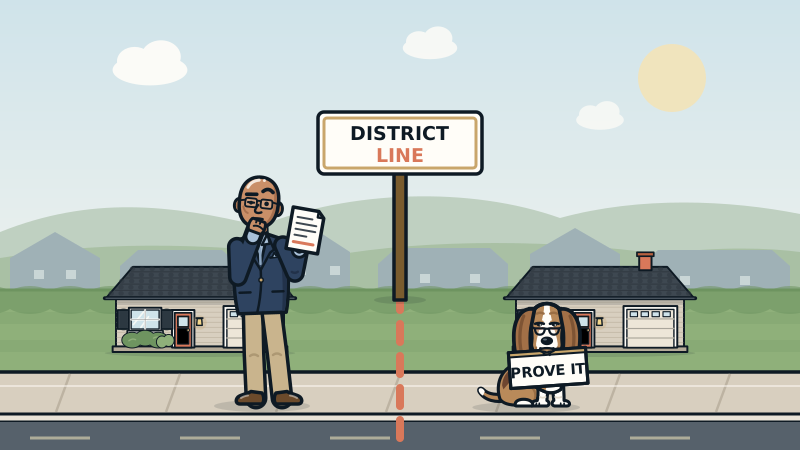
It can. In California, homes on one side of a school district or attendance boundary sometimes sell for more, but the premium has to be measured with paired sales across that line, not assumed. Under the federal Fair Housing Act and California's FEHA (Government Code section 12955), agents and appraisers describe boundaries and data, never the people.
A boundary is a line on a map. A premium is a number buyers prove.
Every California agent has heard it: "We only want homes in that district." Buyers draw a circle on a map, and suddenly a house one street outside the circle is dead to them. That pressure can show up in prices.
Here is the problem. A district name is a fact. A district premium is a claim. The claim is only true if buyers actually paid more for similar homes on one side of the line than on the other.
Fannie Mae lists adjustments that don't reflect market reaction as an unacceptable appraisal practice. So a report cannot add 10% because a listing remark said "top rated schools." The listing remark is marketing. The sale is evidence.
Facts over feelings. The feeling is "everyone pays more for that district." The fact is whatever matched sales on both sides of the boundary say, in your market, this season.
A district address does not promise a seat at a certain school
This is the part buyers miss. The California Department of Education says a district must educate students who live in it, but students have no guaranteed right to a particular school, not even the closest one.
Real California examples:
- Overflow. In Murrieta Valley Unified in Riverside County, a new student is placed at an overflow school when the home school has no space in that grade.
- Lotteries. San Francisco Unified has assigned elementary seats through a citywide choice lottery since 2011. As of October 2026 its board was choosing a new system with neighborhood seat guarantees, with a target of August 2028.
- Split districts. In parts of Santa Clara County, one address sits in an elementary district and a separate high school district. Los Altos School District and Mountain View Los Altos High School District are one pairing.
Transfers exist, but they are not a sure thing. Under Education Code sections 46600 to 46610, a transfer between districts needs both districts to approve. Paying a premium for a school you might not get is like paying extra for a parking spot that comes with a waitlist.
Talk about boundaries and data, never about people
Fair housing is where school talk gets people in trouble. The federal steering rule, 24 CFR 100.70, bars steering buyers toward or away from an area because of race, religion, disability, family status or other protected traits. California's Fair Employment and Housing Act protects even more traits, including source of income, sexual orientation and veteran status, and it reaches anyone whose business involves real estate transactions. That includes appraisers.
On April 24, 2026, HUD's fair housing office issued a Dear Colleague letter. It said agents do not violate the Fair Housing Act just by discussing school quality or crime data, when they share it with all clients in an equal and consistent way. The same letter says guiding clients with racial language is still unlawful. That letter speaks to federal law. California's own law still applies.
Appraisers have tighter rules on lender work. Fannie Mae bans words like "desirable neighborhood," "good neighborhood" and "pride of ownership," and bans references to crime. Value can never rest on who lives somewhere.
The safe habit is boring and good: name the district, the boundary and the source. Hand every client the same official links. Let the sales do the talking.
How I measure a school boundary premium
The cleanest test is paired sales: two closely matched homes that sold close in time, where the main difference is which side of the line they sit on. Boundaries often run down the middle of one tract, which is a gift. Same builder, same floor plans, same era, different district.
Here is a hypothetical. Say a 1970s tract has the same three floor plans on both sides of a district line. I pull every sale of those plans for the past year, adjust each one for size, condition and timing, and compare the two sides. If the adjusted prices on one side sit higher, pair after pair, that gap is the measured premium. If they don't, there isn't one, no matter what the open house flyer says.
Then I check what else the line follows. District lines often follow freeways, creeks or big roads. If the "school premium" homes are also the ones away from the six-lane road, I have to split those effects, or I'm counting the same dollar twice.
Last, I test it on a wider set of sales. A premium built on two pairs is a rumor. One that holds across the wider market is evidence.
Why the premium can shrink, flip or vanish
A district premium is not carved into the deed. It moves when the inputs move.
- Boundaries change. Districts redraw attendance areas as schools fill or empty. San Francisco Unified plans new attendance boundaries as part of its new system.
- Seats run out. If overflow becomes common, buyers start pricing the odds of a seat, not the address.
- Buyer pools change. A neighborhood that sells mostly to downsizers may show almost no school effect, even on the "right" side of a line.
- The market cools. In a slow season, buyers get choosier about price in general, and an old premium can lag behind.
That is why I read the most recent window the data supports, not a lazy 12-month average. A premium measured in a bidding-war spring may not survive a quiet November. Your uncle who "knows the market" measured his in 2004.
What to do before you pay for a boundary
- Confirm the district with the district. Use its official boundary lookup or call the enrollment office. MLS school fields and listing remarks are sometimes wrong.
- Read the enrollment rules. Ask about overflow, lotteries, waitlists and transfers for the grade your child will enter.
- Use official data, the same way for every client. The California Department of Education's California School Dashboard is a public starting point. Share sources, not opinions.
- Ask for paired sales. Have your agent find matched homes on both sides of the line. If nobody can show the gap, don't pay for it.
- Watch what else the line follows. A freeway, a creek or a busy road can explain the gap instead.
- Price the listing from evidence. Sellers: a premium the sales don't support is just a longer days on market number.
If you want the boundary measured with real sales before you list or bid, that is part of how I build a Market Intelligence report. More on matched sales is in this post on paired sales.
Key takeaways
- A school district name is a fact. A school district premium is a claim that sales have to prove.
- In California, living in a district does not guarantee a seat at a particular school.
- Measure the premium with paired sales across the line, and check what else the line follows.
- Under fair housing law, describe boundaries and data, never the people who live there.
Getting this answered in California
School boundary questions come up statewide, and this post draws on Santa Clara County's split elementary and high school districts, San Francisco Unified's assignment lottery and Murrieta Valley Unified's overflow rule in Riverside County. I am a California Certified Residential Appraiser (License AR041465) and appraise homes statewide, including Santa Clara County, San Francisco County, Riverside County. See every area I serve.
Get the best posts once a week.
Priced Right is one email a week with the most useful appraisal and pricing posts and what the market is doing. Never more than one a week. Unsubscribe anytime.
People also ask
Do homes in good school districts sell for more in California?
Sometimes, but not by a fixed amount. The only way to know is to compare closely matched homes that sold on both sides of the boundary around the same time. In some areas the gap is real and in others it is close to zero.
Does buying a house in a school district guarantee my child gets into that school in California?
No. The California Department of Education says students have no guaranteed right to a particular school. Districts can use overflow placements, lotteries or transfers, so check the enrollment rules with the district before you buy.
Can a real estate agent tell me which schools are good?
Under HUD's April 24, 2026 letter, sharing school quality data does not by itself violate the federal Fair Housing Act when it is shared with every client the same way and without racial intent. California's fair housing law still applies, so agents are safest sharing official data sources rather than personal opinions.
Can an appraiser make a school district adjustment?
Yes, if sales prove it. A location adjustment for a district boundary has to be measured from market data, such as paired sales across the line. It can never be based on who lives in an area.
Sources
- HUD: Assistant Secretary Trainor's Dear Colleague Letter on Neighborhood Crime Data and School Quality (April 24, 2026)
- California Government Code section 12955 (Fair Employment and Housing Act, housing discrimination)
- Fannie Mae Selling Guide B4-1.1-04: Unacceptable Appraisal Practices
- California Department of Education: Interdistrict and Intradistrict Transfers FAQ
- Murrieta Valley Unified School District: Overflow Transfers
- The San Francisco Standard: SFUSD set to overhaul its enrollment lottery (October 6, 2026)
Got a question we haven't answered?
Suggest a topic or ask your own appraisal question. The best ones become posts.