Do buyers pay less for a home with Mello-Roos?
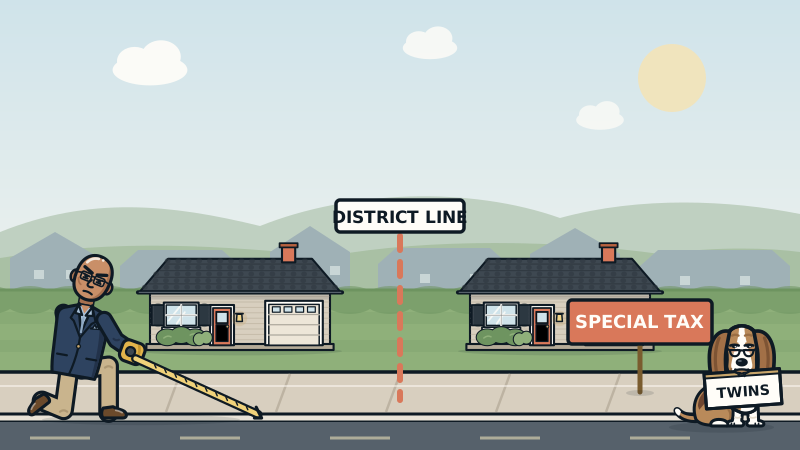
Often, yes, but not by a fixed formula. A Mello-Roos special tax adds to the monthly cost of owning, so the same budget buys a little less house. The tax also pays for roads, schools or parks buyers may value. An appraiser measures the net effect from sales inside and outside the district.
What Mello-Roos actually is
Mello-Roos is the nickname for the Mello-Roos Community Facilities Act of 1982, which starts at California Government Code section 53311. It lets a city, county, school district or other local agency form a Community Facilities District, or CFD. Property owners in the district pay a special tax every year.
The money pays for public facilities like roads, schools, parks and sewers, often through bonds. It can also pay for services such as police, fire, and park or street maintenance. Forming a district takes a two-thirds vote. In a new subdivision with fewer than 12 registered voters, the landowners vote, one vote per acre. In a brand-new tract, that vote can happen before a single homeowner moves in. The future owners find out from the disclosure, ideally before the cookies at the model home run out.
One detail matters for value: the special tax cannot be based on the property's value. Districts use a formula instead, often by land use, home size or lot size. So a bigger house in the same district can owe more, but a new kitchen does not raise the tax.
How to find it before you write an offer
- The property tax bill. CFD special taxes are usually collected on the regular county tax bill, with the same due dates and penalties. Look for the district's special tax line.
- The Notice of Special Tax. Under Civil Code 1102.6b, a seller must make a good faith effort to get a disclosure notice from each agency that levies the tax and give it to the buyer. The agency has to provide it within five working days of a request, and it may charge up to $15.
- What the notice tells you. That the tax is in addition to regular property taxes, that not paying it can lead to foreclosure, the maximum tax, how much it can rise each year, how long it can be levied, and what it pays for.
- The buyer's exit. The notice form says a buyer can cancel within three days if the notice was handed over in person, or five days if it was mailed. Check the timing with your agent or attorney.
Read the maximum tax as well as this year's amount. The annual increase line is the part people skim and later wish they had read twice.
Why the tax can lower what buyers pay
Buyers shop by monthly payment. A Mello-Roos tax is part of that payment. Fannie Mae's definition of the monthly housing expense a borrower qualifies on includes real estate taxes and special assessments, and the special tax arrives on the same bill.
Here is a hypothetical. Say a home carries a special tax of $3,600 a year, or $300 a month. At a 6.5% 30-year rate, $300 a month would carry about $47,500 of mortgage. A buyer with a fixed monthly budget who pays that $300 to the district has $300 less for the loan.
So should the house sell for $47,500 less than the same house outside the district? That is the tempting shortcut. It is also usually wrong, or at least unproven, for three reasons.
- The tax buys something. If it paid for the new school down the street or the park buyers love, some of that cost comes back as demand.
- The tax may not last forever. Taxes tied to bonds run until the bonds are paid off. A district may keep charging a smaller amount for services after that.
- The houses are often different. Mello-Roos districts tend to be newer subdivisions. Newer homes, newer schools and newer streets get mixed into the same price.
How an appraiser measures it
This is where Mello-Roos becomes an adjustment question. My answer is the same as for any feature: measure what buyers did, do not assume it.
- If the comps are in the same district with similar tax amounts, they already carry the tax in their prices. No adjustment is needed for it.
- If some comps are outside the district, I look for paired sales: similar homes, similar age and timing, one inside and one outside. A tract that sits across a district boundary is the best case, because the houses can be nearly twins.
- If the tax varies inside the district, I compare sales with higher and lower tax amounts.
- Then I check the wider market to make sure a gap is not really about age, schools or location.
Sometimes the measured gap is close to the payment math. Sometimes it is much smaller. Sometimes it cannot be separated from everything else, and the honest report says so. What I will not do is subtract a number from a formula and call it the market. Facts over feelings, even when the feeling is a very confident spreadsheet.
What agents and buyers should do
- Pull the tax bill and the Notice of Special Tax early, before pricing a listing or writing an offer.
- Write down three numbers: this year's tax, the maximum tax, and the last year it can be levied.
- Ask what it pays for. A tax that built the school buyers want is a different story than a tax for streets no buyer notices.
- Compare like with like. When pricing, use sales inside the same district first. If you must use sales outside it, adjust for the tax only as much as the sales show.
- Run the monthly payment with the tax included. Buyers will, and so will their lender.
- Give the appraiser the notice through the lender. It saves a research step and avoids guesswork.
Tax questions about deducting or paying off a special tax go to a CPA. For a pricing question inside or near a district, a market analysis can show what the sales say.
What I see in the field
The most common miss is ignoring the tax completely. Two houses look the same on paper, one has a few thousand a year in special taxes, and the price comparison acts like that money does not exist. Buyers do not forget it. Their lender will not let them.
The second miss is the reverse: treating the tax as a straight deduction with no evidence. That can knock a value down by more than the market ever did, especially in a district where the tax built the very things buyers came for.
The fix for both is the same. Find the sales that differ by the tax and little else, and let them set the number. If the district line runs down the middle of a neighborhood, those sales are already sitting there waiting to be compared.
Key takeaways
- Mello-Roos is a special tax from a Community Facilities District, billed with regular property taxes.
- The tax cannot be based on value; check the current amount, the maximum and how long it can be levied.
- It raises the monthly cost of owning, which can lower what buyers will pay.
- The price effect is measured from sales inside and outside the district, not subtracted by formula.
Get the best posts once a week.
Priced Right is one email a week with the most useful appraisal and pricing posts and what the market is doing. Never more than one a week. Unsubscribe anytime.
People also ask
Does Mello-Roos ever go away?
Taxes for bonds run until the bonds are paid off. A district can keep levying a smaller tax for services after that, so read the notice for how long the tax can be charged.
Is Mello-Roos the same as a regular property tax?
No. It is a special tax added on top of regular property taxes, and it cannot be based on the home's value. It is collected on the same bill and carries the same penalties if unpaid.
Do appraisers have to adjust for Mello-Roos?
Only when the comps differ from the subject on it. If the comps sit in the same district with similar taxes, the tax is already in their prices.
Sources
- California Government Code 53311: Mello-Roos Community Facilities Act of 1982
- California Government Code 53340.2: Notice of Special Tax
- California Civil Code 1102.6b: Disclosure of Special Taxes
- California State Treasurer, CDIAC: Mello-Roos Community Facilities Districts
- Fannie Mae Selling Guide B3-6-03: Monthly Housing Expense for the Subject Property
Got a question we haven't answered?
Suggest a topic or ask your own appraisal question. The best ones become posts.